


Behavioral health teams navigating complex behavioral health revenue cycle management requirements face a distinctive challenge: the clinical and administrative workflows that govern care delivery must also produce clean, timely, defensible claims. Whether you’re managing a small outpatient practice or a multi-program treatment center, the medical billing tips below can help your revenue cycle team reduce friction and protect reimbursement.
Alleva’s integrated EMR and RCM tools are designed specifically for behavioral health workflows, if your team is exploring how a purpose-built platform can support these processes, you can see them in practice through a demo.
Tip 1: Improve First-Pass Clean Claim Rates to Reduce Denials
Behavioral health claims commonly fail the first pass due to missing or incorrect patient demographics, insurance eligibility lapses, improper coding for therapy and group services, missing or incorrect modifiers, and incomplete authorization or referral information.
A targeted intake checklist that validates name, date of birth, member ID, payer plan, coverage effective dates, and prior authorization reduces simple rejections before they happen. Use encounter-level templates for outpatient therapy and group sessions that standardize CPT/HCPCS codes, place of service, units, and modifiers, so clinicians document exactly what billers need.
Implement electronic eligibility checks and real-time insurance verification at scheduling or check-in to address coverage gaps before services occur. Build automated edits that flag common problems such as mismatched DOB/member ID combinations or missing modifiers for group therapy.
Closing the loop between clinical notes and charge entries prevents the mismatches that drive downstream denials.
Practical Steps To Take:
Use standardized charge templates per service line with required fields enforced for CPT codes, number of units, modifiers for group vs. individual services, place of service, and rendering provider NPI. Align documentation templates so treatment notes contain billing-necessary elements: service time, modality, participant list for groups, and measurable interventions.
Set up payer-specific adjudication rules in your billing system to apply correct modifiers and frequency edits automatically. Batch-validate claims through a clearinghouse scrub that checks NPI taxonomy, facility vs. individual billing, and unit counts for group psychotherapy.
Run weekly clean-claim rate reports segmented by payer and clinician to identify training gaps or recurring payer edits. These routines also make payer contract conversations easier, you can present clean-claim trends alongside the operational barriers affecting reimbursement.
Tip 2: Front Desk Training and Scripts
Train front desk staff to use short, empathetic scripts that normalize payments as part of treatment access. For example: “We collect the copay at check-in so your clinician can focus entirely on your care.”
Role-play scenarios for new patients, returning patients, and those with past-due balances, and provide staff with escalation routing for financial assistance conversations. Use a simple three-step process: verify coverage and copay amount, state the expected charge clearly, and offer payment options such as card on file, a payment plan, or a sliding-scale referral.
For past-due balances, use brief, respectful language that emphasizes patient support and available options rather than confrontation. Document every financial conversation in a non-PHI location in the workflow so clinicians are not pulled into billing disputes.
Consistent scripting reduces awkward encounters and maintains trust while improving collections. Clear policies at the front desk also support complete charge capture for ancillary items like labs or injections, staff who understand billing expectations are less likely to miss capture opportunities.
Tip 3: Standardize No Surprises Act Workflow
The No Surprises Act requires transparent good-faith estimates (GFEs) for uninsured or self-pay patients for scheduled services. Establish a standard GFE workflow: identify self-pay status during intake, gather service details and expected charges, calculate an estimate using current fee schedules and expected ancillary charges, share the GFE document in writing, and retain proof of delivery.
Ensure your billing system stores GFE versions and timestamps for compliance documentation. For behavioral health, clearly separate bundled program fees from per-session therapy charges when preparing GFEs.
Train admissions staff on when the GFE must be offered and how to handle patient questions about potential out-of-network balances. Maintaining this workflow reduces post-service billing disputes and supports clearer conversations at check-in about anticipated patient responsibility.
Tip 4: Levearge Mental Health Parity
One of the most significant (and underutilized) revenue protection strategies for behavioral health providers involves leveraging mental health parity law to challenge improperly restricted claims.
The Mental Health Parity and Addiction Equity Act (MHPAEA) requires health plans to apply prior authorization requirements, medical necessity standards, and other non-quantitative treatment limitations (NQTLs) to behavioral health and substance use disorder (SUD) benefits no more restrictively than they apply those same limitations to comparable medical or surgical benefits. When a payer denies a behavioral health claim based on prior authorization, level-of-care criteria, or utilization review in a way that would not apply to an equivalent medical service, that denial may constitute a parity violation.
The September 2024 MHPAEA Final Rule introduced stricter requirements for payer documentation and comparative analysis of NQTLs. While federal enforcement of the 2024 Rule was paused in May 2025 pending litigation, the 2013 parity regulations and the Consolidated Appropriations Act (CAA) 2021 NQTL comparative analysis requirements remain fully in force. Providers retain strong legal grounds to challenge improper denials.
Tip 5: Use the Best Medical Billing Software for Behavioral Health
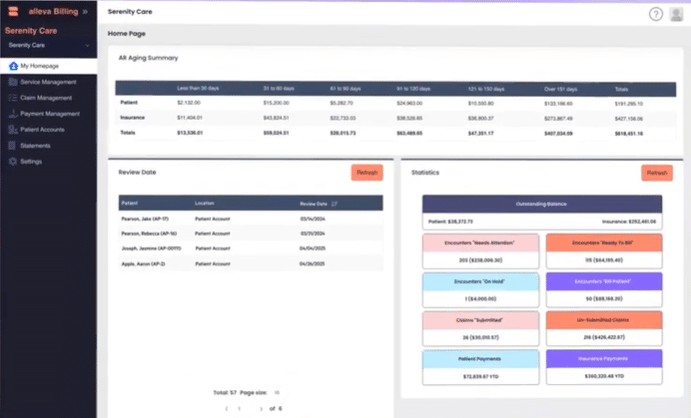
The tools your billing team works in directly shape the accuracy, speed, and defensibility of every claim you submit. Generic practice management software was not designed for behavioral health, it lacks the workflow logic, payer rule configuration, and documentation alignment that mental health and substance use disorder billing requires. Purpose-built behavioral health billing software closes that gap by connecting clinical documentation, charge capture, and claims submission in a single environment.
When billing lives inside the same platform as your clinical notes, the handoff between care delivery and revenue collection becomes automatic rather than manual. Clinicians document a session; the billing system reads that documentation and populates the correct CPT codes, modifiers, and units without requiring a separate data entry step. That integration is the single most reliable way to reduce the transcription errors and omission-based denials that erode clean claim rates in disconnected systems.
What to Look for in a Behavioral Health Billing Platform
Not all integrated billing tools are built equally. When evaluating options for your practice or organization, look for:
- Native behavioral health code support. The platform should recognize the CPT, HCPCS, and H-code sets used in outpatient therapy, group services, IOP, and medication-assisted treatment without requiring manual workarounds.
- Payer-specific rule configuration. Different payers apply modifiers, unit limits, and prior authorization rules differently. A strong billing platform lets you configure those rules at the payer level so they apply automatically at the point of claim generation.
- Real-time eligibility verification. Insurance verification built directly into the intake or scheduling workflow — not a separate portal login — catches coverage gaps before services are rendered rather than after claims are denied.
- Clearinghouse integration with rejection feedback. Claims should flow through a scrubbing layer that surfaces specific X12 reject codes and maps them to correctable actions inside the same system.
- Automated ERA posting. Electronic remittance advice should post automatically to the correct accounts, so your billing team spends time on exceptions and denials rather than manual payment reconciliation.
- HIPAA-compliant infrastructure. Billing data is PHI. Any platform handling claims, remittances, and patient financial records must operate within a fully compliant environment with auditable access logs.
Alleva checks every one of these boxes. If you’re evaluating behavioral health billing platforms, schedule a demo to see how Alleva’s purpose-built tools handle your specific payer mix, service lines, and documentation workflows.
Tip 6: Parity-Aware Denial Management
When a behavioral health claim is denied due to prior authorization, medical necessity, or level-of-care requirements, your billing team should take the following steps:
- Document the denial reason precisely. Capture the specific NQTL cited — such as prior authorization, step therapy, or residential treatment criteria.
- Request the payer’s comparative analysis. Under CAA 2021, plans must provide their NQTL comparative analysis upon request. Use it to assess whether behavioral health restrictions are more stringent than those applied to analogous medical services.
- Build a parity-based appeal letter. Cite MHPAEA, the specific benefit classification, and demonstrate that the applied NQTL does not meet the comparability standard.
- Track parity-related denials as a separate category. Segmenting these in your denial management workflow helps identify systemic payer patterns over time.
- Consult qualified legal or compliance resources when parity violations appear systemic across multiple claims or payers.
Alleva’s AI-powered documentation and intelligence tools support audit-ready clinical notes, a foundational input for the medical necessity documentation payers require and that underpins strong parity-based appeals.
Tip 7: Know Clearinghouse Loops and Segments
Billers should understand the ANSI 837 professional transaction structure, common loops and segments that cause rejections, and the mapping nuances specific to behavioral health services.
Focus on these key areas:
- ISA/GS envelopes for transmission control and ISA/IEA interchange counts.
- Loop 2000A/2000B patient and subscriber hierarchies to ensure correct subscriber relationships.
- Loop 2300 claim information fields for claim frequency, billing provider NPI, and claim-level dates.
- Loop 2400 service line details including HCPCS/CPT codes, units, revenue codes, and service-date alignment.
- Loop 2320 for other subscriber information such as secondary payer coordination.
Common clearinghouse rejections occur when the rendering provider NPI is missing or mismatched, service dates fall outside coverage, units exceed payer-defined limits, or required modifiers are omitted for group vs. individual therapy.
Configure your clearinghouse to surface specific X12 reject codes and map them to actionable corrections in your RCM workflow. Understanding these segments shortens the cycle between rejection and resubmission.
Tip 8: Negotiate and Maintain Payer Contracts
Start payer negotiations with accurate, auditable data: utilization by CPT code, average units per session, group session attendance patterns, and denial rates per code. Request contract language that explicitly recognizes behavioral health modalities and appropriate modifiers for group therapy, care coordination, and intensive outpatient programs (IOP).
Include clauses for timely claims adjudication, accurate reimbursement for drug units and injections when applicable, and periodic rate reviews. Create a contract playbook that tracks effective dates, fee schedules, timely filing windows, and prior authorization requirements.
Regularly audit contracted rates against paid claims to catch underpayments. Maintain a single-source reference for payer rules so billing staff apply contract terms consistently when adjudicating claims and appealing denials.
Tip 9: Complete Charge Capture Processes
Charge capture failures often stem from split workflows where clinical staff document services but charge entry occurs elsewhere. Create point-of-care prompts in your clinical documentation template to capture labs, injections, and administered drug units, with discrete fields for lot numbers, CPT/HCPCS codes, and units.
Implement daily reconciliation between MAR/medication administration records and billing queues to identify missed drug units. Use barcode or barcode-lite scanning at administration where possible to reduce manual entry errors.
For labs, confirm CLIA status and ensure correct place-of-service coding and lab CPTs are present before claim submission. Standardize the mapping of clinical procedure terminology to billing codes and run regular audits comparing clinician notes to posted charges. These reconciliations reduce write-offs and surface training needs.
Tip 10: Smart Staffing Model and Training Cadence
A small behavioral health practice benefits from a blended staffing model that assigns dedicated billers with part-time or shared coding support. A common benchmark is approximately 1.0 full-time equivalent (FTE) biller for every 6–10 providers in outpatient-heavy practices; practices with high ancillary services or complex payers may need a lower provider-to-FTE ratio.
Define roles clearly: eligibility and front-desk verification, claim submission and follow-up, denial appeals, and AR aging management. Establish a weekly short training touchpoint for rapid updates and a monthly in-depth session covering payer policy changes, coding refreshers, and denial trends.
Pair new hires with a documented onboarding checklist and a mentor for the first 60–90 days to accelerate consistent performance. Days in accounts receivable (AR days) is a foundational KPI for monitoring billing team effectiveness — tracking AR aging by payer and bucket identifies exactly where the revenue cycle is slowing.
Tip 11: Predictive Analytics and AI
Predictive models can score claims for denial risk using features such as payer, CPT code, units, provider, prior authorization presence, and historical denial patterns. Use prioritized work queues driven by risk scores so billers tackle high-impact items first — claims most likely to overturn quickly or recover significant revenue.
Apply automated rules that generate suggested appeals language or required documentation checklists for common denial types to speed follow-up. Ensure AI tools operate within HIPAA-compliant environments and log access and outputs to protect PHI.
Monitor model performance continuously and retrain on new denial patterns so predictions remain accurate. Alleva’s behavioral health EMR and intelligence platform includes AI-assisted documentation tools designed to support audit-ready clinical notes, a foundational input for cleaner claims and fewer denials. Combining AI-assisted workflows with clear operational accountability can meaningfully support cash flow.
Explore Whether Alleva Can Support Your Revenue Cycle
If your team is looking to reduce administrative friction and improve billing reliability in behavioral health settings, explore whether Alleva’s integrated EMR, RCM, and AI tools can support your workflows. Our purpose-built templates, payer-aware billing features, and compliance-conscious design are intended to reduce denials and streamline collections while protecting clinical time.
To speak with our team directly, call us at (877) 425-5382.
Medical Billing Tips FAQ
Here are some questions peopel also ask about medical billing tips for behavioral health practices.
What are the most common reasons behavioral health claims are denied, and how quickly should they be triaged?
Common denials include incorrect patient demographics, eligibility or coverage lapses, missing prior authorization, improper or missing modifiers for group services, unit count mismatches, and coding errors. Triage high-risk denials within 24–48 hours where possible, since timely appeals and corrections often depend on timely filing windows and payer reprocessing rules. Lower-risk issues can be scheduled into a regular appeals workflow with tracked SLA targets.
What practical steps increase first-pass clean claim rates for outpatient therapy and group sessions?
Use encounter-level templates that enforce required billing fields, run eligibility checks at scheduling or check-in, configure payer-specific adjudication rules, and perform pre-submission scrubbing via your clearinghouse. Reconcile notes to charges daily or weekly to catch discrepancies before submission.
How should front desk staff be trained to collect copays and past-due balances without jeopardizing patient relationships?
Provide short, empathetic scripts that normalize prepayment and clearly state options such as card on file, payment plans, or sliding-scale referrals. Role-play scenarios and document escalation paths for financial hardship. Keep conversations brief, respectful, and focused on support so patient trust is preserved.
How does the No Surprises Act change billing workflows and the handling of good-faith estimates for self-pay patients?
The No Surprises Act requires offering good-faith estimates to uninsured or self-pay patients for scheduled services and retaining proof of delivery. Build an intake workflow that identifies self-pay status, calculates estimates from current fee schedules, provides the estimate in writing, and stores the documentation.
What is MHPAEA and how does mental health parity affect behavioral health billing?
MHPAEA requires health plans to apply prior authorization requirements and other non-quantitative treatment limitations (NQTLs) to behavioral health services no more restrictively than they apply them to equivalent medical services. Billing teams can use parity law as grounds to appeal denials tied to prior authorization, medical necessity, or level-of-care criteria. Requesting the payer’s NQTL comparative analysis is a powerful first step in building a parity-based appeal.
Which ANSI 837 loops and segments should billers understand to resolve rejections efficiently?
Billers should be familiar with ISA/GS envelopes, Loop 2000 patient/subscriber hierarchies, Loop 2300 claim information, Loop 2400 service lines, and Loop 2320 for coordination of benefits. Common rejects tie to missing NPIs, mismatched subscriber relationships, incorrect service dates, omitted modifiers, or unit count errors. For telehealth claims, verify modifier 95 vs. GT and POS 02 vs. POS 10 before submission.
How do we negotiate and maintain payer contracts so reimbursement reflects correct behavioral health service rates?
Negotiate with auditable utilization data, request language recognizing behavioral health modalities and appropriate modifiers, and include clear terms for timely adjudication and periodic rate reviews. Conduct regular audits comparing contracted rates with paid claims to identify underpayments.
What processes ensure complete charge capture for labs, injections, and drug units?
Integrate discrete fields in clinical documentation for administered items, reconcile MAR logs with billing queues daily, and standardize mapping from clinical terminology to CPT/HCPCS codes. Run periodic audits to compare clinician notes to posted charges.
What staffing model and training cadence produce the best billing performance in small behavioral health practices?
A typical benchmark is roughly 1.0 biller FTE per 6–10 providers in outpatient-heavy practices, with adjustments when ancillary services or payer complexity increase workload. Define clear roles, implement a 60–90 day mentored onboarding, hold weekly briefings for rapid updates, and monthly deeper training sessions for coding, payer rules, and denial trends.
How can predictive analytics or AI be applied to forecast denials and prioritize follow-ups?
Use models that score claims by denial risk based on payer, CPT code, provider, units, and historical denials, and surface prioritized work queues. Complement predictions with automated checklists and suggested appeal language, and ensure all AI workflows operate in HIPAA-compliant systems.