


What is VOB in medical billing, and why does it matter for behavioral health clinics? Verification of benefits (VOB) is an administrative process in medical billing that confirms a patient’s insurance coverage, eligibility, and financial responsibility before or during care delivery.
For behavioral health teams navigating complex payer landscapes, a reliable VOB workflow is one of the most important operational disciplines you can build. When benefits are verified accurately and early, claims are cleaner, admissions move faster, and patients arrive with realistic expectations about cost.
Alleva’s integrated billing tools are designed to support exactly this kind of upfront accuracy — connecting eligibility checks, authorizations, and documentation inside a single behavioral health platform.
What VOB Means and Why It Matters
Verification of benefits is the administrative check that confirms a patient’s insurer, plan details, effective dates, covered services, prior authorization requirements, and estimated patient financial responsibility.
VOB matters because it reduces the chance of claim denials, reduces surprise balances for patients, and helps clinical and billing teams plan authorizations and collections. Getting this step right at intake protects revenue downstream and builds trust with the people you serve.
What Verification of Benefits Typically Includes
A thorough VOB check confirms the following:
- Eligibility status: whether the patient’s plan is active and effective on the date of service
- Plan type: commercial, Medicare, Medicaid, or managed behavioral health organization (MBHO)
- Covered services and exclusions: what the plan will and will not reimburse
- Deductible and out-of-pocket balances: how much the patient has already met for the current benefit year
- Copayments and coinsurance: the patient’s share for each visit or service type
- Prior authorization requirements: whether specific services need pre-approval before delivery
- In-network vs. out-of-network status: which affects reimbursement rates and patient cost-sharing
- Benefit maximums and frequency limits: session caps or dollar ceilings that apply to specific service categories
Knowing which of these elements apply to a planned visit helps teams prioritize authorizations and set accurate patient financial expectations before the first session.
Alleva’s integrated instant VOBs confirm insurance eligibility within seconds, reducing intake delays and improving financial accuracy all within the platform.
VOB vs. EOB vs. COB: Understanding the Difference
These three terms are related but serve distinct functions in the revenue cycle.
VOB (Verification of Benefits) happens before care is delivered. Its purpose is to confirm what the insurance plan covers, what the patient owes, and whether authorization is needed.
EOB (Explanation of Benefits) is a document the payer sends after a claim is processed. It shows how the claim was adjudicated — what was paid, what was denied, and what the patient owes.
COB (Coordination of Benefits) applies when a patient carries more than one insurance plan. COB rules determine which plan pays first (primary) and which pays second (secondary), and how the two plans share responsibility.
Confusing VOB with EOB is a common source of billing errors. VOB is about what will happen; EOB is about what did happen.
Behavioral Health VOB: Carved-Out Benefits and MBHO Complexity
Behavioral health VOB carries a layer of complexity not present in general medical billing: benefit carve-outs.
Many commercial insurance plans separate behavioral health coverage from medical/surgical coverage and administer it through a managed behavioral health organization (MBHO), such as Optum Behavioral Health, Magellan Health, or Beacon Health Options (now Carelon).
When a plan carves out behavioral health, your team must verify benefits with the MBHO, not the primary medical insurer, before submitting claims. Sending claims to the wrong payer is one of the most preventable sources of behavioral health claim denials.
To navigate carve-outs effectively:
- Confirm the primary insurer during intake
- Ask specifically whether behavioral health benefits are carved out and administered separately
- Identify the MBHO and its contact information or portal
- Verify eligibility and authorization rules with the MBHO directly
Documenting this distinction clearly in the patient record prevents downstream billing confusion when services are submitted.
With automation and real-time tracking, Alleva Billing streamlines claims and accelerates reimbursements. Book a demo today.
Common Steps in a VOB Workflow
A consistent workflow reduces the risk of missed steps and inconsistent data capture across staff and locations. Supportive EMR features can make this workflow seamless. Most behavioral health organizations follow a sequence like this:
- Collect patient insurance information at intake (carrier, plan ID, group number, subscriber details)
- Identify the correct payer — including any behavioral health carve-out or MBHO
- Contact the payer via phone, secure portal, or electronic eligibility transaction
- Confirm all relevant benefit details: eligibility, copay/coinsurance, deductible balances, prior auth requirements, and coverage limits
- Document responses with the verification date, method, verifier name, and any reference or confirmation numbers
- Communicate estimated patient financial responsibility clearly before the first visit
Many organizations build checklists or templates into their behavioral health EMR to ensure consistent field capture and reduce dependency on individual staff memory.
Methods for Performing VOB
Teams have several options for completing benefit verifications, and combining methods often produces the most complete picture.
Phone verification allows staff to ask payer-specific questions and get clarification on service-level coverage rules that portals may not surface. It is slower but can yield details that automated checks miss.
Secure payer web portals provide faster responses and are easier to document, but vary in how much detail they expose — particularly for behavioral health or SUD service categories.
Electronic eligibility/benefit inquiry transactions (270/271) are the most scalable option for high-volume teams. These standardized transactions can be routed through a clearinghouse and integrated directly into an EMR or RCM platform for near-real-time results.
Integrated RCM platforms — like Alleva Billing — aggregate payer responses inside the platform, enabling teams to run instant VOBs without toggling between systems, reducing errors and accelerating admissions.
Timing and Best Practices for VOB
Perform VOB 48–72 hours before the scheduled appointment. This window allows enough lead time to resolve discrepancies, obtain authorizations, and communicate cost estimates to patients before they arrive.
For ambulatory and outpatient encounters, re-check eligibility on the day of service to catch last-minute plan changes. Telehealth and virtual services carry their own payer-specific VOB requirements — some plans apply different coverage rules, modifiers, or deductible structures to video visits versus in-person encounters. Confirm telehealth-specific benefit terms separately if your program includes virtual services.
For high-cost admissions, residential placement, or complex procedures, verify earlier and build in a buffer for authorization turnaround.
Additional best practices:
- Document the date, time, method, and verifier identity for every check
- Track re-verification dates in the patient record
- Prioritize VOB for high-cost services, new benefit years, and any patient who reports an insurance change
Ask us about Alleva’s:
– Instant eligibility verification.
– Integrated with admission workflow.
– Automated data capture.
VOB for Medicare and Medicaid Plans
VOB can and should be performed for Medicare and Medicaid patients, though each program has distinct rules and system interfaces.
Medicare provides online eligibility and enrollment data through tools like the HIPAA Eligibility Transaction System (HETS). Coverage decisions for behavioral health services — including outpatient therapy, partial hospitalization, and substance use treatment — often require documentation to confirm medical necessity.
Medicaid varies significantly by state. Each state Medicaid program operates its own portals, coverage policies, and prior authorization requirements. Behavioral health and SUD services may be subject to managed Medicaid arrangements that function similarly to commercial MBHOs.
Treat Medicare and Medicaid verifications with the same rigor and documentation standards as commercial plans, and note any program-specific requirements in the patient record. Behavioral health teams managing multiple payer types benefit from a platform like Alleva’s EMR software that consolidates payer-specific documentation rules in one place.
What Documentation to Store After Verification
A complete verification record should include:
- Date and time of verification
- Verifier name or staff ID
- Payer name, plan ID, and group number
- Reference or confirmation number (if provided)
- Summary of benefits confirmed: eligibility status, copay/coinsurance, deductible balance, coverage limits
- Any prior authorizations issued, including auth number and approved service types
- Method used (phone, portal, or electronic)
Keep verification records linked to the patient account so billing and clinical staff can reference them if a claim is later denied or disputed. A behavioral health EMR that ties verification records directly to the client account makes this accessible to all relevant roles without manual handoffs. Good documentation significantly shortens resolution timelines.
Are Payers Required to Provide Real-Time Eligibility Information?
There is no single universal requirement mandating all payers to provide real-time eligibility data in a standardized format. Many commercial and government payers offer near-real-time electronic eligibility transactions and portals, but the completeness and service-level granularity of data vary.
Organizations should treat documented electronic responses as authoritative but remain prepared to follow up by phone for service-specific questions — particularly when a response seems inconsistent with clinical expectations or your contract terms.
The 2026 CMS Prior Authorization Interoperability Rule: What Behavioral Health Teams Need to Know
The intersection of VOB and prior authorization is changing significantly in 2026.
The CMS Prior Authorization Interoperability and Patient Access final rule requires health plans — including Medicare Advantage, Medicaid managed care, and marketplace plans — to implement electronic prior authorization APIs that allow providers to submit PA requests and receive decisions electronically, within set response windows:
- 72 hours for standard (non-urgent) prior authorization requests
- 24 hours for urgent requests
For behavioral health billing teams, this rule has several practical implications.
Faster authorization feedback integrated with your VOB workflow. Instead of waiting days for a phone-based PA determination, teams can submit electronic PA requests and receive structured responses — enabling earlier admissions and reducing the gap between VOB completion and authorization confirmation.
Gold Carding provisions. Some payers are implementing “Gold Carding” policies — exempting providers with consistently high PA approval rates from routine prior authorization requirements for certain services. Behavioral health organizations should monitor payer communications and contract terms for Gold Carding eligibility.
PARDD — Prior Authorization Requirements, Documentation, and Decisions. This acronym describes the standardized data set payers must make available electronically. Understanding PARDD requirements helps billing teams structure documentation requests more efficiently and flag when a payer’s response is out of compliance with the rule.
Platforms like Alleva Intelligence are designed to help clinical teams generate structured, audit-ready documentation — which becomes especially valuable when electronic PA requests require standardized clinical data to accompany them.
Action step for your team: Review which payers in your mix are covered by the rule, update your VOB and PA workflows to incorporate electronic request channels where available, and document payer-specific timelines in your training materials.
When to Re-Verify Benefits for an Active Patient
Re-verify benefits in the following situations:
- The patient reports a change in insurance, employer, or employment status
- A new or high-cost service is being scheduled (e.g., residential admission, PHP, or a diagnostic procedure)
- The benefit year rolls over (typically January 1 for most commercial plans)
- The previous verification was completed more than 30 days ago for an ongoing patient
- On the day of service, if there has been any gap since the last check
Regular re-verification prevents surprises from policy lapses, mid-year plan changes, and updated prior authorization rules. Teams using Alleva Intelligence can connect eligibility data with clinical workflow triggers, surfacing re-verification needs directly within the platform.
Who Should Be Responsible for VOB
In most behavioral health organizations, VOB responsibility is distributed across roles — and all three must stay coordinated.
Front desk / intake coordinators handle initial eligibility checks at scheduling and confirm basic plan information.
Billing and revenue cycle staff perform deeper benefit verification — confirming service-specific coverage, deductible balances, PA requirements, and carve-out status.
Clinical staff flag service-specific prior authorization needs and ensure clinical documentation supports the level of care being authorized.
Clear role definitions and a shared verification template or EMR-based workflow reduce duplication and missed steps. Organizations using Alleva’s behavioral health EMR can centralize VOB documentation so all three roles work from the same record.
Privacy Safeguards When Sharing PHI With Payers During VOB
Protect patient data throughout the VOB process by following these practices:
- Share only the minimum necessary PHI required to confirm eligibility — name, date of birth, insurance ID, and dates of service are typically sufficient
- Use secure payer portals or encrypted communication channels for all verification exchanges
- Ensure Business Associate Agreements (BAAs) are in place with any third-party vendor or billing service that handles VOB on your behalf
- Maintain audit trails in the patient record documenting who accessed PHI during the verification process and when
- Provide regular HIPAA training for staff who perform verifications, including proper procedures for leaving voicemails and handling verbal confirmation from payers
Should Smaller Practices Outsource VOB?
Outsourcing VOB to a third-party billing service can benefit smaller behavioral health practices when internal administrative capacity is limited or when staff turnover makes consistent processes difficult to sustain.
Outsourcing can reduce administrative burden, but it requires careful vendor selection. Confirm that any third party maintains HIPAA compliance, carries clear BAAs, documents verification records transparently, and provides reporting you can audit.
A hybrid approach works well for many practices: keep day-of-service eligibility checks in-house for speed and control, while outsourcing complex prior authorization verifications for high-cost or residential services.
Alleva Billing can automate claim creation, prevent rejections, and eliminate manual posting — so teams can focus on patient care, not paperwork.
Communicating VOB Findings to Patients
Clear, upfront communication about benefits reduces billing confusion and supports timely collections. When presenting VOB results to patients:
- State plainly what the insurer confirmed — covered services, deductible balance, copay amount
- Present patient financial responsibility as an estimate, not a guaranteed final amount
- Note any pending authorizations that could affect coverage
- Use written estimates for higher-cost services or residential admissions
- Document that estimates are based on payer-provided information at a specific date, and that final responsibility may differ after claim adjudication
Empathetic, plain-language communication — free of insurance jargon — builds patient trust and reduces the likelihood of disputes after the bill arrives.
Steps to Take When a Payer Provides Conflicting Benefit Information
When two contacts with the same payer yield different answers, or when a payer’s response conflicts with your contract terms, take these steps:
- Document everything — record each interaction with date, time, verifier name, and any confirmation or reference numbers provided
- Escalate to the payer’s provider relations team — request written confirmation of the benefit determination
- Submit supporting documentation — clinical records, authorization forms, or the payer contract language if relevant
- Request a pre-claim review if the payer offers this service, to resolve coverage questions before the claim is submitted
- File a formal appeal if necessary, following the payer’s documented appeal process
- Involve your revenue cycle manager or compliance officer for high-value or recurring discrepancies
Retaining complete communication records is essential for protecting payment and supporting any formal dispute resolution.
How to Verify Insurance Benefits More Effectively
If you’re looking to improve your insurance benefit verification process, consider these steps:
1. Choose the Right System
Find a platform that integrates directly with your EHR or CRM so your team doesn’t have to bounce between tools.
2. Standardize the Workflow
Train your staff on consistent steps for verifying eligibility for benefits, including timing for pre-admission, pre-auth, and re-checks.
3. Monitor Benefit Usage
The right system should offer visibility into ongoing benefit usage, not just one-time checks.
4. Automate Where Possible
Modern insurance benefits verification services can reduce human error, save time, and increase client confidence.
Tools That Simplify the VOB Process
Modern behavioral health platforms now include tools that make it easy to verify health insurance benefits directly inside the same system your team already uses.
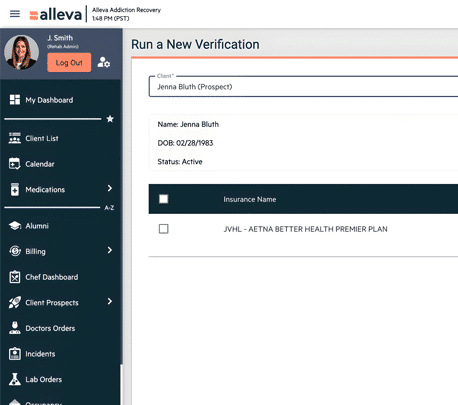
For example, Alleva’s integrated VOB tool allows teams to:
- Run real-time health insurance benefits verification
- View key eligibility data instantly, without leaving the EMR
- Track historical benefit checks across client records
- Eliminate double entry across systems
No toggling between portals. No paper forms. Just fast, accurate, insurance coverage verification that supports efficient admissions.
Final Thoughts: Don’t Let the VOB Process Hold Back Admissions
In behavioral health, your team’s time should go to clients—not phone trees and paperwork. A modern verification of benefits process starts with the right platform, right workflow, and real-time insight.
Whether you’re verifying employee benefits, checking mental health insurance coverage, or simply exploring better tools for benefits verification, Alleva’s integrated VOB system brings clarity to chaos.
Because the people you serve shouldn’t have to wait for care—and your team shouldn’t have to wait for answers.
Frequently Asked Questions About Verification of Benefits (VOB)
How long does a typical VOB check take?
A simple electronic eligibility check can return results in seconds. A full verification that includes service-specific coverage and prior authorization requirements — completed by phone — often takes 10 to 30 minutes. More complex cases, such as residential or long-term treatment authorizations requiring clinical documentation review, can take several days.
Can VOB checks be performed for Medicare and Medicaid plans?
Yes. Both programs can be verified, though processes and portals vary by program and state. Treat these verifications with the same documentation standards as commercial plans, and confirm any program-specific requirements for behavioral health or SUD services.
What documentation should be stored after a VOB?
Store the verification date and time, payer name and plan ID, verifier name or ID, confirmation or reference numbers when available, a summary of benefit details, and copies of any authorizations issued. Link records to the patient account to expedite dispute resolution.
Are payers required to provide real-time eligibility information?
There is no single universal requirement. Many payers offer near-real-time electronic eligibility transactions, but completeness varies. Document electronic results and confirm service-specific details by phone when needed.
When should benefits be re-verified for an active patient?
Re-verify when insurance information changes, before scheduling high-cost or new services, at the start of each benefit year, and on the day of service if the previous check was more than 30 days ago.
Who on the team should be responsible for VOB?
Front desk staff can handle initial eligibility checks; billing or revenue cycle staff should manage benefit details and authorizations; clinical staff should flag service-specific needs. Use shared templates or your EMR to ensure continuity across roles.
What privacy safeguards apply when sharing PHI during VOB?
Share only the minimum necessary PHI, use secure portals or encrypted communications, ensure BAAs are in place for any third-party vendor, and maintain audit trails in the patient record. Provide regular HIPAA training for all staff involved in verification.
Should smaller practices outsource VOB?
Outsourcing can reduce administrative burden for practices with limited internal capacity, but requires careful vendor selection for HIPAA compliance and transparent documentation. A hybrid model — simple checks in-house, complex authorizations outsourced — is a practical middle ground.
How should VOB findings be communicated to patients?
Use plain language, provide written estimates for higher-cost services, and explain that final patient responsibility may differ after claim adjudication. Offer a contact person for follow-up questions.
What steps should be taken when a payer provides conflicting benefit information?
Document each interaction thoroughly, escalate to the payer’s provider relations team, submit supporting documentation, and pursue formal appeal channels if discrepancies affect payment. Retain all communications throughout.