

Healthcare compliance certification (including the CHC, CHPC, CHRC, and CPCO) is a category of professional credentials that validates knowledge of compliance, privacy, research oversight, and program management in regulated healthcare environments.
For behavioral health organizations navigating HIPAA requirements, audit readiness, and operational risk, compliance-certified professionals bring structured knowledge that supports documentation controls, cross-team accountability, and long-term regulatory readiness.
What Each Credential Tests and How They Differ
The four credentials serve distinct compliance functions and are issued by different professional organizations:
- CHC (Certified in Healthcare Compliance): Issued by the Compliance Certification Board (CCB) in partnership with the Health Care Compliance Association (HCCA). Covers healthcare laws, regulations, corporate compliance program elements, auditing, monitoring, and ethics. Designed for compliance professionals at all career levels.
- CHPC (Certified in Healthcare Privacy Compliance): Also from the CCB/HCCA. Focuses specifically on privacy frameworks, including HIPAA Privacy and Security Rules, protected health information handling, and breach response. Well-suited for privacy officers and compliance staff with a privacy-focused scope.
- CHRC (Certified in Healthcare Research Compliance): CCB/HCCA credential for professionals overseeing compliance in healthcare research settings, clinical trials, human subjects protections, and research integrity.
- CPCO (Certified Professional Compliance Officer): Issued by the American Academy of Professional Coders (AAPC), not the CCB. Covers fraud and abuse prevention, OIG guidance, billing compliance, and coding integrity. Requires active AAPC membership. Common among revenue integrity and coding compliance professionals.
Understanding which body issues each credential matters for eligibility, AAPC membership is required for the CPCO, while CCB credentials require documented compliance experience or a qualifying certificate program.
Who Pursues These Credentials in Behavioral Health
In behavioral health settings, compliance roles often span multiple functions, clinical documentation, billing, privacy, and program accreditation all intersect. Teams pursuing CHC, CHPC, or CPCO credentials typically work in compliance, privacy, revenue integrity, or program operations.
The credentials help clarify role scope and strengthen behavioral health compliance accountability across clinical, admissions, and billing teams. Employers commonly value certification for internal audit programs, payer contract requirements, and accreditation readiness with bodies like CARF or The Joint Commission.
Exam Format, Question Count, and Knowledge Domains
Knowing what to expect on exam day helps candidates allocate study time effectively.
CHC, CHPC, CHRC (CCB exams):
- 120 questions total; 100 are scored (20 are unscored pilot items)
- 2-hour time limit
- Multiple-choice format, mix of direct knowledge and scenario-based questions
- Seven formal knowledge domains: standards; policies and procedures; communication, education, and training; compliance program administration; discipline for non-compliance; screening and evaluation of employees and agents; monitoring, auditing, and internal reporting; and investigations and remedial measures
CPCO (AAPC exam):
- 150 questions
- 340-minute time limit
- Covers OIG guidance, fraud and abuse laws, compliance program history, risk areas, and audit/investigation processes
Scenario-based questions test how candidates apply regulations in realistic situations, a format that rewards practical compliance experience over rote memorization.
Eligibility: Experience and Coursework Requirements
CCB credentials (CHC, CHPC, CHRC): Candidates must demonstrate at least one year of full-time compliance work or 1,500 hours of direct compliance activities within the past two years. An alternative pathway exists for CHC candidates who have completed a CCB-accredited certificate program within the past two years. All candidates must also complete 20 CCB-approved CEUs before applying, with at least 10 from live training events.
CPCO: Active AAPC membership is required. No minimum experience is mandated, though the AAPC strongly recommends at least two years in a compliance-related role and at least an associate’s degree in a healthcare field.
Document your compliance work history carefully before applying. Applications require attestation of experience, and employer verification may be needed.
Exam Fees, Study Resources, and Timelines
CCB (CHC, CHPC, CHRC): $275 for HCCA/CCB members; $375 for non-members.
CPCO: $399 (AAPC membership required separately).
Most certifying bodies provide a candidate handbook and a limited practice item set with the application fee. Comprehensive study guides, prep courses, and full practice exams are typically sold separately. Build your budget to include both exam fees and supplemental materials.
Timelines vary. Candidates with documentation ready and a strong study plan may schedule within weeks of submitting an application. Others take several months. Build in extra time for employer verification and to secure your preferred test date.
Exam Retake Policy and Waiting Periods
Retake policies differ by certifier. CCB credentials typically include a mandatory waiting period between attempts and a fee for each retake. The AAPC has its own retake schedule for the CPCO. Review the specific candidate handbook for your credential before scheduling, plan for the possibility of a waiting period so it doesn’t disrupt your career timeline.
ADA Accommodations and International Applicants
Most certifying bodies offer reasonable testing accommodations under ADA-equivalent policies. Requests require supporting documentation (medical or educational) and must be submitted well before the exam date, some certifiers require several weeks’ lead time.
International applicants are generally permitted for these U.S.-focused credentials, though availability of testing centers, remote proctoring options, and eligibility documentation requirements vary. Confirm your country’s specific policies with the issuing organization before applying.
CEUs, Recertification, and Employer Reimbursement
CCB credentials: Recertification every two years, requiring 40 CCB-approved CEUs (20 must come from live training).
CPCO: Renewal every two years, requiring 36 AAPC CEUs.
Accepted CEU activities include conferences, approved webinars, coursework, presentations, publications, and relevant workplace compliance activities. Keep organized records, certificates of completion, transcripts, and employer attestations, and submit them according to the certifier’s process.
Many behavioral health employers fund exam fees, study materials, and ongoing recertification costs when the credential supports organizational compliance needs. Clarify reimbursement expectations, documentation requirements, and any service commitments before incurring costs.
Compliance Certification and GRC Technology in Behavioral Health
A meaningful shift is underway in how compliance-certified professionals do their work. Behavioral health organizations are increasingly adopting Governance, Risk, and Compliance (GRC) platforms, purpose-built software that moves compliance from reactive survey preparation to continuous, audit-ready monitoring.
Certified professionals now operate inside systems that automate policy tracking, document control, staff training records, and incident reporting. This environment introduces new vocabulary and workflows: continuous compliance monitoring, audit-ready documentation pipelines, credentialed workflow ownership, and GRC content management.
For behavioral health organizations, this intersection matters practically. Healthcare audit readiness depends increasingly on platforms that surface documentation gaps in real time, not just at survey time. Compliance-certified staff who understand how to configure and use these systems bring compounding value, their credential knowledge is applied inside technology that scales it across teams.
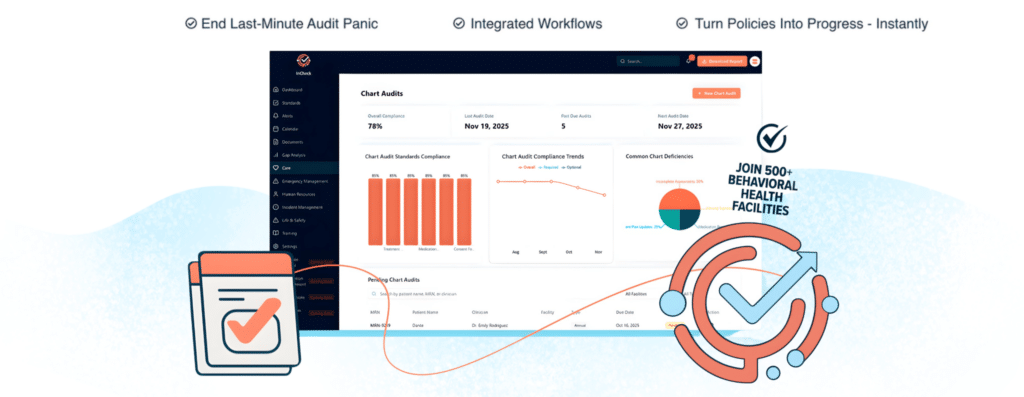
Alleva’s InCheck is a GRC content management system built specifically for behavioral health, giving compliance-certified professionals the tools to operationalize what they know. Systems like this also mean that understanding what a HIPAA violation looks like is no longer just a knowledge credential, it’s an actionable capability inside a live compliance infrastructure.
Which Credential to Pursue First
Candidates often ask which certification to start with. A practical approach:
- Start with the CHC if your role is broadly in compliance, or if you want the most widely recognized general credential.
- Pursue the CHPC if your work centers on privacy, HIPAA compliance, or PHI handling, common in behavioral health settings where sensitive health information is a daily operational concern.
- Consider the CPCO if your work involves billing compliance, coding integrity, or revenue cycle oversight, the AAPC credential is particularly relevant for revenue integrity roles.
- Choose the CHRC if your organization conducts clinical research and you oversee research compliance activities.
Many behavioral health compliance professionals eventually hold more than one credential as their scope expands.
Study Tips and Recommended Resources
- Anchor your study plan to the official content outline or Detailed Content Outline (DCO) from the credentialing body.
- Use the candidate handbook as a primary reference, then layer in practice exams for scenario-based fluency.
- Connect study content to live work: tie exam topics like auditing, documentation standards, and policy administration to real cases from your workplace.
- Study in focused sessions of 45–90 minutes with specific topic targets, not marathon sessions.
- Peer study groups and mentors with existing CHC or CHPC credentials are especially valuable for applying compliance frameworks to behavioral health workflows.
Support Compliance-Ready Operations at Your Organization
For behavioral health teams evaluating compliance staffing, certification pathways, or the systems that support compliance-aware workflows, Alleva is designed to help. Our platform, including the behavioral health EMR built for documentation controls and regulatory readiness, is used by organizations across the treatment spectrum.
Schedule a demo to see how Alleva supports behavioral health compliance in practice.
Frequently Asked Questions About Healthcare Compliance Certification
Do I need prior compliance experience or specific coursework to be eligible?
Most CCB credentials require at least one year of full-time compliance experience or 1,500 hours of documented compliance activities. A CCB-accredited certificate program is an accepted alternative pathway for the CHC. The CPCO has no formal experience minimum, though the AAPC recommends two-plus years of relevant experience.
What is the retake policy if I don’t pass?
Retake policies vary by certifier. CCB credentials typically include a waiting period and a retake fee. Review the candidate handbook for your specific credential before scheduling.
Are ADA testing accommodations available?
Yes. Submit your accommodation request with supporting documentation well before your exam date — many certifiers require several weeks’ advance notice.
Will certification help with salary or promotion?
CCB surveys have indicated that certified professionals generally report higher compensation than non-certified counterparts. The impact varies by employer, region, and role. Presenting the credential alongside documented compliance contributions strengthens any internal case.
Can international applicants take these exams?
Many programs permit international candidates, but remote testing availability, testing center locations, and documentation requirements vary. Confirm policies with the issuing organization before applying.
How long does the process take, from application to exam?
Some candidates complete eligibility, apply, and schedule within a few weeks. Others take several months to prepare fully. Build in time for documentation verification and preferred date availability.
Are study materials included in the exam fee?
Basic candidate resources are typically included. Comprehensive prep courses and practice exams are usually sold separately.
Can employers reimburse exam costs?
Yes. Many behavioral health employers fund certification and recertification costs when the credential supports organizational compliance programs. Clarify terms before incurring expenses.
How are CEUs earned and documented?
CEUs are earned through conferences, webinars, approved coursework, presentations, and relevant workplace activities. Keep certificates of completion and employer attestations. Submit documentation per the certifier’s recertification process.
Where can I find official pass-rate statistics?
Published pass rates, if available, appear on the credentialing organization’s website, in candidate handbooks, or in annual reports. Contact the certification department if data isn’t publicly posted.

Erica Ward is a Product Manager at Alleva.