


Effective healthcare task management in behavioral health treatment centers depends on three interconnected factors: the complexity of coordinated care workflows, the compliance documentation requirements of HIPAA-regulated environments, and the technology infrastructure your team uses to tie those workflows together.
When any one of these breaks down, the consequences reach far beyond administrative inconvenience. They affect client outcomes, staff retention, and your organization’s financial health. Alleva’s behavioral health platform is designed to address each of these layers within a single integrated system.
Key Takeaways
- Administrative burden is a clinical risk: Poor task management contributes to documentation errors, missed follow-ups, and fragmented care, not just staff frustration
- Compliance documentation is a task management problem: HIPAA-required records, 42 CFR Part 2 confidentiality logs, and treatment plan timelines all generate recurring task loads that require a systematic approach
- Admissions is the highest-volume bottleneck: Intake, benefits verification, and insurance authorization generate more concurrent tasks than any other stage of the care continuum
- A purpose-built platform is the most durable fix: General healthcare software adapted for behavioral health rarely accommodates the workflow nuances, like level-of-care transitions, group therapy documentation, or SUD-specific billing codes, that drive task complexity in this field
Your clinical and administrative teams are carrying a task load that general healthcare software was never designed to support. Understanding where that burden originates, and how a purpose-built EMR system can benefit them, is the foundation of any sustainable improvement.
Why Healthcare Task Management in Behavioral Health Is Uniquely Complex
Behavioral health treatment centers operate across multiple concurrent care layers: admissions, group and individual therapy, medication management, case coordination, billing, and compliance reporting. Each layer generates its own recurring task streams, and those streams frequently intersect within your behavioral health platform.
A single client’s care episode can require intake documentation, insurance authorization, treatment plan creation, daily progress notes, group session logs, medication administration records, discharge planning tasks, and post-discharge follow-up, all coordinated across clinical, administrative, and billing staff. When those handoffs are managed through disconnected systems or manual processes, tasks get missed.
The result is not simply inefficiency. Missed documentation tasks create compliance exposure. Delayed authorization tasks delay care.
Fragmented communication between departments means the same information gets entered multiple times, or not at all.
Where Task Overload Originates: Four High-Volume Bottlenecks
Understanding the root causes of task overload is the first step toward addressing them systematically. Most behavioral health organizations experience the same four bottlenecks regardless of size or program type.
1. Admissions and Intake
Admissions generates more concurrent tasks than any other stage of the care continuum. Staff must simultaneously manage initial assessments, verify insurance benefits, complete authorization requests, coordinate with clinical leadership on level-of-care placement, and prepare client records, often for multiple clients at once.
Verification of Benefits (VOB) workflows alone involve multi-step communication with payers, internal documentation, and time-sensitive follow-up. Without a system that tracks each step, authorizations get delayed and admissions bottleneck.
2. Clinical Documentation
Progress notes, treatment plans, and group session records are time-sensitive compliance requirements, not optional administrative tasks. Under HIPAA, late or incomplete documentation creates legal and audit risk. Under payer contracts, undocumented care is unbillable care.
Clinicians who manage their task queues manually, through paper lists, email reminders, or personal habit, are operating one system failure away from a documentation gap. The cognitive burden of tracking what is due, what is overdue, and what is assigned to someone else reduces the time and mental energy available for direct client care.
3. Billing and Revenue Cycle Tasks
Behavioral health billing involves a level of complexity most general medical billing systems were not designed to accommodate. Substance use disorder (SUD) treatment billing involves specialized CPT codes, level-of-care authorization management, and concurrent payer requirements that generate recurring task demands on your revenue cycle team.
Claim denials, authorization renewals, and remittance reconciliation each create downstream task queues. When those tasks aren’t tracked and assigned within a shared system, revenue cycle work stalls and cash flow suffers.
4. Compliance and Regulatory Documentation
HIPAA documentation requirements, 42 CFR Part 2 confidentiality logs for SUD programs, and accreditation standards from bodies like The Joint Commission or CARF all generate recurring compliance task loads. These are not one-time setup tasks, they require ongoing maintenance, staff training documentation, and audit preparation that compounds over time.
Organizations without a systematic approach to compliance task management often discover their gaps during an audit rather than in advance. By that point, remediation is both expensive and time-consuming.
| Task Category | Primary Staff Affected | Compliance Exposure If Missed | EMR Feature That Addresses It |
|---|---|---|---|
| Intake & admissions documentation | Admissions coordinators | Delayed authorizations, incomplete records | Intake workflow automation |
| Clinical progress notes | Clinicians, group facilitators | HIPAA violation, claim denial | Overdue note alerts, documentation templates |
| Treatment plan updates | Clinical directors, case managers | Payer audit risk, care gaps | Treatment plan task reminders |
| Billing & authorization follow-up | RCM/billing staff | Denied claims, revenue delays | Integrated billing task queue |
| Compliance recordkeeping | Compliance officers, administrators | Audit findings, accreditation risk | Compliance documentation logs |
| Staff training records | HR, clinical supervisors | Accreditation non-compliance | Training tracking module |
The Staff Burnout Connection
Chronic task overload is a leading driver of staff burnout in behavioral health settings. When clinicians spend their evenings catching up on documentation instead of focusing on client care during the day, the cumulative toll is measurable.
Behavioral health already faces serious workforce retention challenges. Staff who feel unsupported by the systems they work within are more likely to leave, and when they do, they take institutional knowledge with them. Disorganized task systems make onboarding slower, increase training costs, and create new documentation gaps during transition periods.
Understanding when your current software is no longer serving your team is an important leadership responsibility. High turnover, frequent after-hours documentation, and repeated workarounds are all signals that your task management infrastructure needs attention.
How EMR Integration Changes the Healthcare Task Management Equation
The most durable solution to behavioral health task management is not a new workflow protocol or a better paper-based system, it is a platform that manages task assignment, tracking, and completion within the same environment where clinical and billing work happens.
When your EMR, CRM, and billing system are separate tools, every handoff between departments creates a potential task gap. Staff must re-enter information, follow up manually, and rely on personal memory or informal communication to move work forward. Integration eliminates that fragmentation.
Alleva consolidates EMR, billing, and CRM into a single operational environment. Clinical documentation tasks, billing workflow queues, and care coordination reminders operate within the same system, so nothing moves between departments without a record.
Streamlining practice operations through EMR integration also reduces the volume of duplicative data entry that inflates administrative workloads. When intake information flows directly into clinical documentation, and clinical documentation flows directly into billing, your staff are managing one workflow instead of three.
AI-Assisted Task Routing: What Purpose-Built Behavioral Health EMRs Now Offer
The most significant development in behavioral health task management over the past two years is the emergence of AI-assisted task routing and automated documentation reminders within purpose-built EMRs. These are not experimental features, they are now core functionality in platforms designed specifically for behavioral health organizations.
Overdue Note Alerts and Documentation Prompts
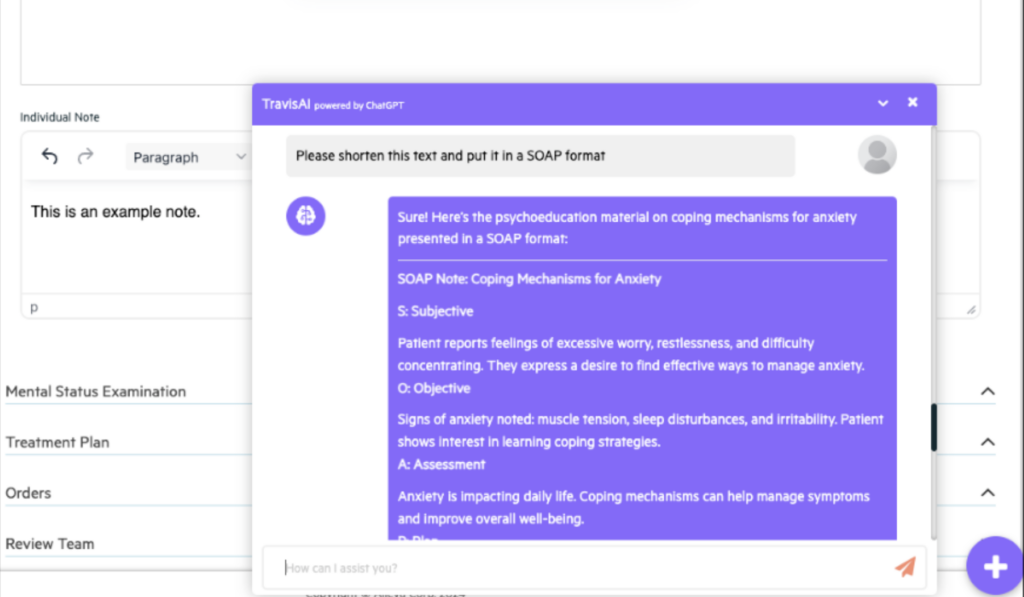
AI tools within behavioral health EMRs can monitor documentation timelines and surface alerts when clinical notes are approaching their due window. Rather than relying on clinicians to self-track their documentation obligations, the system flags what is outstanding and routes the alert to the responsible staff member’s task queue.
The role of AI in behavioral health has expanded substantially beyond clinical decision support. AI-assisted documentation workflows are now reducing the after-hours documentation burden that contributes most directly to clinician burnout.
Staff Task Queues and Assignment Routing
Purpose-built platforms can assign tasks to specific staff members based on role, caseload, or care team configuration. When a treatment plan is due for renewal, when an authorization is approaching expiration, or when a client’s follow-up window is opening, the system routes the task to the right person, not to a shared inbox where it can be overlooked.
Automated Care Coordination Reminders
For clients transitioning between levels of care, from residential to PHP (Partial Hospitalization Program) to IOP (Intensive Outpatient Program), care coordination generates significant task volume. Automated reminders for transition documentation, referral follow-ups, and post-discharge contact reduce the likelihood that handoffs fall through the cracks.
| AI/Automation Feature | Task Problem It Solves | Who Benefits |
|---|---|---|
| Overdue note alerts | Clinicians missing documentation deadlines | Clinicians, compliance officers |
| Staff task queue routing | Tasks lost in shared inboxes or informal communication | Admissions, clinical, billing teams |
| Authorization expiration alerts | Missed renewals causing claim denials | RCM/billing staff |
| Treatment plan renewal reminders | Late plan updates creating payer audit risk | Clinical directors, case managers |
| Transition of care task automation | Care coordination gaps at level-of-care changes | Case managers, discharge planners |
| Compliance documentation prompts | Recurring regulatory tasks missed during high-census periods | Compliance officers, administrators |
What to Look for in a Behavioral Health Task Management System
Not all EMR platforms approach task management the same way. When evaluating whether your current system, or a prospective platform, can support your organization’s task management needs, these are the capabilities that matter most.
The top features to look for in a behavioral health EMR go well beyond documentation templates. Task management functionality should be evaluated as a core operational capability, not a secondary feature.
Task assignment and tracking. Can the system assign tasks to specific staff members, set due dates, and track completion? Can supervisors see what is outstanding across their team?
Workflow automation. Does the platform automate recurring task generation, for example, creating a documentation task every time a group session is logged, or triggering an authorization review task when a client’s stay reaches a threshold?
Cross-department visibility. Can admissions, clinical, and billing staff see the task status of handoffs that cross their department lines? Or does each team operate in isolation?
Compliance task management. Does the system support HIPAA documentation workflows, 42 CFR Part 2 recordkeeping requirements for SUD programs, and accreditation-related task tracking?
Integration depth. Is task management a bolt-on module, or is it built into the core of the EMR, billing, and CRM workflow? The difference determines whether task data is accurate and current or perpetually out of sync.
Building a Task Management Culture That Supports the Technology
Even the most capable platform requires organizational habits to match. A few operational practices can significantly improve task management outcomes for behavioral health teams transitioning to a more structured system.
Establish clear task ownership. Every recurring task type should have a designated owner by role, not by individual, so that staff transitions don’t create orphaned responsibilities. Successful EMR migration depends in part on establishing these ownership protocols before go-live, not after.
Review task queue health weekly. Brief weekly reviews of outstanding and overdue tasks allow supervisors to catch gaps early and redistribute load before it compounds. Many behavioral health EMRs can generate these reports automatically.
Treat documentation as care, not administration. When clinical teams understand that accurate, timely documentation directly affects client outcomes, through billing accuracy, care continuity, and audit readiness, task completion rates improve. Framing documentation as a care function rather than a compliance burden is more effective than compliance-based pressure.
How Alleva Supports Task Management Across the Care Continuum
Alleva was purpose-built for behavioral health, not adapted from a general healthcare system. That distinction matters most in the workflows that general systems handle poorly: level-of-care transitions, SUD-specific billing, group therapy documentation, and the compliance task load unique to HIPAA-regulated treatment environments.
Optimizing task management with Alleva EMR means your team works within a single operational platform rather than coordinating across disconnected tools. Clinical documentation, billing workflows, care coordination reminders, and compliance task tracking operate together, so the handoffs that currently create your highest task-loss risk become system-managed rather than staff-managed.
Our implementation team works alongside your staff to configure task workflows, establish ownership protocols, and build the reporting visibility your leadership team needs to manage operational health over time. Customer service and ongoing support are part of the platform relationship, not a separate engagement.
If your organization is ready to move from reactive task management to a proactive, system-supported approach, schedule a demo to see how the platform works in practice.
Ready to Transform Your Center? Choose Alleva
If you’re determined to enhance your center’s operations and elevate the level of care you provide, choosing Alleva is the next step toward transformation. Our platform is more than just a product; it’s a commitment to excellence in behavioral health task management. By selecting Alleva, you empower your staff with tools that streamline their workflows and maximize their impact. The decision to work with Alleva is to invest in your center’s future, ensuring that you stay at the forefront of client care and operational efficiency. We invite you to schedule a demo to see firsthand how Alleva can revolutionize how you manage tasks and help you focus on what truly matters – your clients’ recovery. When you’re ready to take this crucial step, Alleva will guide you through a smooth and successful transition.
Consider your to-do list done.