

EMR features for behavioral health are the clinical, operational, and compliance capabilities that define whether an electronic health record platform can support the real-world complexity of addiction treatment and mental health programs.
Behavioral health teams navigating complex documentation demands, payer requirements, and compliance obligations deserve technology that fits their workflows, not general-purpose tools adapted from primary care. Choosing the right behavioral health EMR software means evaluating more than a EMR features list. It means understanding which capabilities will reduce administrative burden, protect clinical quality, and hold up under audit. For the full comparison, see our buying guide.
Top 10 EMR Features to Know Before You Buy
This guide covers what to look for across clinical documentation, interoperability, AI-assisted documentation, e-prescribing, billing, patient engagement, security, and deployment, so your team can evaluate platforms with confidence. It can further help you learn how to use EMR software to the utmost advantage in your service facility or clinic.
1. Clinical Documentation and Workflow EMR Features
Behavioral health clinicians need charting that fits clinical workflows rather than forcing therapy notes into medical templates. Purpose-built documentation should include:
- Note types tailored to behavioral health: intake, progress, group, individual therapy, discharge, and sobriety assessments
- Structured problem lists, DSM-5 coding support, and ICD-10 mapping to simplify diagnosis and billing
- Configurable progress note templates with the ability to add free-text or narrative sections
- Audit trails and documentation timestamps that support compliance and supervision workflows
- Standardized behavioral health screeners such as PHQ-9, GAD-7, and HAM-A/D, which support evidence-based care and outcomes documentation
Clinician usability has a direct impact on documentation time and record quality. Strong documentation workflows also lay the groundwork for accurate medication management and e-prescribing.
2. Interoperability: HL7, FHIR, and Real-World Connectivity
Before selecting a platform, confirm whether it supports modern interoperability standards and real integrations. Look for:
- FHIR APIs for exchanging discrete data elements such as medications, allergies, problems, and clinical summaries
- HL7 v2 integrations for lab results, ADT feeds, and legacy system connections used by hospital partners
- Support for CCD/CCDA documents for common data exchange scenarios
- Direct or SFTP interfaces for payers and labs when API connections are not available
Interoperability reduces manual entry and helps maintain accurate medication lists and lab data. For programs subject to 42 CFR Part 2 (the federal confidentiality rule governing substance use disorder records) confirm that the system’s data-sharing architecture supports compliant disclosures and consent management. This is a distinct requirement from standard HIPAA obligations, and not all platforms handle it adequately.
3. E-Prescribing and Medication Management
Medication safety and workflow efficiency rely on e-prescribing that integrates with the clinical chart. Key addiction EMR features include:
- Electronic prescribing of controlled substances (EPCS) capability, which is essential for programs handling controlled medications
- Drug-drug and drug-allergy interaction checks integrated into the ordering workflow
- Medication reconciliation tools and medication history import from pharmacy benefit managers or Surescripts where available
- Refill workflows, prior authorization tracking, and clear audit logs
- Support for Medication-Assisted Treatment (MAT) workflows, including PDMP integration and opioid stewardship tools, for programs treating substance use disorders
Medication tools should connect to the overall care record and to pharmacy networks to reduce clinician administrative burden and patient risk.
4. Patient Engagement: Portals, Messaging, and Telehealth Access
Patient-facing features that support engagement and compliance include:
- Patient portal access for appointment scheduling, secure messaging, and viewing select results or documents per your access policies
- Two-way secure messaging routable to intake, care managers, or clinicians with configurable notification rules
- Electronic consent and intake forms that feed directly into the chart
- Built-in telehealth with no third-party logins required, telehealth is no longer optional; it is a core access feature for outpatient, IOP, and PHP programs
- Appointment reminders and automated scheduling tools to reduce no-show rates
Patient engagement features should be configurable to match privacy preferences and state laws relevant to behavioral health records, including minor confidentiality and sensitive record protections.
5. Billing, Revenue Cycle Management, and Reporting
Behavioral health practices benefit from integrated billing and revenue cycle management that connects directly to clinical documentation. Evaluate for:
- Claims creation with CPT and ICD-10 mapping, payer-specific rules, and electronic claims submission
- Denial management tools, claims scrubbers, and automated eligibility checks
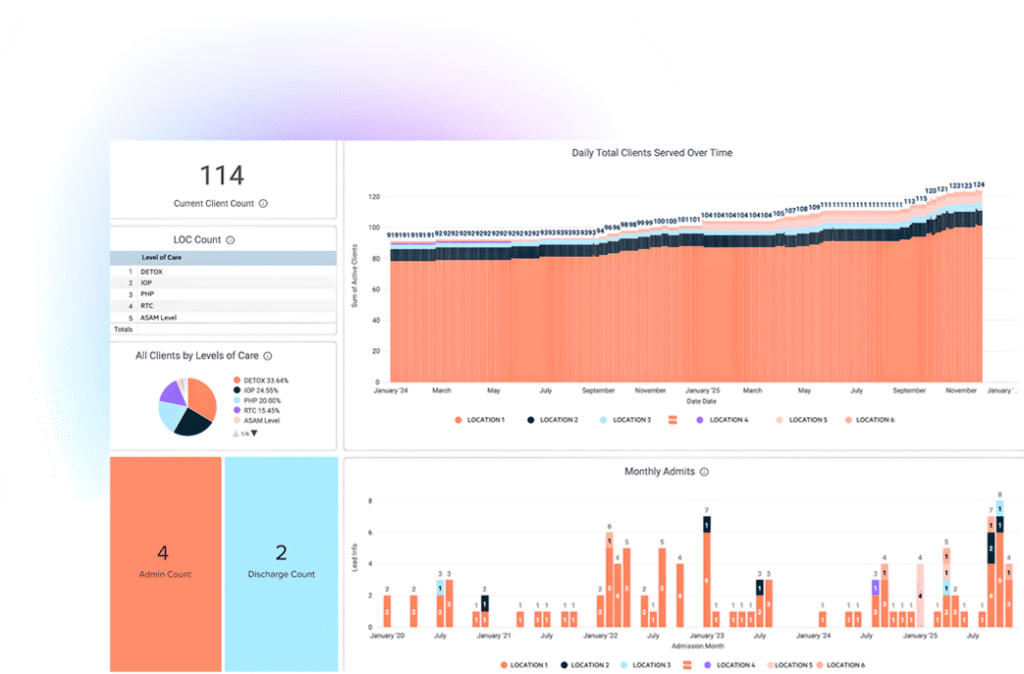
- Dashboards for AR aging, payer mix, and per-provider productivity
- Configurable reporting for clinical metrics, utilization, and financial performance
- Verification of benefits (VOB) automation to streamline the intake-to-billing handoff
Clear handoffs between clinical documentation and billing workflows can reduce claim denials and support more predictable revenue cycles.
6. Ambient Clinical Intelligence and AI-Assisted Documentation
AI-assisted documentation has evolved significantly. The current frontier in behavioral health platforms is Ambient Clinical Intelligence (ACI), a passive, always-on AI layer that captures the clinician-client conversation in real time and generates structured, audit-ready clinical notes automatically.
This is meaningfully different from template-based charting or earlier AI documentation tools:
- Template-based charting relies on predefined fields and structured prompts that speed entry but can encourage checkbox-style notes
- AI-assisted concept processing extracts clinical meaning from free text or clinician speech and maps it to diagnoses, problems, interventions, and billing codes
- Ambient Clinical Intelligence (ACI) uses automatic speech recognition (ASR) and large language models to listen passively during sessions, generate draft notes in formats such as DAP, SOAP, and UR, and surface them for clinician review — without the clinician stopping to dictate or type
Research published in JAMA Network Open in 2025 found that ambient AI was associated with decreased time spent writing notes, reduced cognitive load, and improved clinician well-being.
Alleva’s AI documentation tools: Echo and TravisAI are built on this approach. Echo uses HIPAA-compliant ambient AI to listen to sessions and generate structured notes in real time, with a zero-retention audio policy (only compliant notes are stored, not recordings). TravisAI provides in-platform support for treatment plans, documentation questions, and workflow guidance.
Safeguards to require from any AI documentation tool:
- Mandatory clinician review before any AI-generated content is committed to the legal medical record
- Transparent audit logs showing AI-suggested content versus clinician-confirmed content
- Zero-retention or minimal-retention audio policies
- Data minimization practices and documented storage and security controls
- Opt-out capability for individual clinicians
Reducing “pajama time”, the after-hours documentation burden that contributes to clinician burnout, is one of the clearest operational benefits ambient AI can provide for behavioral health teams.
7. Security, HIPAA, and Certifications
Security and privacy protections are central for any vendor handling protected health information (PHI). Confirm:
- Encryption at rest and in transit, role-based access controls, multi-factor authentication options, and regular vulnerability testing
- Business Associate Agreement availability and adherence to HIPAA privacy and security rules
- SOC 2 attestation as evidence of security posture
- ONC Cures Act certification where interoperability claims or federal program participation require it, this is the current standard, not legacy ONC certification
Ask how the vendor documents compliance practices and how they support your organization during audits. Behavioral health programs with substance use disorder populations should also confirm alignment with 42 CFR Part 2.
8. Certifications and Regulatory Supports
Request documentation that the vendor supports relevant regulatory reporting and certification requirements:
- ONC Cures Act certification when required for interoperability claims or federal program participation
- Tools or reporting support for MIPS or MACRA if clinicians participate in those programs
- Audit-ready logs, consent management features, and reporting that supports state licensing and accreditation obligations
- CCBHC reporting support, if applicable to your program model
Confirm what the vendor provides out of the box versus what requires your operational configuration or additional services.
9. Data Portability, Open APIs, and Avoiding Vendor Lock-In
Preventing vendor lock-in is a practical priority during vendor selection:
- Look for documented export processes for clinical and billing data in open formats such as FHIR resources or CSV for financial records
- Publicly documented RESTful APIs with clear rate limits and scopes
- Contract language that defines data export timelines, formats, and vendor support during migrations
Strong data portability and API access reduce long-term migration risk and make integrations with specialty tools easier to manage.
10. Marketing, Reporting, and Performance Benchmarking
Some EMR platforms provide tools that support referrals, outcomes tracking, and benchmarking:
- Referral and CRM features that help admissions teams track leads and conversion
- Operational reporting on length of stay, readmissions, utilization, and clinician productivity
- Benchmarking tools that compare anonymized metrics to peer groups where the vendor supports such programs
These EMR features can help leadership make data-driven decisions and support growth while keeping privacy protections in place.
Schedule a Demo to See Alleva EMR in Practice
Behavioral health is shifting toward value-based, outcome-driven care. Success will depend on clean data, integrated systems, and actionable insights. At Alleva, we’re committed to giving providers the tools to thrive by connecting every part of the care journey—systems, teams, families, and clients. Ask us about the EMR features that matter most to your behvioral health clinic, and we’ll walk you through them.
Ready to see how connected workflows, Alleva Insights, and more can transform your organization? Schedule a demo today.
EMR Features FAQ
What are the key EHR and EMR features behavioral health providers should prioritize?
Prioritize clinical documentation tailored to behavioral health, configurable progress and group notes, DSM-5 and ICD-10 support, integrated e-prescribing with EPCS where needed, standardized outcome screeners, secure patient engagement tools, interoperability (FHIR and HL7), integrated billing and RCM workflows, audit trails for compliance, and vendor-provided implementation and support. EMR features that reduce clinician administrative time while preserving clinical nuance are especially valuable.
How do EMR and EHR differ and why does that matter for a treatment program?
An EMR is primarily an electronic chart for use inside a single practice. An EHR adds the expectation of data exchange across organizations. For treatment programs that coordinate care with hospitals, primary care, or community providers, EHR-level interoperability enables smoother transitions of care and better-shared clinical context.
Can EHR or EMR feaetures measurably improve efficiency and quality of patient care?
Well-designed systems can reduce duplicate entry, speed documentation with templates or AI assistance, improve medication safety through interaction checks, and provide dashboards for clinical oversight. These improvements depend on workflow fit, implementation quality, and clinician adoption rather than technology alone.
What is Ambient Clinical Intelligence and how does it differ from standard AI documentation tools?
Ambient Clinical Intelligence (ACI) uses passive listening and large language models to capture clinician-client conversations and generate structured clinical notes in real time, without requiring the clinician to dictate or interact with a template. Standard AI documentation tools typically assist with structured input or summarization after the fact. ACI operates upstream, during the session itself, and is associated with measurable reductions in after-hours documentation and clinician cognitive load.
What is 42 CFR Part 2 and does my EMR features need to support it?
42 CFR Part 2 is a federal confidentiality rule that governs the disclosure of substance use disorder treatment records. It is more restrictive than standard HIPAA requirements and requires patient consent for most disclosures. If your program treats SUD populations, your EMR’s interoperability and data-sharing architecture must support compliant handling of Part 2 records.
Does the EMR features include e-prescribing and medication management with drug-interaction checks?
Most behavioral health EMR vendors offer e-prescribing and medication management EMR features, often including drug-drug and drug-allergy interaction checks and support for medication reconciliation. For SUD programs, verify MAT workflow support and PDMP integration in addition to EPCS capability.
How does the EMR support patient engagement (portal, secure messaging, access to results)?
Typical patient engagement EMR features include a portal for appointment scheduling and document access, two-way secure messaging, electronic intake forms, built-in telehealth, and configurable access to results. Confirm how the vendor handles consent, minor and sensitive records, and notification routing aligned with behavioral health privacy requirements.
How does the EMR handle billing, revenue cycle management, and reporting?
Integrated RCM commonly includes claims creation, electronic submission, eligibility checks, VOB automation, denial management, and AR reporting. Look for configurable billing rules, payer-specific settings, and dashboards for productivity and financial performance. Confirm what is built in versus available as an optional managed service.
Is the system secure and HIPAA-compliant, and should I expect a certification?
Vendors should provide HIPAA-compliant practices, a Business Associate Agreement, encryption, access controls, and security testing evidence. ONC Cures Act certification applies to certain EHR capabilities and interoperability claims. SOC 2 attestation is common for security posture. Ask for documentation of security controls and third-party attestations.
What AI or ambient documentation tools are available and what safeguards are needed?
Available tools include speech-to-text dictation, ambient AI that generates draft notes from session audio, and AI summarization or structured extraction tools. Required safeguards include explicit clinician review before committing content to the legal record, audit logs distinguishing AI-suggested from clinician-confirmed content, zero-retention audio policies, and documented data minimization practices.
What data portability and open API EMR features prevent vendor lock-in?
Look for documented export formats, FHIR-based APIs, bulk data export capabilities, and contract terms that define migration timelines and vendor support. Publicly documented endpoints and developer documentation ease third-party integrations and future migrations.
What uptime, disaster recovery, and backup SLAs should I request?
Request uptime SLAs as a percentage with defined maintenance windows, RTO and RPO commitments, backup frequency and retention documentation, incident communication procedures, and restoration testing support. SLA specifics should reflect your clinical continuity requirements.
How long does implementation typically take?
Implementation timelines vary by organization size, data migration complexity, customization needs, and staff availability for training. Smaller clinics onboard faster. Mid-market and enterprise behavioral health organizations can expect longer timelines due to integrations, custom workflows, and phased rollouts.
How do I evaluate clinical usability before buying?
Arrange hands-on demos with real workflows, request clinician sandbox access, solicit feedback from end users, and run usability scenarios that reflect typical charting, prescribing, group note, and admissions tasks. Include staff from admissions, billing, and clinical teams in evaluations.
Looking Ahead: A Future Built on Connection
Alleva is a leading behavioral health EHR platform built to support the clinicians and organizations changing lives. Designed by industry professionals, our cloud-based solution has all the EMR features you need most: simplified documentation, strengthened compliance, and prioritized whole-person care—so providers can focus on what matters most: helping people heal.

Alex Inglish is a Product Manager at Alleva.