

Healthcare GRC software is a platform category that centralizes governance, risk, and compliance workflows, including policy management, control mapping, audit evidence, and vendor oversight for healthcare organizations and businesses.
HIPAA, HITECH, state licensing requirements, accreditation surveys, and business associate agreements all require consistent documentation, audit-ready evidence, and defensible processes.
This guide covers the best healthcare GRC platforms on the market today, some key features, and best use cases for each.
What is Healthcare GRC Software?
Healthcare-specific GRC platforms are built to map clinical systems, including EHRs and practice management tools, into risk models. They must also support business associate agreement (BAA) workflows and produce records that satisfy OCR reviewers and state licensing agencies. That specialization is what separates a general-purpose GRC tool from one designed for behavioral health environments.
Best Healthcare GRC Software
Here are the best healthcare GRC solutions available and what they work best for.
1. Alleva InCheck – Best Behavioral Health GRC Software
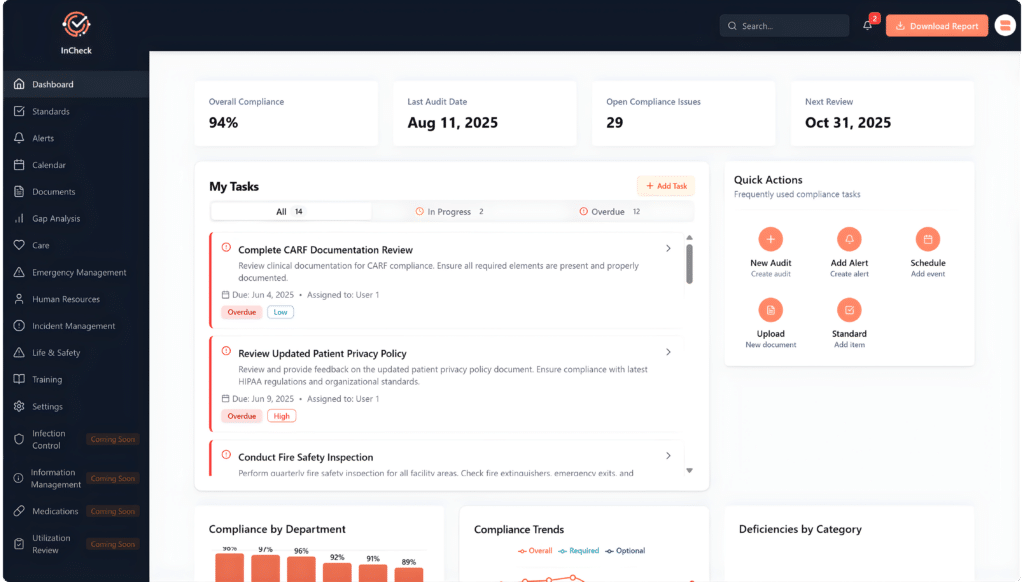
Alleva InCheck is a governance, risk, and compliance (GRC) platform purpose-built for behavioral health organizations managing regulatory requirements, clinical documentation standards, and HIPAA obligations. It operates as part of the broader Alleva suite, giving treatment programs a centralized place to track compliance workflows, credential staff, and reduce administrative risk. InCheck is designed for the specific operational realities of addiction treatment, mental health, and integrated care settings — not adapted from general healthcare tools.
Alleva InCheck is best for behavioral health organizations, like intensive outpatient programs, partial hospitalization programs, therapy offices, psychiatry practices, and addiction treatment services. It’s particularly well-suited for organizations that are scaling, navigating accreditation requirements, or managing compliance across multiple programs or locations within a single platform. Learn more about EMR benefits.
Alleva InCheck Features:
- Staff credentialing and license tracking: Monitor employee credentials, certifications, and expiration dates to stay audit-ready
- Policy and procedure management: Store, version, and distribute compliance documents across your organization
- Incident reporting and tracking: Log, manage, and resolve incidents with a clear audit trail
- HIPAA-compliant documentation workflows: Built-in safeguards for handling protected health information (PHI) throughout clinical and administrative processes
- Compliance task assignment and accountability: Assign GRC tasks to specific team members with due dates and completion tracking
- Integration with Alleva EMR, CRM, and RCM: Compliance workflows connect directly to clinical, admissions, and billing data in one unified system
PROS
- Specialized GRC for the behavioral health industry
- Full Alleva suite comes with EHR/EMR, billing, intelligence, and more
- HIPAA compliant AI therapy notes
CONS
- Not for healthcare services that don’t fall under the behavioral health category
2. Vanta – Best for Simple Automation
Vanta is an AI-powered trust management platform that automates compliance workflows, continuous monitoring, and security reviews, all in one place. It helps healthcare teams get compliant faster by eliminating manual evidence collection and scaling their security programs without adding headcount.
Vanta works well for healthcare organizations that need to manage multiple frameworks like HIPAA, SOC 2, and HITRUST simultaneously without juggling separate tools or spreadsheets.
Vanta Features
- Automated HIPAA and HITRUST compliance monitoring
- AI-driven evidence collection and audit prep
- Continuous third-party vendor risk management
- Centralized risk management dashboard with scoring
- Questionnaire automation for security reviews
Pros
- Cuts compliance time dramatically
- Supports 20+ regulatory frameworks
Cons
- Pricing not publicly disclosed
- Can overwhelm smaller compliance teams
- Enterprise features require higher-tier plans
3. MetricStream – Best for Enterprises
MetricStream is an AI-first connected GRC platform that helps large healthcare organizations manage risk, compliance, audits, cyber threats, and third-party relationships from a single unified system. It gives compliance and risk leaders real-time visibility across the entire enterprise to drive smarter, faster decisions.
MetricStream works well for healthcare enterprises that need to connect risk data across departments, from internal audit and regulatory compliance to operational resilience and vendor oversight.
MetricStream Features
- AI-powered enterprise risk and compliance management
- Internal audit management with real-time issue tracking
- Third-party and vendor risk monitoring dashboards
- Cyber GRC with IT risk and policy management
- Operational resilience and business continuity planning
Pros
- Recognized leader across multiple analyst reports
- Deeply connected cross-functional GRC modules
- Strong enterprise scalability and customization
Cons
- Likely complex to implement and configure
- Built for enterprise, not smaller teams
- No transparent public pricing available
4. Scrut – Best for Scaling
Scrut is an AI-powered GRC automation platform that helps healthcare organizations move beyond checkbox compliance and build a security program mapped to their real, unique risks. It automates control monitoring, evidence collection, and audit workflows so compliance teams can focus on what actually matters.
Scrut works well for healthcare organizations that need to manage multiple compliance frameworks like HIPAA, SOC 2, and CMMC simultaneously while keeping audit prep from derailing day-to-day operations.
Scrut Features
- Continuous 24/7 automated control monitoring
- Pre-built auditor-approved policy templates library
- Multi-framework compliance tracking in one view
- AI-assisted risk identification and remediation guidance
- Deep tech stack integrations for automated evidence collection
Pros
- Fast setup with pre-built templates
- Live expert InfoSec support included
- Highly configurable to unique risk profiles
Cons
- Geared more toward tech-forward teams
- Less suited for large enterprise complexity
- Lighter on operational resilience features
5. Delve – Best for Ease of Use
Delve is an AI-powered compliance platform that automates evidence collection, continuous monitoring, and security workflows so healthcare organizations can get compliant in days rather than months. Its AI agents act as a co-pilot, handling the tedious manual work while your team stays focused on patient care and operations.
Delve works well for healthcare organizations at any growth stage that need to quickly achieve and maintain HIPAA, SOC 2, or HITRUST compliance without building out a large internal compliance team.
Delve Features
- AI agents automate screenshots and evidence collection
- AI-powered security questionnaire auto-fill
- Continuous infrastructure scanning for compliance gaps
- AI SAST code scanning for every pull request
- Free trust report to share compliance proof with partners
Pros
- Gets teams compliant in days
- 1:1 Slack support with security experts
- Free white-glove onboarding included
Cons
- Lighter on enterprise-scale GRC features
- Relatively newer platform with smaller track record
- Advanced features require higher-tier plans
6. Optro – Best for Large Risk Programs
Optro, formerly known as AuditBoard, is a GRC platform that connects audit, cyber risk, compliance, and IT governance into a unified system. It is used by large organizations to manage risk programs at scale.
Optro works well for large healthcare organizations that need to coordinate risk and compliance activity across multiple teams and want measurable reporting on program performance and control effectiveness.
Optro Features
- Unified audit, risk, and compliance management platform
- AI-powered control testing and risk signal analysis
- Third-party risk management with continuous monitoring
- Regulatory compliance and cross-framework mapping
- Advanced reporting dashboards with real-time risk visibility
Pros
- Good for large organizations
- AI trained on compliance and risk domain data
Cons
- Primarily built for enterprise-scale deployments
- Likely requires dedicated resources for implementation
- No public pricing available
7. Sprinto – Best for Integrations
Sprinto is a compliance automation platform that monitors posture changes, maps controls to regulatory frameworks, and takes action across compliance, vendor risk, and AI governance without requiring constant manual oversight. It supports over 200 frameworks and is used by organizations ranging from early-stage startups to large enterprises.
Sprinto works well for healthcare organizations that need to stay current across multiple frameworks simultaneously, including HIPAA, HITRUST, SOC 2, and CMMC, without dedicating significant internal resources to running the compliance program day-to-day.
Sprinto Features
- Autonomous compliance monitoring across 200+ frameworks
- AI-powered evidence collection and gap analysis
- End-to-end third-party risk management and vendor diligence
- AI governance with live registry and real-time risk tracking
- 300+ native integrations across cloud, HR, and SaaS tools
Pros
- Scales from startup to enterprise without switching tools
- Auto-maps controls across multiple frameworks simultaneously
- Broad integration library reduces manual data collection
Cons
- Autonomous approach may limit manual oversight preferences
- Depth of healthcare-specific features not clearly documented
- No public pricing available
8. StandardFusion – Best for Configurability
StandardFusion is a centralized GRC platform that covers risk management, compliance, audit, vendor management, and policy management in a single system. It was recently acquired by Wolters Kluwer, which is integrating it with TeamMate’s audit capabilities to broaden its assurance offering.
StandardFusion works well for healthcare organizations that need a flexible, configurable GRC platform that can be tailored to their existing workflows without requiring a full operational overhaul.
StandardFusion Features
- Centralized risk register with heat map visualization
- Compliance management across multiple frameworks including healthcare
- Audit and internal controls management
- Vendor and third-party risk management
- Policy and privacy management with workflow automation
Pros
- Highly configurable to organization-specific needs
- Covers all core GRC functions in one platform
Cons
- Wolters Kluwer acquisition may bring platform uncertainty
- Less automation-forward than newer AI-native competitors
- No public pricing available
9. MedTrainer – Best for Training Staff on Compliance
MedTrainer is a healthcare-specific compliance platform that combines learning management, credentialing, and compliance workflows in a single system. It is built specifically for the regulatory requirements of the healthcare industry, including HIPAA, OSHA, CMS, TJC, and others.
MedTrainer works well for healthcare organizations that want to manage staff training, provider credentialing, and compliance documentation in one place rather than juggling multiple separate systems.
MedTrainer Features
- Learning management system with 1,000+ healthcare-specific courses
- Provider credentialing and license tracking tools
- Compliance workflow automation with certificate and reminder management
- Exclusion checking and sanction monitoring
- Real-time reporting and compliance dashboards
Pros
- Purpose-built for healthcare compliance requirements
- Covers learning, credentialing, and compliance in one platform
Cons
- Less suited for broader enterprise GRC needs
- More focused on staff compliance than security or IT risk
- Pricing requires direct contact with sales team
10. MedStack – Best for Building HIPAA-Compliant Apps
MedStack is a compliance platform designed specifically for digital health companies that need to build and deploy HIPAA-compliant applications. It combines built-in security controls, inheritable policy templates, and framework mapping to help development teams meet healthcare data privacy and security requirements without building compliance infrastructure from scratch.
MedStack works well for digital health startups and software teams that need to demonstrate compliance to healthcare payers and providers in order to close enterprise deals and pass security reviews.
MedStack Features
- Built-in HIPAA security controls mapped to major frameworks
- Inheritable policy templates designed for digital health
- Turnkey security questionnaire and evidence generation
- Third-party validation for healthcare industry requirements
- Support for HIPAA, SOC 2, GDPR, PIPEDA, and PHIPA
Pros
- Built specifically for digital health use cases
- Combines developer platform with compliance tooling
- Supports both US and Canadian privacy frameworks
Cons
- Narrower focus than broader GRC platforms
- Less suited for non-software healthcare organizations
- Smaller customer base than more established competitors
11. CloudApper HIPAA Ready – Best for HIPAA Task Management
CloudApper HIPAA Ready is a HIPAA-specific compliance management application that centralizes policy management, employee training, security risk analysis, incident tracking, and vendor management in a single platform. It is accessible via both web and mobile, and is designed for a broad range of covered entities including healthcare providers, clearinghouses, insurers, and business associates.
CloudApper HIPAA Ready works well for healthcare organizations that need a straightforward, dedicated tool to manage HIPAA compliance tasks and maintain audit readiness without the complexity of a broader GRC platform.
CloudApper HIPAA Ready Features
- Security risk analysis with automated gap identification
- Customizable HIPAA policy and procedure management
- Employee HIPAA training with certification tracking
- Incident logging with corrective action management
- Business associate and vendor agreement tracking
Pros
- Focused specifically on HIPAA compliance requirements
- Accessible via mobile and web for remote teams
Cons
- Limited to HIPAA, not a broader GRC solution
- Less suited for organizations needing multi-framework coverage
- Narrower feature set than enterprise compliance platforms
Healthcare GRC Software Key Features
Health teams navigating complex compliance workflows should look for platforms that reflect both clinical realities and PHI sensitivity. Essential features include:
- Healthcare-focused control library with HIPAA, HITECH, and state-rule mappings
- Risk and compliance assessments tailored to clinical workflows
- Policy and procedure management with version control and attestation tracking
- Role-based access control (RBAC) enforcement and audit logging
- Incident and breach management workflows with notification timeline tracking
- Business associate and vendor oversight modules with automated BAA tracking
- Searchable evidence repository for logs, training records, and contracts
- Reporting dashboards accessible to both leadership and compliance teams
- Integration support for EHRs, HRIS, identity providers, and logging systems
- Web-based clinician attestation and training interfaces that minimize documentation burden
Healthcare GRC Software Trends for 2026
AI documentation and intelligence tools are now embedded in modern EHR platforms. And the AI systems your clinicians use should themselves be subject to governance and vendor risk assessment within your GRC program.
These capabilities do not replace compliance officers or clinical leaders, they reduce the manual workload so your team can focus on judgment-dependent decisions rather than evidence assembly.
Key capabilities emerging in AI-powered GRC platforms include:
- Automated evidence collection: Browser agents and API integrations that continuously pull audit evidence from connected systems without manual effort
- Predictive risk scoring: AI models that analyze access logs, billing patterns, and user behavior to flag potential compliance issues before they escalate
- Autonomous regulatory change tracking: Systems that monitor regulatory updates across HIPAA, state privacy laws, and accreditation bodies — then map changes to existing controls automatically
- AI governance as a GRC domain: As behavioral health organizations adopt AI tools for documentation and clinical support, GRC platforms are adding modules specifically for assessing AI vendor risk and governing AI tool deployments under HIPAA
Healthcare GRC Integrations
A GRC platform that cannot connect to your existing systems will ultimately add administrative work rather than reduce it. Integrations typically rely on secure APIs, SFTP feeds, log ingestion, or custom connectors. Practical expectations for a behavioral health environment include:
- Identity and provisioning standards: SAML and SCIM for user directory sync
- Audit log ingestion from EHRs and security appliances
- Automated user sync from HRIS for role and access reconciliation
- FHIR-based API support where applicable
- Webhooks or API endpoints that can trigger incident workflows from SIEM or security alerting tools
- Fine-grained access controls limiting what PHI surfaces in the GRC platform itself
Well-designed integrations reduce manual evidence collection and help maintain the continuous compliance visibility that both accreditation bodies and OCR increasingly expect.
Pro Tip: Make sure your EMR is HIPAA-compliant with our handy checklist!
Explore Whether Alleva Is the Right GRC Fit for Your Behavioral Health Organization
If your behavioral health organization is balancing care quality, compliance, and growth, schedule a demo to see how Alleva’s compliance-aware platform can support governance, risk, and vendor oversight while reducing clinician administrative burden.
Learn how Alleva’s integrations, implementation support, and purpose-built workflows can fit your operational needs. Schedule a demo today.
Frequently Asked Questions About Healthcare GRC Software
What is the difference between general IT GRC and healthcare GRC software?
Healthcare GRC focuses on PHI flows, clinical documentation controls, business associate oversight, and compliance with HIPAA, HITECH, state privacy laws, and healthcare accreditation standards. General IT GRC emphasizes IT asset management, vulnerability and patch management, and broad cyber risk frameworks. Healthcare GRC requires tighter integration with EHRs, auditing of clinical systems, and built-in controls for privacy and breach notification.
Can one GRC platform manage multiple frameworks such as HIPAA, HITRUST, NIST, HITECH, and accreditation requirements?
Yes. Modern GRC platforms use a central control library so a single control can be mapped to multiple frameworks simultaneously. That approach reduces duplicated effort, demonstrates coverage across regulations, and simplifies reporting for audits and attestation processes.
How does GRC software help prepare for OCR audits?
GRC software centralizes policies, risk assessments, incident logs, BA agreements, training attestations, and evidence artifacts. It provides time-stamped records, version control, and templated reports that auditors can review to assess ongoing program activity and remediation timelines.
Which core features should a behavioral health provider require?
Look for a healthcare-focused control library, clinical-process risk assessment tools, policy and attestation workflows, RBAC auditing, incident and breach management, vendor and BAA management, searchable evidence repositories, reporting dashboards, and integrations with EHRs, HRIS, and identity systems.
How does GRC software support vendor risk management and BA oversight?
GRC platforms support vendor risk through inventories, questionnaire-based scoring, contract and BAA storage, expiration alerts, and continuous monitoring. They link BA relationships to the specific systems handling PHI so organizations can quickly identify downstream exposures.
Do small healthcare organizations need dedicated GRC software?
Spreadsheets may be workable for very small, low-complexity environments for a limited time, but they lack versioning, auditable trails, role-based access, and scalable evidence management. Organizations anticipating growth, frequent audits, or complex vendor relationships will generally find dedicated software reduces both risk and long-term administrative burden.
What are typical implementation timelines and change management best practices?
Timelines range from a few months for scoped pilots to six months or more for full rollout, with phases for discovery, configuration, integrations, training, and optimization. Best practices include executive sponsorship, clinician champions, phased rollouts, and metrics to track adoption.
Can a GRC solution quantify ROI?
A GRC platform can support ROI modeling by tracking time saved on audit preparation, reductions in duplicated control activities, and improvements in incident response. ROI is situational; platforms provide dashboards and data to support evidence-based cost-benefit analysis, but specific financial outcomes cannot be guaranteed.
Does GRC software offer white-label support for MSPs and MSSPs?
Many vendors offer white-label and partner programs including multi-tenant setups, custom branding, delegated administration, and partner-specific SLAs. Providers should evaluate how PHI responsibilities, co-support models, and compliance obligations are defined in partner contracts before committing.

Erica Ward is a Product Manager at Alleva.