


Behavioral health EMR types differ across deployment model, infrastructure ownership, and specialty configuration. Together, these axes determine your clinical workflows, compliance posture, and total cost of ownership. This guide walks through how cloud, on-premise, hosted, and specialty systems compare for addiction and mental health programs.
Key Takeaways
- Three core deployment types exist: Cloud and SaaS shifts upgrades and infrastructure to your vendor; on-premise gives full control with full IT responsibility; dedicated hosted sits between the two with predictable monthly costs.
- EMR is not the same as EHR: An EMR is a single practice’s digital chart, while an EHR is built to share data across providers, which changes referrals, billing, and population reporting.
- Behavioral health needs specialty configuration: Look for ASAM 4th Edition support, validated assessments, group therapy scheduling, and 42 CFR Part 2 segregated SUD records — not generic healthcare templates.
- Interoperability standards matter: Confirm vendor support for FHIR R4, HL7v2, and CCD or CCDA, and test referral, lab, and medication exchanges in a sandbox.
Why EMR classification matters for behavioral health
Choosing the right EMR or EHR system shapes documentation, billing, and compliance for behavioral health organizations. The Office of the National Coordinator (ONC) has reported widespread certified EHR adoption among U.S. hospitals. Deployment choices now affect daily operations across the care continuum.
For addiction and mental health programs, the stakes are higher than in general healthcare. SUD records carry stricter privacy rules, multidisciplinary teams need shared treatment plans, and accreditation reviewers expect specific documentation patterns.
A platform built for behavioral health reduces these frictions. To see how a connected platform handles admissions, clinical, and billing in one system, review the Alleva behavioral health platform.
This guide breaks classification into three axes: deployment model, infrastructure ownership, and specialty configuration. It then compares core functions, interoperability tradeoffs, and translates those choices into a practical evaluation checklist. The goal is to help you compare vendors with confidence.
How EMR systems are classified
EMR and EHR systems are typically classified by deployment model, hosting ownership, and clinical specialty. Each axis carries its own tradeoffs around upfront cost, control, uptime, and audit evidence.
Weighing all three together leads to better selection decisions. The right combination depends on your IT maturity, multi-site footprint, and the level of behavioral health specialization you need.
Deployment and hosting tradeoffs
| Deployment Model | Upfront Cost | Ongoing Cost | IT Burden | Control | Best For |
|---|---|---|---|---|---|
| Cloud / SaaS | Low | Per-user or per-site subscription | Low | Limited customization | Small to mid-size clinics, multi-site groups, telehealth |
| On-Premise | High | Lower over time | High | Full | Large systems with mature in-house IT |
| Dedicated Hosted | Medium | Predictable monthly fee | Medium | Moderate | Mid-size groups wanting vendor SLAs |
| Physician-Hosted | Medium | Variable | Variable | Clinician-controlled | Solo or small practices |
Cloud or SaaS lowers upfront capital and accelerates rollout because the vendor owns upgrades, hosting, and most of the security stack. On-premise raises capital and internal IT burden, since your team owns backups, patching, and uptime.
Hosted appliances sit between the two for organizations wanting vendor support without full multi-tenant SaaS constraints. The choice shifts total cost of ownership, the scope of incident response, and what SLAs and audit artifacts you maintain.
For a deeper look at how to weigh these tradeoffs against your team’s IT maturity, see this guide to choosing addiction treatment EMR software.
Specialty and customization
Specialty configuration changes fit and adoption more than most buyers expect. Behavioral-health-specific workflows include modality-specific notes, care plans, group attendance, and billing logic tuned for addiction and mental health. All of these reduce documentation time.
Platform type matters too. Native macOS apps may improve clinician experience for in-clinic use; web-first systems simplify multi-site access for distributed teams.
A closer workflow fit usually lowers long-term admin work and audit headaches. That is where a purpose-built behavioral health EMR earns its keep.
Cloud and SaaS EMRs
Cloud and SaaS EMRs are web-hosted electronic medical record systems. They store patient records and serve workflows over the internet, accessed through browsers or native apps.
SaaS implies vendor-managed infrastructure and subscription licensing. Some cloud EMRs are simply cloud-hosted but remain self-managed by your provider, which is not the same as full SaaS.
Key advantages
- Faster deployment and centralized updates that reduce local IT work
- Subscription pricing that converts capital expense into operating expense
- Native mobile access for distributed care teams and telehealth programs
- Vendor-managed backups and continuous feature delivery
Typical features
Clinical charting, scheduling, e-prescribing, billing integrations, role-based access, audit logs, APIs, and vendor-managed backups are standard. Quality varies, so confirm each through a guided demo and a sandbox before signing.
Concerns and common use cases
Consider internet reliability, data residency, compliance needs, and vendor SLAs before committing. SaaS pricing is usually per-user or per-site subscription, which scales linearly with growth.
Common use cases include outpatient clinics, multi-site behavioral health groups, intensive outpatient programs (IOPs), and telehealth-enabled programs. For mid-size operators evaluating cloud-first systems, learn how an all-in-one behavioral health EMR can streamline your practice.
On-premise, dedicated hosted, and physician-hosted models
On-premise gives you full operational control, data residency, and customization. The tradeoff is internal IT, capital for hardware, and in-house backup and disaster recovery.
Dedicated hosted moves infrastructure management to a vendor. It converts capital to predictable monthly fees and typically includes vendor SLAs, routine backups, and failover planning.
Physician-hosted setups use clinician-owned servers or colocation to keep closer control while outsourcing networking and power. Each model fits a different operational profile.
When each model fits
Pick on-premise when you have mature IT and need strict data residency or custom integrations. Pick dedicated hosted to reduce IT overhead and stabilize OPEX.
Consider physician-hosted only when clinicians need ownership but cannot support full IT. The decision often comes down to budget, scale, and how much operational risk you want to manage day to day.
What on-premise installs require
On-premise installs require internal servers, dedicated IT staff, capital expenditure for hardware, and responsibility for backups, disaster recovery, and meeting SLA targets internally. A solid runbook and quarterly testing cadence make audits less stressful.
For organizations weighing the tradeoff between control and overhead, consider how a connected behavioral health platform supports each deployment choice without forcing a single approach.
Mac-native vs web-based EMRs
Mac-native EMRs provide tighter device integration than web-based EMRs. They are macOS apps that use local hardware and system APIs, while web-based systems run in a browser across platforms.
Mac-native clients often deliver smoother interface responsiveness and tighter integration with printers, scanners, and local peripherals. They can also offer offline access and reduced latency for rich interfaces.
Web EMRs emphasize centralized data, easier cross-site access, and simpler IT maintenance. Those tradeoffs matter for multi-location networks, telehealth programs, and distributed teams that need one consistent view of every client.
Choosing between them
If you run an Apple-first clinic that values offline uptime and tight device integration, a Mac-native client usually fits better. If you manage many device types, remote clinics, or need centralized IT and rapid rollouts, a web-based EMR usually scales better.
Either way, prioritize how the solution supports compliance, billing workflows, and multidisciplinary teams. The right client type affects revenue, audit readiness, and day-to-day operations, not just charting speed.
EMR vs EHR: what the terms actually mean
An EMR is a clinic’s digital chart used for day-to-day patient care. An EHR is built to aggregate and share patient data across providers and settings.
For behavioral health organizations, that distinction affects how you streamline documentation, coordinate care, and run revenue and compliance workflows. The wrong label can cost you weeks reconnecting data that should have flowed automatically.
Practical examples
- EMR: SOAP notes, medication lists, and visit history kept within a single practice
- EHR: Hospital discharge summaries and lab results exchanged with community providers
Why this matters for sharing, billing, and reporting
EHR-capable systems enable cross-site care coordination and broader data exchange. EMR-focused systems simplify local workflows but may limit interoperability and population reporting.
The Office of the National Coordinator clarifies these definitions and interoperability expectations on HealthIT.gov. For a deeper walkthrough of where these systems overlap and diverge, see this comparison of EMR vs EHR and what makes them different.
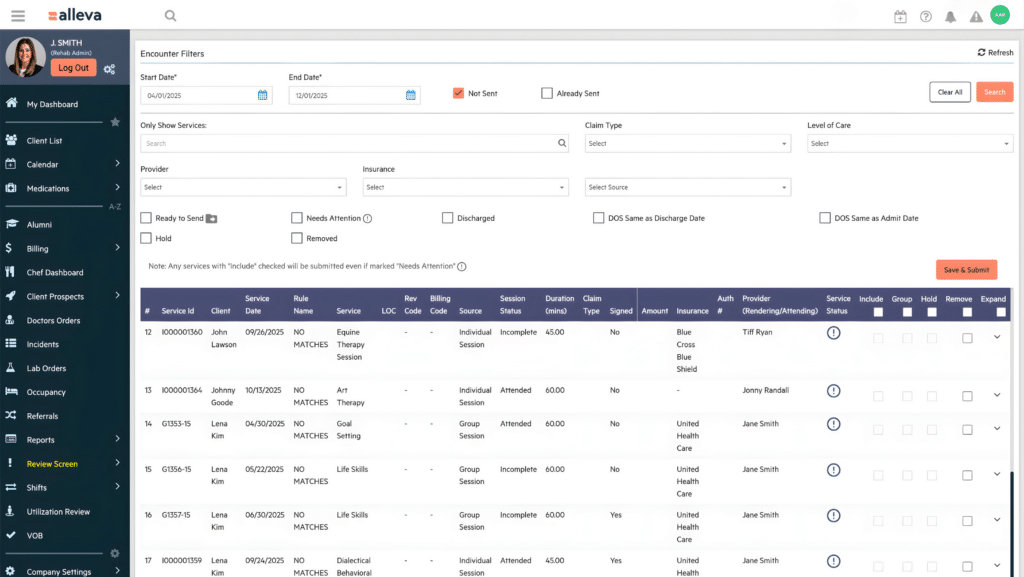
Core EMR functions and behavioral health features
Core clinical and operational functions standardize documentation, orders, medications, scheduling, patient access, billing, and analytics. The point is to free clinicians from system-toggling so more time goes to care.
Core clinical and operational functions
- Clinical charting and visit notes
- E-prescribing and computerized provider order entry (CPOE)
- Medication interaction checks and problem lists
- Care plans, scheduling, and patient portal access
- Billing integration and reporting
Getting these right reduces errors, speeds claims submission, and improves audit readiness.
Behavioral health specialty features
Behavioral health workflows need features tuned to multidisciplinary teams, group modalities, and regulatory forms. The following table shows the gap between generic EMRs and purpose-built behavioral health platforms:
| Feature | Generic EMR | Behavioral Health EMR | Why It Matters |
|---|---|---|---|
| Progress note templates | Generic visit notes | Modality-specific (CBT, DBT, MAT) | Cuts documentation time |
| Group therapy scheduling | Limited or manual | Built-in with attendance tracking | Critical for IOP and PHP programs |
| 42 CFR Part 2 compliance | Not native | Segregated SUD records, single-consent | Federal SUD privacy law |
| ASAM Criteria support | Not supported | Native ASAM 4th Edition decision logic | Level-of-care decisions |
| Validated assessments | Variable | PHQ-9, GAD-7, AUDIT, ASAM | Outcome and quality tracking |
| State reporting forms | Generic | State-specific BH and SUD forms | Accreditation and licensure |
| Multidisciplinary care plans | Single-provider | Treatment team workflows | Coordinated care |
These specialty features help you document treatment accurately, support CARF and Joint Commission accreditation readiness, and avoid rekeying data across systems.
Interoperability: how EMRs exchange data
EMRs exchange data through standards including FHIR, HL7v2, CCD or CCDA, and direct APIs. Mapping which standards your partners use, then testing end-to-end, keeps clinical workflows consistent.
Confirm supported standards
Confirm vendor support for FHIR R4, HL7v2, and CCD or CCDA. FHIR is the modern API-first standard documented in the HL7 FHIR specification. Ask which FHIR resource versions they implement and which HL7v2 triggers they support.
Test realistic exchange scenarios
Run end-to-end tests for referrals, medication history, and lab results to find mapping mismatches early. Use test data that reflects behavioral health workflows, for example consent-limited records or court-mandated treatment notes.
Make sure clinical codes translate cleanly. LOINC, SNOMED CT, RxNorm, and ICD-10 should all map without losing context.
Verify portability and contractual controls
Request documented export formats, a representative sample extract, and timelines for bulk export and ongoing feeds. Include written export and import specifications and SLA language in contracts to protect operational continuity.
A clear, tested data exchange plan prevents surprises during go-live. It also makes it easier to keep multidisciplinary teams aligned when moving patient records between systems.
42 CFR Part 2 and behavioral health EMR requirements (the 2024 final rule)
The 42 CFR Part 2 final rule was published by SAMHSA and HHS in February 2024, with full compliance required by February 2026. It reshaped how behavioral health EMRs must handle substance use disorder (SUD) records. This is the most consequential federal SUD privacy update in decades, and most generic EMR comparisons miss it entirely.
What changed in the 2024 final rule
The rule aligns 42 CFR Part 2 more closely with HIPAA while preserving heightened SUD-specific protections. Key changes affect EMR design directly:
- Single patient consent for treatment, payment, and healthcare operations (TPO). Previously, patients had to sign repeated consents for each redisclosure. Under the new rule, one consent can cover ongoing TPO uses. The EMR must still keep tracked consent records.
- Aligned breach notification. Part 2 breach notification now mirrors HIPAA’s Breach Notification Rule, which means your EMR’s audit and incident workflows must support both standards in parallel.
- Patient right of access. Patients now have a HIPAA-style right of access to Part 2 records, requiring portal features that distinguish Part 2 records from general PHI.
- Restrictions on use in legal proceedings. SUD records remain protected from use in civil, criminal, administrative, or legislative proceedings without specific patient authorization.
- Penalties aligned with HIPAA. Violations can now carry HIPAA-level civil and criminal penalties, raising the stakes for any system handling Part 2 data.
What your EMR must support
For a behavioral health EMR to handle Part 2 records compliantly under the new rule, it should provide:
- Segregated SUD record storage with role-based access flags
- Tracked, dated patient consent records with revocation workflows
- Breach detection that tags Part 2 disclosures separately from general PHI
- Patient portal access controls that respect Part 2 versus HIPAA distinctions
- Audit logs that capture consent status at the time of every disclosure
- Re-disclosure notices that travel with exported records
If your current EMR was built before 2024 and has not been updated, it is unlikely to handle the new consent and breach workflows natively. Ask vendors directly which Part 2 features were added in 2024 or 2025, and how they are preparing for the February 2026 deadline.
Why this matters for vendor selection
Generic EMRs often treat 42 CFR Part 2 as an afterthought, leaving compliance to manual workarounds. A purpose-built behavioral health EMR integrates Part 2 controls directly into clinical workflows.
Segregated records, consent capture, and disclosure tracking happen inside the system rather than on a side spreadsheet. That reduces compliance exposure and audit prep time materially.
For more on the broader compliance landscape, see this overview of daily compliance in behavioral health.
Security, privacy, and compliance controls
Behavioral health EMRs require strict security, privacy, and compliance controls. Strong controls reduce the risk of PHI breaches, protect patient confidentiality, and support uninterrupted care.
HIPAA, HITECH, and Part 2 essentials
HIPAA requires risk assessments, policies, training, and breach reporting. HITECH adds breach notification timing and penalty enforcement. The 42 CFR Part 2 final rule layers SUD-specific consent, redisclosure, and segregation requirements on top.
Together, these create a repeatable compliance foundation for accreditation, state licensure, and federal audits. HHS publishes the Security Rule requirements that vendors and providers must follow.
Business associate agreements
Use BAAs to assign responsibilities, confirm breach notification obligations, define indemnity, and require secure data return or destruction. For Part 2 records, the BAA should also specify how Part 2 redisclosure restrictions flow through to subcontractors.
Core technical controls
Deploy encryption in transit and at rest, enforce role-based access controls and multifactor authentication, and maintain immutable audit logs for forensic readiness. Behavioral health records can carry extra stigma and now extra federal penalty exposure, so treat access and disclosure rules with heightened care.
For a deeper walkthrough, see this overview of why privacy matters in behavioral health EMR systems and a checklist of common HIPAA violations to avoid.
How EMRs improve efficiency and reduce errors
EMRs can improve efficiency and reduce medical errors when documentation, prescribing, billing, and reporting live in a single system. Real gains depend on workflow design, training, and template quality, not the software alone.
Charting and billing impacts
Charting templates and structured notes reduce duplicate entry and let billing workflows start sooner. That improves revenue-cycle velocity, may lower denials, and returns time to clinicians for direct care.
Safety and error reduction
Built-in clinical decision support and e-prescribing alerts can catch transcription and medication errors and help standardize care across multidisciplinary teams. Configurable alerts let you enforce behavioral-health dosing and documentation rules without adding noise.
Reporting and population health
Structured data speeds regulatory reporting and population-health queries, which improves follow-up, audit readiness, and operational visibility. Get workflows and training right to turn these capabilities into measurable time savings.
For a closer look at clinical impact, review how EMRs improve client care.
Common operational and clinical risks
Behavioral health EMRs present operational and clinical risks. Recognizing them up front lets you negotiate protections into the contract before any signatures.
Operational risks are business risks
Require uptime SLAs, failover and backup plans, and routine integration tests to protect revenue and continuity. A vendor outage is not just an inconvenience; it disrupts admissions, blocks billing, and compromises clinical visibility.
Clinical safety depends on staff behavior
Enforce concise note templates, scheduled chart audits, and training to reduce alert fatigue and copy-paste errors. Templates that are too rigid push clinicians to copy-paste, while templates that are too loose lose audit value.
Contract terms matter
Negotiate exportable formats, set export timelines, add indemnity limits, and build a documented exit playbook with a budgeted migration window. A small amount of preparation now prevents large headaches during a vendor change.
For a quick operational checklist, implement SLAs with penalties, run regular data export tests, formalize documentation policies, and include clear exit and indemnity clauses.
Integrated billing and RCM
Integrated EMR-driven billing and revenue cycle management (RCM) automates claim generation, eligibility checks, charge capture, accounts-receivable workflows, and reconciliation. Claims move from the visit note to the payer with fewer manual handoffs.
How integrated billing works
Clinical documentation maps to charge capture so encounters generate coded claims automatically. Eligibility checks run at scheduling. Claims submit through the clearinghouse, AR queues route denials for follow-up, and daily reconciliation matches payments to claims to close the loop.
Benefits of tight integration
- Fewer manual coding errors and faster collections
- Clearer revenue visibility and simplified audit readiness for multidisciplinary teams
- Reduced administrative work across admissions, clinical, and billing workflows
Key considerations
Validate clearinghouse connections, payer rules for behavioral health, specialty CPT and HCPCS modifiers, and configurable denial workflows before go-live. Test behavioral-health-specific workflows and run parallel claims for a short period to catch edge cases.
For more on why this matters, see this overview of built-in billing in your behavioral health EMR and the verification of benefits process explained.
AI-assisted documentation in modern behavioral health EMRs
A growing share of behavioral health EMRs released or updated in 2024-2026 include AI-assisted documentation, ambient scribing, or summary generation. Clinicians evaluating new platforms should understand what these tools actually do and where they fall short.
What AI features typically include
- Ambient documentation: Audio captured during a session is transcribed and structured into a draft progress note for clinician review.
- Note summarization: AI condenses long encounter histories into a one-paragraph context block for the next clinician on the case.
- Treatment plan suggestions: Pattern-matched goals and interventions based on diagnosis, ASAM level, and prior outcomes, always reviewed and edited by the clinician.
- Documentation gap detection: Flags missing required fields before sign-off, including consent, medication reconciliation, and suicide risk assessment.
What to verify before adopting AI features
- The vendor’s BAA covers AI processing and training data use
- AI-generated content is clearly marked as draft until clinician review
- No PHI is used for cross-customer model training without explicit consent
- Patient consent language reflects AI use where required by state law
For a broader view of how AI fits into clinical workflows, see the role of AI in behavioral health and how AI supports the human touch in behavioral health.
Vendor stability and the EMR consolidation risk
The behavioral health EMR market saw significant consolidation in 2024-2026, with private equity-backed roll-ups and discontinued product lines reshaping the buyer landscape. Vendor stability has become a real evaluation criterion, not just a footnote.
What to ask about vendor health
- Ownership history and any private equity transactions in the last three years
- Customer churn rate (request a number, not a marketing line)
- Public product roadmap with delivered milestones, not just future promises
- Engineering and support headcount trends
- Any sunset notices for products in your category
Why this matters for behavioral health specifically
Behavioral health programs run on tight margins and depend on continuous clinical documentation. A surprise EMR sunset or forced migration can stall admissions, block billing, and force expensive emergency conversions.
A purpose-built, well-funded vendor with a clear behavioral health roadmap reduces this exposure. For a deeper analysis, see this perspective on the hidden cost of EMR vendor consolidation.
How to choose an EMR: a practical selection checklist
A behavioral health EMR should support clinical documentation, streamline operations, and manage billing in one connected workflow. Map your needs into a focused checklist before sitting through a single demo.
1. Needs analysis (specialty workflows)
Identify the behavioral health workflows you rely on most. Prioritize intake, multidisciplinary treatment plans, progress notes, group therapy tracking, and the billing triggers that affect revenue.
2. Deployment model
Choose cloud, on-premise, or dedicated hosted based on IT resources, desired control, and expected uptime. Use the comparison table earlier in this guide as a starting frame.
3. Interoperability and APIs
Require FHIR R4 and HL7v2 support plus sandbox access so integrations with labs, payers, and analytics are testable before signing.
4. Security, BAA, and Part 2
Confirm HIPAA controls, audit logs, role-based access, a signed BAA, and explicit 42 CFR Part 2 final rule support before exchanging any PHI.
5. Pricing and SLA
Ask for total cost of ownership, implementation fees, training costs, and a minimum uptime SLA with remedies, not just a marketing claim.
6. Implementation and training timeline
Set measurable milestones for data migration, pilot users, and staff training. Track progress against the timeline so adoption is visible to leadership.
7. Reporting, multi-site, mobile, and offline
Verify built-in analytics, role-based views across sites, and mobile access that works in low-connectivity settings for clinicians in the field.
8. Sample contract clauses to review
- Data ownership and portability
- Termination and exit assistance
- Liability caps and indemnity
- SLA remedies and uptime credits
9. Vendor demo evaluation script
Require vendors to perform three timed tasks while you observe: document an intake, enter a session note, and submit a billing claim. Polished slides hide friction; live tasks reveal it.
10. Usability test with real clinicians
Have three clinicians run the demo script, score clicks and time, capture qualitative pain points, and demand vendor follow-up on fixes. Pre-purchase usability testing prevents post-purchase regret.
Training, adoption, and change management
Behavioral health EMRs reduce administrative burden when training matches actual roles. Generic, one-size-fits-all training is the most common reason adoption stalls in the first 90 days.
Train by role
Train clinicians on the templates and flows they will actually use, not the full feature catalog. Role-specific training lowers cognitive load and shortens time to competency for nurses, therapists, prescribers, and admin staff.
Identify super-users and champions
Super-users field questions, provide peer coaching, and accelerate troubleshooting. They shorten feedback loops and keep training practical, especially in week two when initial enthusiasm wears off.
Phased rollout with clear milestones
Pilot in a single unit for four to eight weeks, collect feedback, then expand in waves while refining workflows and templates. Phased rollout makes problems small and fixable instead of system-wide.
Measure adoption and protect productivity
Track logins, chart-completion rates, and task turnaround to spot adoption gaps early. Reduce short-term productivity dips with shadowing, protected documentation time, quick-reference guides, and rapid-response support.
For more on transition planning, see this guide to migrating your EMR successfully.
Data ownership and vendor exit planning
Data ownership determines who controls patient records. Patients retain access rights under HIPAA. Providers usually remain the record custodians, while vendors hold a license to host or process data.
For organizations evaluating a behavioral health platform, include explicit contract clauses that preserve patient access and clinical continuity. HHS publishes federal guidance on individual access to medical records that is worth reading before any contract negotiation.
Key contract clauses to insist on
- Ownership and access: State that the provider owns or controls all clinical data and that patients retain HIPAA access rights.
- Export guarantees: Require machine-readable exports such as FHIR JSON, HL7v2, and CSV.
- Retention and escrow: Define how long exports are retained and when escrowed snapshots are provided.
- Termination SLAs: Specify staged handover, technical assistance, and remedies for missed deadlines.
- Cost allocation: Clarify who pays extraction, mapping, and integration fees.
Practical safeguards
- Automated nightly backups and verified restores
- Vendor-held escrow of the latest full export
- Staged handover with at least 90 days of technical assistance
- Audit-readiness records to support CARF or Joint Commission review
Plan for the messy parts now so you are not negotiating data handoffs while a caseload waits for access. Keeping exports current makes any future migration less stressful and keeps patient care uninterrupted.
Pricing models, ROI expectations, and SLAs to request
Behavioral health operations software comes in three common pricing patterns: subscription SaaS (per-user or per-location), perpetual license, and hybrid module-based billing. Subscription SaaS typically reduces upfront costs and shifts spending to predictable operating expenses.
Implementation costs
Implementation typically covers software configuration, data migration and interface builds, training, workflow redesign, and ongoing optimization. These line items are where most projects exceed budget if not scoped tightly.
Get training and configuration right up front to reduce clinician frustration and speed time to value. The hidden costs are almost always in change management, not licensing.
ROI timeline
Smaller practices often recover cost faster due to simpler workflows and fewer integrations. Larger systems typically require phased rollouts and more complex billing logic, which extends timelines.
Track these KPIs to quantify ROI:
- Days in accounts receivable (AR)
- Claim denial rate
- Revenue per visit
- Documentation time per encounter
Measure monthly and adjust vendor deliverables or internal staffing to protect projected returns.
SLA items to negotiate
- Uptime guarantee with measurable remedies for misses
- Tiered response times: critical, high, normal, each defined in hours
- Scheduled maintenance windows with at least 72-hour notice
- Data export and portability clauses with clear formats and timelines
- Financial credits for missed SLAs
- Security incident reporting timelines and evidence of annual penetration testing
Practical negotiation tips
Ask for a pilot or phased pricing model and cap implementation change orders. Require a rollback and exit plan that specifies data handover formats. Tie a portion of fees to performance milestones and SLA credits.
For small practices, push for per-user caps. For larger groups, secure volume discounts and multi-year price protections. The goal is firm SLA language and measurable KPIs that protect revenue and clinician time.
Integrations, migration, and telehealth support
Behavioral health EMRs require well-tested integrations and migration support. Coverage should include telehealth platforms, labs, pharmacies, payment processors, and analytics, all connected through standard, testable interfaces.
Common technical patterns
- SIP or WebRTC for real-time telehealth visits
- HL7v2 and FHIR for clinical data exchange
- PCI-compliant gateways for payments
- Secure ETL pipelines for analytics and reporting
Migration and offline resilience
Migrations succeed with clear mapping dictionaries, vendor migration utilities, iterative testing, and reconciliation to source records. Mobile apps need native offline workflows, local caching, encrypted sync, and lightweight templates so clinicians can chart reliably without constant connectivity.
For a closer look at telehealth scaling, see what 30 million minutes of Alleva telehealth experience taught the team.
How consultants and specialty advisors support EMR selection
You should design operations before locking in an EMR. Consultants, compliance advisors, and specialty vendors translate multidisciplinary care paths into EMR requirements and reveal gaps between clinical practice and billing or accreditation rules.
Mapping multidisciplinary workflows
Document team roles, handoffs, decision points, and documentation touchpoints so the EMR mirrors real work. Map intake to clinical triage, care coordination, and discharge notes to reduce duplicate entry across the workflow.
Audit readiness
Consultants align policies, templates, and audit trails with accreditation checklists to reduce risk and manual rework. The CARF standards framework is commonly used to align records and policies for accreditation reviews.
Designing billing and program-specific rules
Advisors build authorization logic, payer rules, and billing workflows tailored to addiction and mental health services. That reduces denials and speeds revenue, while highlighting configuration choices that determine user adoption.
For more on operational task management within EMRs, see eight strategies to optimize task management in substance abuse clinics.
Frequently asked questions about EMR types and behavioral health
What are the main types of EMR systems and which fits a small behavioral health clinic?
Main deployment types include cloud or SaaS (vendor-hosted, web access), on-premise (installed and managed by your IT), and hosted or managed (a vendor or third-party runs an installation for you). Specialty systems are tailored for behavioral health with features such as progress-note templates, group-therapy scheduling, state regulatory forms, and outcomes tracking.
Small behavioral health clinics commonly choose cloud or SaaS. Subscription pricing, faster deployment, and vendor patching reduce upfront IT burden while still delivering specialty workflows.
How is an EMR different from an EHR and why does it matter for data sharing?
An EMR is a digital record of care generated within a single practice. It focuses on documentation and internal workflows. An EHR is designed to aggregate and share patient information across organizations for continuity of care.
The difference matters because an EHR typically supports broader exchange standards needed for referrals, care coordination, and population reporting. An EMR may need vendor modules or APIs to accomplish the same sharing.
What core functions should I expect from an EMR used in mental health or addiction treatment?
Expect standard clinical functions: visit notes and problem lists, scheduling, e-prescribing, medication interaction checks, billing and RCM integration, reporting, and patient portal access. Behavioral health specifics include structured progress-note templates, validated assessments (PHQ-9, GAD-7, ASAM), group session scheduling and attendance tracking, multidisciplinary care plans, state or payer authorization forms, and measurable outcomes dashboards that support accreditation workflows.
What security and compliance features must an EMR include to meet HIPAA, HITECH, and 42 CFR Part 2?
At minimum, the EMR must support a signed business associate agreement, encryption in transit and at rest, role-based access controls, complete audit logs, breach notification procedures, and routine backups. For 42 CFR Part 2, it should also support segregated SUD records, single-consent TPO disclosures, redisclosure prohibition notices on exports, and patient access workflows that distinguish Part 2 records from general PHI.
How can we minimize downtime and ensure business continuity with a cloud EMR?
Require clear SLAs that define uptime targets, scheduled maintenance windows, and remedies for missed targets. Confirm redundant infrastructure, automated backups, and documented recovery time objectives. Test failover and offline workflows for critical activities like scheduling and medication lists, and maintain export routines so clinicians can continue care during outages.
Who owns patient data in an EMR and what happens to records if we leave the vendor?
Clinics retain legal responsibility for patient records. Vendor contracts grant a license to host or process data but do not transfer ownership.
Contracts should specify export formats (FHIR, HL7, CSV), export timelines, fees, and a data-escrow or migration assistance clause so you can retrieve records in a usable form. Plan and budget for extraction, mapping, and validation costs well before any potential exit.
Compare EMR deployment models for your organization
Choosing an EMR is a multi-year operational decision, not a software purchase. The right system supports clinical workflows, satisfies federal SUD privacy rules, integrates billing without manual handoffs, and survives industry consolidation.
The wrong one creates documentation backlogs, audit exposure, and surprise migration projects. If you want a hands-on comparison against your current workflows, request a demo of Alleva’s behavioral health platform. You can see how cloud deployment, ASAM 4th Edition decision logic, 42 CFR Part 2 controls, and integrated billing fit into one connected system.
The team can also walk through implementation timelines and exit-planning clauses so you know exactly what you are signing.