

Behavioral health insurance billing software turns therapy, psychiatry, and treatment-program services into paid claims by connecting eligibility checks, authorizations, coding, claim submission, and denial follow-up. The best fit depends on how you bill: treatment centers usually want billing built into a behavioral health EMR, while small practices often do fine with a practice-management tool or an outsourced billing service.
TL;DR: Treatment centers should shortlist software that ties insurance billing to the clinical record. Solo and small practices can start with simpler tools or add a billing service.
Key Takeaways
- If you run IOP, PHP, residential, or several sites, choose a behavioral health EMR with built-in insurance billing, such as Alleva.
- If you’re a solo clinician or small group, SimplePractice or Ensora Mental Health covers everyday insurance claims.
- If you’d rather hand off claims work, look at vendors that pair their software with billing or RCM services, such as DrChrono or Osmind.
- Must-haves: authorization tracking, claim scrubbing, group and time-based billing, ERA auto-posting, and 42 CFR Part 2 handling.
- Price the full year: implementation, clearinghouse, and per-claim fees change the total more than the subscription does.
What is behavioral health insurance billing?
Behavioral health insurance billing covers everything between a client’s first call and the payer’s final payment: verifying benefits, securing authorizations, coding encounters with CPT/HCPCS and ICD-10, submitting electronic claims (837), posting electronic remittance advice (835 ERA), and working denials.
It differs from general medical billing in four places:
- Authorizations are often short and session-limited, so they lapse mid-treatment.
- Group and time-based services need attendee records and minute-based unit math.
- Level-of-care billing for intensive outpatient (IOP), partial hospitalization (PHP), and residential care can mean institutional claims (UB-04 / 837I) alongside professional claims (CMS-1500 / 837P).
- Substance use disorder (SUD) records carry extra confidentiality rules under 42 CFR Part 2.

7 best behavioral health insurance billing software and services at a glance
| Software | Best for | Billing model | Pricing |
|---|---|---|---|
| Alleva | Behavioral health treatment centers | All-in-one EMR/EHR with integrated billing | Custom quote |
| Osmind | Interventional psychiatry practices | Psychiatry EHR with billing services | Quote-based |
| DrChrono | Practices that want software plus RCM services | EHR with optional full-service RCM | Quote-based |
| ICANotes | Fast, template-driven documentation | Behavioral health EHR with billing and RCM | Varies by plan |
| SimplePractice | Solo mental health practitioners | Practice management with insurance billing | Tiered plans |
| Ensora Mental Health (formerly TheraNest) | Therapy groups and nonprofits | Practice management with electronic claims | Scales with client volume |
| Tebra | Independent practices wanting growth tools | EHR+ with billing and claims management | Bundled plans |
1. Alleva: Best for behavioral health treatment centers
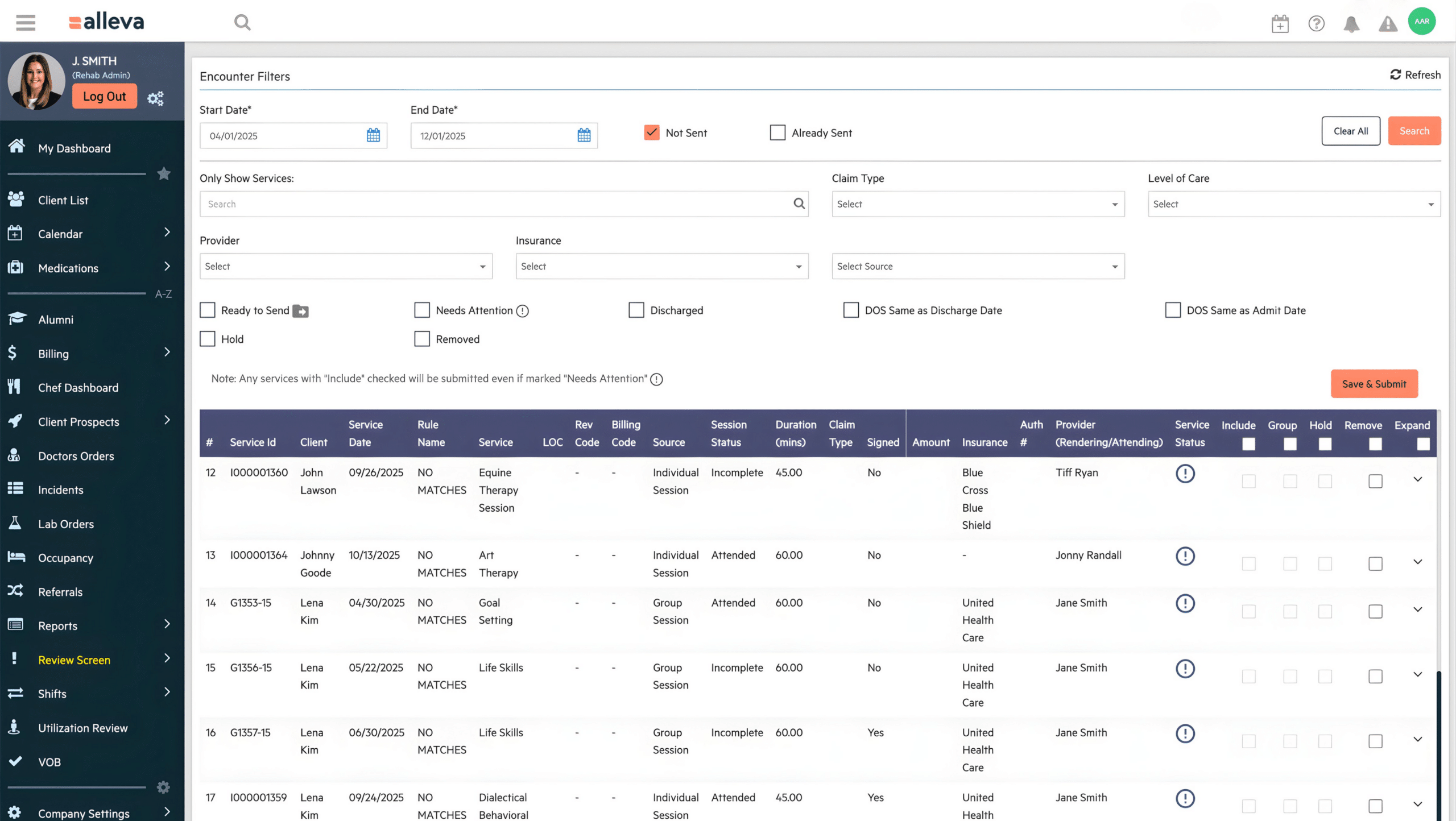
Alleva is an all-in-one EMR/EHR built exclusively for behavioral health and addiction treatment programs, with insurance billing connected to the clinical record from intake to payment. It’s designed for treatment centers running IOP, PHP, residential, and detox programs, from a single site to a multi-location organization.
Insurance billing capabilities:
- Self-service eligibility checks with integrated VOB powered by Waystar
- Waystar clearinghouse integration for claim submission
- Custom billing rules per payer and program, with automated claim scrubbing
- Pre-submission review in the Encounter Transmission Table
- Prior authorization tracking with alerts and status logs
- Group therapy billing, live claim status tracking, and ERA auto-posting
- Denial management and appeals
Pros
- Built only for behavioral health, so level-of-care workflows aren’t retrofitted
- Clinical documentation, compliance (InCheck), and billing share one record
- HIPAA-compliant ambient AI (Echo) supports documentation upstream of the claim
Cons
- Not designed for solo practitioners or non-behavioral-health specialties
- Implementation takes real setup time from your billing and clinical leads
Pricing: Custom quote. Book a demo to see insurance billing with your own programs and payers.
2. Osmind: Best for interventional psychiatry practices
Osmind is a psychiatry-specific EHR built by psychiatrists for medication management and interventional treatments such as TMS, ketamine, and SPRAVATO®, with billing services available.
Key features: mobile e-prescribing with PDMP access · patient engagement and outcomes app · billing services for interventional psychiatry
Pros: built around psychiatric workflows; billing services available for complex interventional claims
Cons: full-service tiers add cost; less suited to therapy-only or residential programs
Pricing: Quote-based
3. DrChrono: Best for practices that want software plus RCM services
DrChrono is an EHR and medical billing platform that combines scheduling, charting, telehealth, and revenue cycle management (RCM) in a mobile-first system, with full-service RCM as an option.
Key features: iPad and iPhone charting · behavioral health forms such as PHQ-9 · optional full-service RCM
Pros: software and billing service from one vendor; mobile charting
Cons: not built specifically for behavioral health programs; pricing only by quote
Pricing: Quote-based
4. ICANotes: Best for fast, template-driven documentation
ICANotes is a behavioral health EHR for mental health clinicians, designed around menu-driven charting, with billing and RCM support.
Key features: e-prescribing with automatic coding · telehealth and patient portal · billing and revenue cycle management
Pros: fast note completion feeds coding; serves prescribers and therapists
Cons: templated notes can read alike; learning curve at first
Pricing: Varies by plan
5. SimplePractice: Best for solo mental health practitioners
SimplePractice is a practice-management and EHR platform for therapists and wellness professionals, with insurance claims, telehealth, and a client portal.
Key features: insurance claims and ERA receipt · insurance and credentialing tools · telehealth and client portal
Pros: easy to learn; fast setup for small teams
Cons: limited multi-site and per-program billing controls; add-ons raise the price
Pricing: Tiered plans
6. Ensora Mental Health (formerly TheraNest): Best for therapy groups and nonprofits
Ensora Mental Health, formerly TheraNest, is practice-management software for therapists, counselors, and social workers, scaling from solo practices to large clinics and nonprofits.
Key features: electronic claims and superbills · supervisor review and co-sign · client portal with intake forms
Pros: group and supervisor tools; plans scale with caseload
Cons: therapy-first, with limited medication management; cost rises with active clients
Pricing: Scales with client volume
7. Tebra: Best for independent practices wanting growth tools
Tebra, formed from Kareo and PatientPop, is an EHR+ platform for independent practices that connects charting, insurance billing, scheduling, and practice marketing.
Key features: integrated billing and claims management · reputation and marketing tools · telehealth and e-labs
Pros: marketing tools in the same platform; bundled pricing
Cons: not specialized for behavioral health
Pricing: Bundled plans
How we chose these behavioral health insurance billing options
We compared vendors using their public product pages and documentation, judged against what behavioral health programs need from insurance billing. Alleva publishes this guide and lists its own product first; we’ve said so here so you can weigh it accordingly.
The criteria we used:
- Behavioral-health-specific billing (authorizations, group and time-based services, level-of-care claims)
- Connection between clinical documentation and claims
- Availability of billing or RCM services alongside the software
- Clearinghouse, ERA, and integration support
- Compliance and security posture
- Implementation support and pricing transparency
Software, billing services, or both?
| Model | How it works | Best fit | Trade-offs |
|---|---|---|---|
| Billing built into your EMR | Claims are generated from the same record clinicians document in. | IOP, PHP, residential, and multi-site programs | Bigger implementation; you staff the billing team |
| Standalone billing software | A separate billing system connected to your EHR. | Practices that like their current EHR | Two systems to reconcile; integration gaps |
| Outsourced billing services (RCM) | A billing team works claims, follow-up, and appeals for a fee. | Teams without in-house billing staff | Percentage-of-collections cost; less day-to-day control |
Many programs combine models, for example built-in billing for daily claims plus a service partner for appeals backlogs. For more on the first two, see why built-in billing beats a bolt-on.
What to look for in behavioral health insurance billing software
| Feature | Why it matters | Ask the vendor |
|---|---|---|
| Eligibility and VOB | Coverage problems caught at intake never become denials. | Can staff verify benefits inside the system? |
| Authorization tracking | Session-limited authorizations lapse mid-treatment. | How are staff alerted before an authorization expires? |
| Claim scrubbing | Front-end edits catch coding, eligibility, and format errors. | Which payer-specific edits run before a claim leaves? |
| Group and time-based billing | IOP, PHP, and group therapy need correct unit math. | Can it calculate time-based units and bill groups with more than one clinician? |
| Institutional and professional claims | Facility programs may bill UB-04 while clinicians bill CMS-1500. | Do you support both claim types for one program? |
| Telehealth POS and modifiers | Payers pair codes differently. | Who maintains telehealth rules per payer? |
| ERA and clearinghouse | Auto-posted remittances save ledger work. | Which clearinghouses do you integrate with? |
| Denial management | Behavioral health denials often need clinical or auth evidence. | Can you report denials by reason and payer and assign appeals? |
| 42 CFR Part 2 handling | SUD records need consent tracking and controlled disclosure. | How are Part 2 records tagged and kept off claims that shouldn’t carry them? |
A clear verification of benefits process prevents more denials than any later step, and days in A/R benchmarks show whether your billing is working once you’re live.
How much does behavioral health insurance billing cost?
Most vendors price by custom quote, so ask each one for a 12-month total cost of ownership.
| Cost component | What drives it |
|---|---|
| Software subscription | Modules (EMR, billing, CRM) and user count |
| Per-provider licenses | Seat pricing by tier |
| Billing service fee | Percentage of collections or a hybrid model |
| Clearinghouse and per-claim fees | Claim volume and payer mix |
| Implementation and migration | Data mapping, integrations, training |
Costs teams most often miss:
- Payer re-enrollment and credentialing gaps that hold claims
- Cleaning and mapping data before migration
- Running old and new systems in parallel during cutover
- Clearing an appeals backlog with temporary staff
How to switch insurance billing systems without losing revenue
Plan payer enrollment, EDI testing, and a parallel run before cutover. Timelines depend on your sites, programs, and payers, so ask each vendor for a dated plan built on your payer list.
- Set scope and owners for credentialing, EDI testing, training, and cutover.
- Start payer enrollment early. Gather W-9s, NPIs, taxonomy codes, and CAQH profiles; re-enroll if the billing TIN changes.
- Map your data. CPT/HCPCS, ICD-10, modifiers, place of service (POS), payers, and open authorizations. Our EMR migration plan covers the data side.
- Test EDI and run in parallel. Validate 837 and 835 files, then shadow-bill IOP units, group sessions, and bundled stays.
- Train by role: clinicians on medical-necessity documentation, billers on eligibility and appeals.
- Monitor at 30, 60, and 90 days: clean-claim rate, denial rate, first-pass acceptance, and days in A/R.
2026 rules that affect behavioral health insurance billing
Telehealth. Medicare uses POS 02 for telehealth outside the patient’s home and POS 10 for telehealth in the patient’s home. Modifier rules change by payer and year, so confirm them in CMS’s telehealth guidance and each payer’s policy. Our guide to CPT codes and telehealth billing for mental health services covers the common pairings.
Prior authorization. The CMS Interoperability and Prior Authorization final rule (CMS-0057-F) requires impacted payers, including Medicare Advantage, Medicaid, and CHIP, to issue prior authorization decisions within 72 hours for expedited requests and 7 calendar days for standard requests, starting in 2026. [Verify effective-date wording against the CMS page at publish.]
42 CFR Part 2. HHS finalized updates to the Part 2 rule in February 2024, with a compliance date of February 16, 2026, and HHS’s Office for Civil Rights now accepts complaints and breach notifications involving SUD records (HHS fact sheet). Confirm your EHR and clearinghouse can tag Part 2 records and control what goes out with claims.
Billing controls also support accreditation readiness for CARF and The Joint Commission. Compliance tracking with InCheck keeps that evidence in one place.
FAQs about behavioral health insurance billing
What is the best behavioral health insurance billing software?
It depends on how you bill. Treatment centers running IOP, PHP, or residential care usually do best with billing built into a behavioral health EMR, like Alleva. Solo practitioners often start with SimplePractice or Ensora Mental Health.
Should we buy billing software or outsource to a billing service?
Software keeps billing in-house and gives you direct control. A billing service adds staff and appeals expertise for a percentage of collections. Some programs use both.
How do you bill insurance for mental health services?
Verify eligibility, confirm any authorization, document medical necessity, code with CPT and ICD-10, apply POS and modifiers, submit through a clearinghouse, then post the ERA and work denials.
How is behavioral health billing different from medical billing?
Behavioral health adds session-limited authorizations, group and time-based units, level-of-care claims for IOP, PHP, and residential care, and Part 2 rules for SUD records.
How much do mental health billers charge?
Billing services usually charge a percentage of collections or a hybrid fee. Software vendors charge subscriptions plus implementation and transaction fees. Request quotes and compare a 12-month total.
How do IOP and PHP programs bill differently from outpatient therapy?
Facility-based IOP and PHP services may be billed on institutional claims with revenue codes, while clinician services go on professional claims. See our breakdown of CMS IOP billing guidelines.
What causes most behavioral health claim denials?
Missing or expired authorizations, CPT and ICD-10 mismatches, and documentation that doesn’t support medical necessity.
Does 42 CFR Part 2 affect billing?
Yes. Part 2 limits how SUD treatment records are used and disclosed, so billing teams need consent tracking and controls on claims and attachments.
Is behavioral health billing software HIPAA compliant?
It should be. Ask for security documentation and a Business Associate Agreement. Alleva is SOC 2 Type II, HIPAA compliant, and ONC certified, with documentation at its trust center, and signs a BAA on request.
Bring your numbers to your next billing demo
Ready to see insurance billing that starts in the clinical record instead of a spreadsheet? We’ll walk one of your real claims through Alleva, from benefits verification at intake to ERA posting, using your own programs, payers, and billing rules. Bring your days in A/R, denial rate, and payer mix, and we’ll show you exactly where Alleva fits. Less headache. More connection.
This guide is written for U.S. behavioral health operators, billing teams, and clinical leaders. Payer rules vary by state and plan, so treat specifics as starting points to confirm with your own payers. It isn’t legal or reimbursement advice.

Kayla Briones is Sr. Product Marketing Manager at Alleva.