

EMR migration for behavioral health organizations involves the planned transfer of clinical records, workflows, and integrations from one system to another, shaped by care continuity requirements, HIPAA obligations, and the complexity of behavioral health documentation that general healthcare guides rarely address.
Done well, EMR migration preserves revenue, protects audit readiness, and positions your organization to access modern tools, including ambient AI documentation, that legacy systems cannot support.
If your organization is evaluating a platform built specifically for behavioral health, schedule a demo with Alleva to see how migration support is handled end to end. For the full comparison, see our buying guide.
Key Takeaways
- EMR migration scope in behavioral health is broader than clinical data: Active medications, allergy records, consent flags, 42 CFR Part 2 protections, and billing history all require domain-specific handling before cutover.
- Three EMR migration approaches exist: Lift-and-shift (fastest, least optimization), rearchitect (full redesign, highest long-term value), and hybrid (phased, most common in multi-site behavioral health).
- Typical EMR migration timelines range from 3 to 12 months: Duration depends on organization size, number of integrations, data quality, and whether workflows are rearchitected alongside the migration.
- ROI on EMR migration is measurable: Track data reconciliation rate, claims denial rate, clinician time per note, and support ticket volume before and after go-live to quantify the operational impact of the move.
What EMR Migration Means for Behavioral Health Organizations
EMR migration in behavioral health involves moving clinical records, administrative data, and workflows from one system to another, with requirements that go well beyond general healthcare migrations. Behavioral health records include sensitive therapy notes, long-term treatment histories, and substance use documentation governed by 42 CFR Part 2.
MAT tracking and ASAM-aligned assessment data add additional layers that a general healthcare migration approach may not account for.
Providers migrate for a range of operational reasons: to consolidate intake, clinical, and billing workflows into a single platform; to reduce administrative burden on clinical staff; or to replace a vendor that no longer supports behavioral health–specific compliance requirements.
Understanding your primary driver shapes which migration approach, timeline, and governance model makes sense for your organization.
The Alleva behavioral health EMR platform is purpose-built for these workflows, not adapted from a general healthcare system, which affects how migration scoping, data mapping, and post-go-live optimization are approached.
Why Behavioral Health Migrations Carry Higher Stakes
Behavioral health records require a level of data fidelity that clinical and compliance teams must actively validate, not just assume. A medication reconciliation error, a missing consent flag, or a lost 42 CFR Part 2 restriction in the target system creates patient safety risk and potential regulatory exposure.
Billing continuity adds another layer. Claims denial rates, prior authorization workflows, and RCM logic tied to behavioral health coding are not always preserved cleanly when migrating between systems with different billing architectures. Involving your revenue cycle team early, before mapping begins, reduces the risk of revenue lag after cutover.
Benefits That Justify the Effort
EMR migration completed with proper governance and testing deliver measurable operational value. Connected workflows across admissions, clinical documentation, billing, and reporting reduce duplicate data entry and manual handoffs.
Consolidated platforms support CARF, Joint Commission, and state reporting requirements without requiring separate tools. For organizations moving to modern platforms with ambient AI scribing, documentation time can decrease substantially, freeing clinicians for direct care.
Three EMR Aigration Approaches: Lift-and-Shift, Rearchitect, and Hybrid
| Approach | Speed | Disruption | Optimization Potential | Best For |
| Lift-and-shift | Fastest | Lowest | Low: legacy workflows preserved | Small clinics, tight timelines, limited integrations |
| Rearchitect | Slowest | Highest | High: full workflow redesign | Multi-site organizations, major compliance or billing gaps |
| Hybrid (phased) | Moderate | Controlled | Moderate-to-high | Most mid-size behavioral health organizations |
Lift-and-Shift
Lift-and-shift EMR migration moves existing templates and workflows into the new system with minimal change. It is the fastest path to go-live and suits organizations with simple data structures and limited integrations. The tradeoff: you carry legacy technical debt and limited optimization potential into the new platform.
Rearchitect
Full rearchitecture EMR migration redesigns workflows alongside the data migration. Full rearchitecture delivers the highest long-term efficiency gains, standardized multidisciplinary care templates, cleaner billing logic, and compliance workflows built for the new platform. It requires more time and budget, but organizations that rearchitect report fewer workarounds and better cross-team coordination post-go-live.
Hybrid (Phased)
The hybrid approach migrates core clinical and billing functions first, then reworks high-value workflow areas in structured phases. It is the most common model for mid-size behavioral health organizations because it keeps operations continuous while delivering targeted improvements.
Organizations often migrate active client records and billing workflows in phase one, then address historical archive, reporting schemas, and integration reconfiguration in subsequent phases.
Decision Criteria
Choose based on organization size, regulatory constraints, number of integrations, and data quality. If your primary goal is to access modern documentation tools, such as ambient AI scribing, while preserving daily operations, a hybrid approach that prioritizes core clinical workflows first typically delivers the best balance of speed and value.
Planning, Governance, and Migration Team Structure
Behavioral health EMR migration requires a defined governance structure with clear roles before any data work begins. Organizations that assign explicit owners to each migration domain, clinical data, billing logic, compliance documentation, and vendor coordination, consistently experience fewer cutover surprises and faster issue resolution during hypercare.
Core Migration Team Roles
| Role | Primary Responsibility |
| Executive Sponsor | Owns funding, escalation authority, and final go/no-go decisions |
| Project Manager | Manages vendor coordination, milestone tracking, and daily delivery |
| Clinical Leads | Validate workflow design and provide clinical acceptance sign-off |
| Data Stewards | Own data quality, provenance tracking, and reconciliation sign-off |
| IT / Infosec | Manage security controls, integrations, and HIPAA compliance |
| RCM / Billing Owner | Preserve claims logic, code mappings, and revenue continuity |
| Training Lead | Design and deliver role-based training across clinical and admin teams |
| Vendor Representatives | Deliver technical migration work and escalation support |
Governance Artifacts to Create Before Migration Begins
A project charter documents scope, constraints, and organizational commitments. A milestone timeline assigns owners and deadlines to each EMR migration phase. A living risk register surfaces emerging issues early, data quality problems, integration gaps, or vendor delays, so they can be addressed before they affect the cutover window.
Executive sponsorship is not ceremonial. Migrations without active sponsor involvement tend to experience scope creep, delayed decisions, and under-resourced testing phases that create post-go-live instability.
Assessing and Mapping Your Existing Data
Behavioral health data inventory should begin with a complete catalog of clinical, administrative, and operational domains, then prioritize by regulatory risk, clinical continuity, and billing impact before any mapping work begins.
Understanding which elements to migrate actively (versus archive or retire) is one of the highest-leverage decisions in a behavioral health migration. It shapes testing scope, cutover timing, and the resources required for reconciliation.
Data Priority Classification for Behavioral Health
Migrate first (highest clinical and compliance risk):
- Active client records with current treatment plans
- Active medications, prescribing history, and allergy records
- Consent and authorization flags, including 42 CFR Part 2 restrictions
- Recent clinical encounter notes
- Open billing records and prior authorization data
Migrate in phase two (important but lower immediacy):
- Historical encounter notes from the past 24–36 months
- Resolved treatment episodes with associated billing history
- Lab results and diagnostic documentation
Archive (retain for legal access; do not need to be operationally active):
- Records older than your organization’s retention policy threshold
- Scanned documents with no active clinical use
Data Quality Assessment
Sample records across each domain to profile completeness, duplicate rates, and invalid values before mapping begins. Flag inconsistencies in coding systems, ICD, LOINC, RxNorm, early, because mapping errors discovered during testing are significantly more expensive to fix than errors caught during inventory.
Produce a source-to-target field map documenting transformation logic, code mappings, validation rules, and domain owner sign-off for each data element. The data map becomes the primary reference artifact for testing and post-cutover reconciliation.
Migrating Clinical and Administrative Data While Preserving Integrity
Clinical and administrative data migration requires a disciplined extract-transform-load (ETL) process that preserves provenance, timestamps, and consent metadata at every stage.
Extract
Capture full source records including version history, consent flags, and original timestamps. Export in lossless formats and validate extraction by comparing source row counts and checksums before proceeding to transformation.
Transform
Normalize schemas while preserving raw source values alongside mapped fields. Map local codes to standard terminologies, SNOMED CT, LOINC, ICD, using reversible mappings so original values remain accessible for audit purposes.
For behavioral health records specifically, ensure 42 CFR Part 2 consent flags are attached to each transformed record and that access restrictions are enforced in the target system from day one.
Load and Verify
Use transactional, versioned writes that retain original timestamps and generate immutable audit logs for every write operation. Implement deterministic duplicate resolution and flag uncertain matches for manual clinical review before enabling downstream systems.
Reconcile and Certify
Reconcile row counts and record-level hashes between source and target. Run targeted clinical sample validation with clinicians to confirm data fidelity across high-risk record types. Maintain discrepancy logs and require formal stakeholder sign-off before cutover.
For organizations concerned about compliance documentation after EMR migration, maintaining audit-ready records is a discipline that should be built into the new system’s workflows from go-live, not retrofitted afterward.
Ambient AI Documentation: What Migration Makes Possible
One of the most consequential benefits of migrating to a modern behavioral health EMR, and one that is frequently overlooked, is access to ambient AI documentation tools that legacy systems cannot support. For behavioral health organizations still operating on older platforms, migrating is not just a system swap. It is the entry point to a materially different documentation workflow.
Ambient AI scribing tools like Alleva’s Echo listen during clinical sessions and generate structured, audit-ready notes in real time, without the clinician needing to type, dictate, or spend post-session time on documentation.
Shorter documentation cycles reduce what might be called documentation-to-claim latency: the gap between a clinical encounter and a billable, compliant note. Reduced latency means faster claims submission, fewer denial cycles, and less clinician time on administrative tasks that do not contribute to care.
For behavioral health organizations evaluating EMR migration, this capability is worth factoring into the ROI analysis. If your current EMR does not support ambient AI scribing, every day on that platform is a day your clinical team carries a documentation burden a migration could reduce.
The role of AI in behavioral health workflows is expanding, and for most organizations, it requires a modern platform foundation to access.
What Migration-Triggered Workflow Modernization Looks Like in Practice
Migration to a platform with ambient AI documentation and integrated billing changes how clinical and revenue teams interact with the EMR on a daily basis. Clinicians spend less time on post-session documentation and more time in direct care. Billing staff receive notes that are already structured for claim generation, reducing the manual review step that creates downstream denial risk.
Organizations that plan for this workflow shift during migration, rather than discovering it after go-live, are better positioned to capture the full operational value of the move. Capturing full value means configuring AI documentation tools, building note templates, and training clinical staff on new workflows as part of the migration project, not as a separate initiative afterward.
Handling Integrations with Labs, Billing, and Third-Party Systems
Integration inventory is one of the most under-resourced phases of behavioral health EMR migrations. Every connection your current system maintains, labs, pharmacy systems, billing clearinghouses, state PDMP reporting, FHIR-based payer interfaces, requires explicit planning, testing, and cutover sequencing.
For organizations using built-in billing within their EMR, migration is an opportunity to evaluate whether separate billing tools can be consolidated into the new platform, reducing integration complexity and single points of failure.
Integration Inventory and Risk Classification
Catalog every integration by owner, data elements exchanged, frequency, and transport protocol. Tag each by risk tier: revenue impact, regulatory exposure, and clinical safety. Prioritize revenue cycle management integrations and state reporting interfaces when sequencing cutover, since disruption to either carries the highest operational consequence.
EMR Migration Plan by Interface Type
Real-time APIs require credential swaps, endpoint validation, and test environment configuration before go-live. HL7 and batch interfaces require file format validation, delivery window confirmation, and reconciliation process testing. FHIR interfaces require resource mapping confirmation and scope verification for patient and clinical data access.
Cutover Sequencing for Behavioral Health
Keep billing flows live first, then bring labs and imaging, then state reporting interfaces like PDMPs. Communicate cutover windows, expected impacts, escalation contacts, and rollback criteria to all affected teams before the cutover window opens.
Define SLA metrics, escalation paths, and real-time dashboards to monitor integration health after go-live. Automated alerts for failed deliveries and reconciliation mismatches allow issues to surface before they affect care or cash flow.
EMR Migration Testing and Validation Before Go-Live
Behavioral health EMR migration requires a structured testing program that spans unit, system, integration, performance, security, parallel run, and user acceptance testing. Define test scope, sample sizes, and acceptance criteria before any test execution begins.
EMR Migration Test Data Strategy
Use synthetic data for edge cases and scrubbed production records when real-world fidelity is required. Document data provenance and masking steps for audit readiness. For behavioral health records specifically, ensure test datasets include scenarios covering 42 CFR Part 2 record access restrictions, MAT documentation, and multi-site client records.
Acceptance Criteria and Clinical Validation
Capture pass/fail thresholds and remediation SLAs for every test type. Include multidisciplinary chart spot checks, medication reconciliation validation, and critical-path clinical scenarios with clinical leads and compliance reviewers. Formal sign-off from clinical domain owners is required before test completion.
Cutover Readiness Package
Package testing outputs into a cutover readiness checklist, a risk register, and a signed go/no-go approval. Operations leads should take formal ownership of the migration handoff based on documented test results, not verbal confirmation.
Cutover Planning, Downtime Management, and Rollback Triggers
Cutover planning should be finalized before testing begins, not after. Organizations that define rollback triggers, downtime protocols, and incident command structure in advance consistently experience more controlled go-live windows.
For most behavioral health organizations, a phased or module-by-module cutover strategy reduces disruption compared to a full big-bang switch. Preload and validate core patient, treatment, and billing data; run parallel operations during the transition window; and rehearse runbooks so that live cutover time is focused and predictable.
Cutover Approach Comparison
- Big-bang: Single switch. Expect planned downtime of a few hours to 24 hours for final data loads and reconciliation. Highest risk; requires the most rigorous pre-cutover testing.
- Phased by location or module: Limits user impact and isolates risks to specific departments or sites. Best for multi-location behavioral health organizations.
- Module-by-module: Useful when clinical and billing workflows can be decoupled and migrated on separate timelines.
Rollback Triggers
Define clear, objective triggers before go-live: confirmed data loss, patient safety incidents, or SLA breach thresholds. If a trigger fires, stop new writes and move systems to controlled read-only mode, execute a verified restore from the latest pre-cutover snapshot, and validate clinical and billing integrity before returning users to normal operations.
Incident Command and Hypercare
Assign an incident commander, clinical lead, operations lead, and communications owner before go-live. Run hypercare for at least 72 hours post-cutover with daily standups and a structured triage queue. Extend hypercare windows for large multi-site organizations or complex integration environments.
Training, Change Management, and 30–90 Day Post-Go-Live Stabilization
Role-based training should begin before go-live and continue through structured optimization sprints at 30, 60, and 90 days. Organizations that invest in superuser certification and on-floor shadow support during the first two to four weeks after go-live consistently resolve issues faster and reach stable adoption earlier.
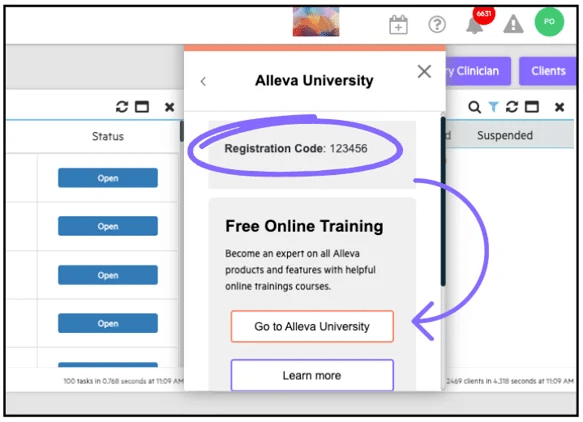
For platform training resources specific to Alleva, Alleva University provides structured training and certification content for administrators and clinical users.
Role-Based Training Design
Map clinician, intake, administrative, and billing workflows to short, scenario-driven training modules with competency checks. Keep modules under 30 minutes so clinical staff can complete them between sessions. Superuser cohorts, trained before go-live on advanced workflows and escalation paths, serve as the first line of support during the early post-go-live period.
Communication Cadence During Go-Live
Use daily pre- and post-go-live standups during the initial EMR migration transition window and weekly leadership reports thereafter. Send role-targeted communications that address one workflow change at a time to reduce cognitive load across teams managing both their clinical responsibilities and system adoption simultaneously.
30/60/90 Optimization Sprints
At 30 days, focus on resolving the top workflow bottlenecks identified during hypercare. At 60 days, assess documentation time, claims denial rates, and support ticket volume against pre-migration baselines. At 90 days, evaluate whether additional retraining or configuration changes are needed to reach full operational stability.
Security, Privacy, and Regulatory Compliance During Migration
Every data transfer during EMR migration is a potential HIPAA access event. Organizations must document controls, apply minimum necessary standards, and maintain chain-of-custody records throughout the migration process to demonstrate compliance readiness to auditors and payers.
For a practical reference on HIPAA exposure points in behavioral health operations, this overview of common HIPAA violations and how to avoid them is relevant to understanding where migration-related risk tends to surface.
Encryption and Access Controls
Encrypt data in transit and at rest throughout the EMR migration process. Require multi-factor authentication for all migration-related system access and enforce least-privilege role-based access controls so only necessary personnel can view PHI during the transfer window.
Behavioral Health–Specific Privacy Requirements
42 CFR Part 2 imposes stricter consent requirements for substance use disorder records than HIPAA alone. Verify that your destination EMR enforces 42 CFR Part 2 access restrictions natively, not through manual workarounds, before migration begins. State privacy laws may impose additional requirements beyond federal standards; confirm applicable state rules with your compliance team.
Vendor Contracts and BAAs
Require a signed business associate agreement that defines vendor responsibilities for breach response, data handling, and notification timelines. Specify uptime and incident response SLAs for the migration period. Confirm that your vendor’s SOC attestation and HIPAA compliance documentation are current before transferring PHI. Related reading: choosing your next EHR.
Legacy Retention and Audit Preparation
Define retention and secure-delete policies for legacy systems before migration begins. Retain migration artifacts, reconciliation reports, test logs, signed acceptance documents, for the duration your organization’s audit readiness policy requires. Run mock audits for Joint Commission, CARF, and state regulators before go-live to surface documentation gaps while there is still time to address them.
Estimating Costs and Timelines for Behavioral Health EMR Migrations
EMR migration costs and timelines vary significantly by organization size, data volume, number of integrations, and whether workflows are rearchitected alongside the migration. Use phased workstreams and explicit ownership assignments to keep scope and budget visible throughout the project.
Phased Timeline and Cost Drivers
| Phase | Typical Duration | Primary Cost Driver |
| Discovery | 2–6 weeks | Stakeholder time, vendor assessment |
| Data extraction | 2–8 weeks | Legacy system access, export tooling |
| Transformation | 4–12 weeks | FTEs for mapping, cleaning, and validation |
| Testing | 2–6 weeks | Clinical staff time, UAT coordination |
| Cutover | 1–7 days | Overtime staffing, rollback readiness |
| Hypercare | 2–12 weeks | On-floor support, rapid-fix capacity |
Implementation fees for behavioral health EMR platforms typically range from several thousand dollars for smaller organizations to $100,000 or more for large multi-site deployments, depending on configuration complexity and data volume. SaaS subscription costs vary by platform and user count; request a fully scoped implementation quote before comparing headline pricing.
KPIs to Track Pre- and Post-Migration
Track these metrics with a three-month pre-migration baseline, weekly during the cutover window, and monthly for six to twelve months post-go-live: data reconciliation rate, clinician time per note, claims denial rate, revenue lag (days from encounter to paid claim), and support ticket volume. Measurable ROI typically emerges between six and eighteen months, depending on revenue cycle complexity and adoption rate.
Common Pitfalls and How to Mitigate Them
Behavioral health EMR migrations fail most often for predictable, avoidable reasons. Understanding these failure modes before scoping begins is one of the highest-leverage investments a project team can make.
If your organization is evaluating whether its current EMR is still meeting operational needs, these signs that it may be time to upgrade your software provide a useful decision framework before committing to a migration project.
Common Failure Modes
- Incomplete discovery: Missing workflows, undocumented integrations, and unmapped data domains surface during testing or cutover, when they are most expensive to fix.
- Dirty or unmapped data: Duplicate records, invalid coding values, and inconsistent consent flags break clinical continuity and create billing errors in the target system.
- Missed integrations: Labs, billing clearinghouses, PDMP interfaces, and state reporting connections that were not inventoried during discovery require emergency remediation during cutover.
- Narrow testing: Test plans that cover only common scenarios miss edge cases, including the specific data patterns that break most frequently during transformation.
- Insufficient training: Clinical staff who are not confident in the new system’s workflows default to workarounds that create documentation inconsistencies and billing errors.
Mitigation Approach
Require formal gating criteria and signed acceptance at each phase boundary before the project advances. Hire migration specialists with behavioral health workflow experience, not general healthcare IT generalists.
Use automated reconciliation tools to compare source and target records rather than relying on manual spot checks alone. Build contingency reserves of 20–30% into both schedule and budget for remediation work that is almost always necessary in complex migrations.
How EMR Migration Connects to Broader Behavioral Health Operations
A well-executed EMR migration is a strategic inflection point, not a one-time IT project. Organizations that treat migration as an opportunity to align admissions, clinical, billing, and reporting workflows around a single platform gain operational advantages that compound over time.
For multi-site or private equity–backed behavioral health organizations, the strategic dimensions of EMR standardization across portfolio companies are explored in this overview of EMR’s role in private equity–owned behavioral health operations.
Admissions-to-Billing Workflow Alignment
Map intake fields to treatment plan, clinical documentation, and billing workflows before migration begins so that admission data flows directly into claims without manual re-entry. Intake-to-billing alignment reduces both administrative burden and the data fragmentation that creates billing errors and compliance exposure.
Compliance and Reporting Continuity
Consolidated records make audit trail preparation more efficient and reduce the documentation preparation time required for CARF, Joint Commission, and state reviews. Preserve documentation templates and role-based access configurations during migration to maintain audit readiness from day one in the new system.
Revenue, CRM, and Analytics Integrity
Involve RCM, CRM, and analytics teams in migration planning early to preserve code mappings, billing logic, and report schemas. Validate downstream reports with sample records before switching live systems. Historical claim linkages and referral source fields should be explicitly included in the data map, not assumed to transfer automatically.
Plan Your Migration with Alleva
Behavioral health EMR migration is a significant operational undertaking, and the right platform partner makes a measurable difference in how smoothly it goes. Alleva is built specifically for behavioral health workflows across admissions, clinical documentation, billing, and compliance, not adapted from a general healthcare system, which shapes how migration scoping, data mapping, and post-go-live support are handled.
To see how Alleva approaches migration support and to review the platform’s behavioral health–specific capabilities in practice, request a demo or call us at (877) 425-5382.
Frequently Asked Questions
How long does an EMR migration take for a behavioral health organization?
Most behavioral health migrations take 3 to 12 months from discovery through go-live, depending on organization size, number of integrations, and whether workflows are being rearchitected alongside the data migration. Multi-site organizations or projects with complex integration environments typically fall toward the longer end of that range.
What is the difference between EMR migration and data backup or archiving?
EMR migration moves active clinical and administrative records into a new operational system, with full field-level mapping, workflow configuration, and functional testing. Backup creates point-in-time recovery copies for disaster recovery purposes.
Archiving moves historical records into long-term storage for retention or legal access without preserving transactional workflows. Only migration makes records operationally active in the destination system.
Which clinical data elements should be migrated first?
Prioritize elements clinicians need in real time: active problems, current medications with prescribing history, allergy and adverse reaction records, consent and authorization flags (including 42 CFR Part 2 restrictions), and recent encounter notes. These elements carry the highest patient safety and compliance risk if lost or corrupted during migration.
How do we prove data integrity to auditors after migration?
Maintain an auditable trail that combines automated reconciliation reports, hash-based record verification, and clinician chart spot checks. Produce row-count reconciliations and field-level transformation logs. Retain chain-of-custody and access logs for all transfer windows, along with signed test and acceptance documents.
What are realistic downtime expectations during cutover?
A big-bang cutover typically requires planned downtime of a few hours to 24 hours for final data loads and reconciliation. Phased or module-based cutovers can limit downtime to specific departments or functions.
Preloading patient schedules and charts, running a final incremental sync during a data freeze window, and maintaining read-only legacy access for historical lookup keeps clinical teams operational throughout.
How do we keep clinicians productive during and after the migration?
Deploy on-floor shadow support for two to four weeks post-go-live, route issues to a triage queue with defined SLA-based resolution timelines, and update runbooks in real time as workflows stabilize. Organizations that build clinician-facing quick-reference materials before go-live, not after, consistently report faster adoption and fewer support escalations.
Harnessing the Power of Alleva in Your EMR Transition
Alleva: Your Trusted Advisor in EMR Transition
Navigating an EMR transition can be complex, but with Alleva as your trusted advisor, you have a partner every step of the way. Alleva’s expertise in the behavioral health sector means that you’re working with a team that understands your unique challenges and needs. From the initial assessment of your practice’s requirements to the final stages of implementation and training, Alleva offers guidance and support. The commitment to building a lasting relationship with your practice doesn’t end with the transition; Alleva provides continuous improvement and support to ensure that your EMR system evolves with your practice. By choosing Alleva for your EMR transition, you’re not just getting a behavioral health software solution; you’re gaining a long-term partner dedicated to enhancing the quality of care you provide and the efficiency of your operations.
A New Era of EMR with Alleva
The transition to a new EMR system with Alleva marks the beginning of a new era for your practice. Alleva’s cloud-based EMR is designed to meet the evolving demands of behavioral health care, offering a system that’s as dynamic as the field itself. With features tailored to enhance client engagement, streamline workflow, and ensure compliance, Alleva’s EMR solutions are more than just a product—they’re a pathway to transforming the way you deliver care. The commitment to innovation and user-friendly design places Alleva at the forefront of EMR technology. As your practice enters this new era, Alleva stands by your side, continuously offering the tools and support needed to navigate the ever-changing landscape of healthcare. With Alleva, you can look forward to a future where technology enables, empowers, and elevates the important work you do every day.
If you’d like to learn more about switching to Alleva, request a quick, hassle-free demo tailored to your organization.

Les Wilson is VP of Product at Alleva.