

EHR safety depends on three things working together: the technical configuration of your system, the governance and patient safety culture that wrap around it, and the workflows your clinicians use day to day. When any of those three is weak, your health information technology can shift from a safety asset to a source of risk.
Key Takeaways
- EHR safety is socio-technical, not just technical: Fixes typically require changes in people, processes, and configuration together; software alone rarely closes a safety gap.
- The SAFER Guides give you a starting blueprint: The Office of the National Coordinator (ONC) publishes eight SAFER Guides covering high-priority practices, contingency planning, CPOE, test results, and patient identification.
- Alert fatigue is the most common avoidable risk: Override rates above 80% on a given alert category signal the rule is not actionable; retire, retune, or change modality before clinicians learn to ignore the warning.
- Downtime planning is a measurable, repeatable practice: Quarterly full drills and monthly tabletops are the cadence most behavioral-health surveyors expect.
If your team is evaluating a behavioral health EMR built around these safety patterns, the platform overview is a good place to start. For the full comparison, see our buying guide.
What EHR safety means in practice
Electronic health record safety is the discipline of designing, configuring, monitoring, and governing your health information systems so technology reduces harm rather than introducing it. It covers patient outcomes, clinical data integrity, system availability, workflow fit, and access controls.
The work spans two areas. Clinical device safety addresses behavioral health software defects, interface design bugs, and incorrect clinical decision support. Socio-technical safety addresses workflow mismatch, training gaps, policy failures, safety culture, and the contract relationships your EHR vendors carry into your organization.
Behavioral health raises specific risks around documentation sensitivity, consent, and continuity of care across levels of care. For a deeper look at why privacy controls matter in this setting, see Alleva’s guide on privacy in behavioral health EMR systems.
The ONC’s SAFER Guides give you a practical starting point for self-assessment and mitigation. Getting the assessment right helps you prioritize fixes that protect both clients and staff.
How EHRs improve patient safety
A well-configured EHR can reduce preventable harm by standardizing records, automating checks, and sharing real-time data across multidisciplinary teams. The Agency for Healthcare Research and Quality has documented how computerized decision support and structured workflows can lower medication errors and adverse drug events.
Real safety gains require configuration to fit clinical workflow and ongoing attention to alert volume.
Legible documentation. Structured clinical notes remove handwriting ambiguity, so histories and orders are readable and less likely to be misinterpreted by the next clinician on the chart.
Medication reconciliation. Automated medication lists, medication alerts, and reconciliation at transitions can reduce duplicate or omitted medications, which may lower adverse events and readmissions.
Clinical decision support. Drug interaction and dosing alerts help catch incorrect prescriptions. Tuning alerts reduces unnecessary overrides without blocking care delivery.
Test-result workflows. Queued abnormal-result processes support timely follow-up on laboratory results and faster diagnosis, with documented closure built into the workflow.
Care coordination. Shared clinical data gives every team member visibility into plans and tasks. That visibility is designed to reduce missed handoffs between admissions, clinical, and billing.
Decision history and audit trails. Saved rationales and immutable logs improve continuity, support investigations, and strengthen audit readiness during CARF or Joint Commission reviews.
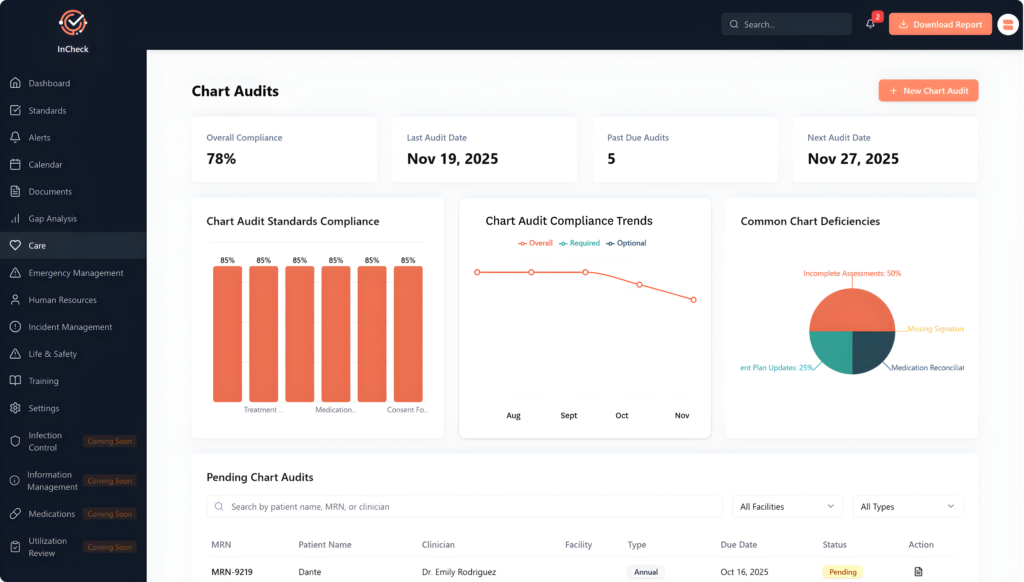
For a platform view that ties safety to admissions, billing, and compliance in one system, Alleva’s EMR consolidates those workflows.
The new patient-safety risks EHRs can introduce
The same systems that reduce harm can also create it. The Joint Commission has documented sentinel events in which health IT failures contributed to events causing death or permanent harm. These EHR safety challenges fall into three buckets your team should monitor directly.
Workflow mismatches and configuration errors. When the build does not match clinical practice, persistent workarounds appear. These workflow issues increase task time, create documentation gaps, and raise audit risk for CARF or Joint Commission reviews.
Alert fatigue and CDS problems. Too many non-actionable alerts train clinicians to override warnings. That raises error rates by increasing the chance of missing a critical warning when it actually matters.
Interoperability, mapping, and downtime. Broken interfaces, poor code mapping, and unplanned downtime can lead to lost data, delayed care, and denied claims that affect both patient safety and revenue.
The SAFER Guides and how to map them to your operations
The SAFER Guides are eight checklists published by the Office of the National Coordinator for Health IT. They help organizations reduce EHR-related safety risks, prioritize actions, and measure improvements over time.
Treat each guide as a checklist tied to priority safety activities and measurable metrics, not abstract recommendations.
What the SAFER Guides cover
The eight guides cover high-priority practices, organizational responsibilities, contingency planning, system configuration, system management, patient identification, Computerized Physician Order Entry (CPOE) with decision support, and test results reporting and follow-up. Together they form the closest thing the U.S. has to baseline Health IT Standards for safe EHR use.
How to operationalize them
Pick one guide and tie it to an active safety program. Convert checklist items into measurable tasks with owners, deadlines, and KPIs. Run small Plan-Do-Study-Act (PDSA) cycles and scale changes across sites.
A concise task template helps you assign ownership and measure outcomes more predictably. For organizations that report against the Leapfrog Health IT Safety Measure or similar external benchmarks, SAFER work feeds directly into the underlying capability score, which makes it easier to tie checklist items into your audit-readiness and compliance workflows.
Where to focus first and what to measure
Limited resources should target the issues most likely to cause harm. Score issues on risk, volume, detectability, and severity, then pick three to five high-impact targets.
For behavioral health, that usually maps to medication safety, test-result follow-up, patient identification, alert tuning, clinician communication, downtime planning, and inbox or workflow backlog. For practical metrics tied to platform features, Alleva’s top 10 features to look for in a behavioral health EMR walks through what to measure.
Core EHR safety metrics by category
| Metric | What it measures | Target / signal | Cadence |
| Alert override rate by category | % of alerts dismissed without action | >80% on a category = retire or retune | Monthly |
| Time-to-acknowledge (critical results) | Minutes from result post to clinician sign-off | <60 min for critical labs | Weekly |
| Missed or late result follow-up | % of abnormal results without documented closure at 7 days | <2% | Monthly |
| Wrong-patient retract events | Note or order moved to a different chart within 24h | Trend toward zero | Monthly |
| Downtime minutes (cumulative) | Total unplanned downtime per quarter | Aligned to vendor SLA | Quarterly |
| Inbox backlog (per clinician) | Messages open >72h | <10 per clinician | Weekly |
| Note length (avg) | Words per clinical note | Trend down over 90 days | Quarterly |
| Copy-paste rate | % of note text duplicated from prior encounter | Trend down; flag >50% | Quarterly |
Set SMART targets and feed findings into rapid PDSA cycles so data prompts action. Pulling these metrics into a single composite safety score gives your committee one number to track over time, and a steady review cadence with clear owners is designed to reduce risk and administrative churn.
Reducing alert fatigue and using CDS and CPOE safely
Alert fatigue reduces clinician attention in clinical decision support (CDS) and computerized provider order entry (CPOE). Start by inventorying and categorizing alerts, retiring low-value ones, retuning thresholds, validating rules before rollout, and governing order sets to balance safety with workflow.
For behavioral-health-specific workflows, align alerts with treatment protocols and documentation practices to reduce irrelevant interruptions.
Baseline alert inventory and categorization
List all alerts and tag each by severity, clinical impact, and owner. Focus first on alerts that affect medication safety, medication-allergy checks, suicide risk screening, and discharge orders. Those drive the largest clinical and compliance risk.
Tune, remove, and change modality
Remove low-value alerts and raise thresholds where evidence supports it. Use tiered visual cues and limit audible prompts to high-severity events. Require justification only when it demonstrably improves safety or audit readiness.
A light touch tends to preserve workflow efficiency and reduce bypass behavior. Converting a frequent interruptive drug-interaction alert into a passive notification can be appropriate when the interaction is minor and documentation shows low harm.
Validate CDS rules before deployment
Validate rules with clinical test cases and realistic test case scenarios, run them in shadow mode, and obtain clinician sign-off to catch false positives. Published medical literature on CDS has identified high override rates and usability issues as recurring problems, which is why validation and iterative tuning matter.
CPOE governance: order sets, hard stops, soft stops
Use multidisciplinary committees to govern order-set changes. Reserve hard stops for immediate, high-harm scenarios and prefer soft stops with clear next steps to keep clinicians moving.
Track who changes order sets and why. That record supports audit readiness and continuous improvement.
Improving EHR usability to reduce cognitive load and note bloat
EHR usability affects clinician cognitive load. Poorly organized records can raise information overload and error risk.
For behavioral health teams looking to simplify documentation and workflows, the signs of credible electronic health record software include consolidating clinical, compliance, and billing workflows into a single view.
Practical UI and template changes
Start with problem-list-first note templates that surface active diagnoses, current treatments, and next steps at the top of the note. Configure clinician views so the immediate problem list, safety concerns, and recent medications appear before historical or auto-populated text.
Favor structured fields for problem-based summaries and searchable tags so teams can find the right item without reading a full note.
For progress documentation, the choice between a traditional SOAP note (Subjective, Objective, Assessment, Plan) and an APSO note (Assessment and Plan first, then Subjective and Objective) matters more than it sounds. APSO surfaces the clinical decision at the top of the visual display, which most clinicians scan first.
Quick practice interventions
- Limit indiscriminate copy and paste. Train clinicians to paste only essential assessment details and use structured synopses for prior-history elements.
- Set a one-screen visit-note target. Encourage concise documentation and reduce scrolling.
- Use problem-based summaries that require confirmation. Auto-populate key fields but require clinician sign-off to avoid outdated or irrelevant text.
- Run short audits and feedback loops. Review a sample of notes weekly for length, accuracy, and actionability, then share quick tips in staff huddles.
Templates and small practice habits, applied consistently, can reduce friction, improve chart clarity, and make audits less painful.
EHR design, user interface, and human factors
EHR design is a patient-safety control in its own right, not a cosmetic concern. The way information is laid out on screen (sometimes referred to in the literature as Electronic Medical Records Interface Design) shapes how fast a clinician can spot a critical lab, an overdue medication, or a missed consent.
Strong interface design follows three human factors principles:
- Match the user’s mental model. A behavioral health intake clinician reads a chart differently than a billing analyst, so role-based views should reflect those workflows.
- Reduce visual clutter on critical paths. Surface medications, allergies, active problems, and risk flags above the fold; collapse historical sections by default.
- Make the safe action the easy action. Order sets, consent prompts, and result-acknowledgement steps should be one click from where the clinician already is.
User-centered design is the practice that operationalizes these principles. It means involving frontline clinicians early, running usability testing on candidate builds, and measuring frontline user experience after deployment. The ARCH Collaborative EHR User experience survey is one widely used instrument; tracking user experience scores quarterly gives your governance committee a signal that complements the safety score above.
Some EHR vendors pursue Usability Certification (such as the ONC SED criterion under the Promoting Interoperability program) as evidence of structured human factors work. Certification is a useful baseline, but not a substitute for ongoing usability testing in your own facility.
Planning for EHR downtime and unavailability
Behavioral health EHRs require downtime planning to prevent clinical interruptions and protect patient safety. Preparation starts with a clear risk assessment, documented offline workflows, and regular drills.
Downtime drill cadence and ownership
| Activity | Frequency | Owner | What “done” looks like |
| Tabletop exercise | Monthly | Safety officer | Scenario walkthrough + gap log |
| Full simulation drill | Quarterly | IT + clinical leadership | All sites participate; gaps closed in 30 days |
| Critical-data offline export refresh | Weekly | Clinical informatics | Medications, allergies, care plans current |
| Paper-form audit | Quarterly | Compliance | Forms current; versions match digital |
| Vendor drill (joint) | Annually | Vendor manager | SLA-aligned restoration timing verified |
| Post-downtime reconciliation | Per incident | Clinical informatics | All paper-to-EHR within 24 to 72 hours |
| Communication plan rehearsal | Semiannually | Safety committee | Templates, escalation paths confirmed |
| Logging and root-cause review | Per incident | Safety committee | Findings feed change control |
The downtime playbook in nine elements
- Risk assessment and prioritization: Map systems, rank risks, assign owners.
- Paper and alternate workflows: Role-specific forms for intake, progress notes, and billing.
- Offline access to critical data: Secure files with medications, allergies, care plans.
- Downtime drills and frequency: Quarterly full drills, monthly tabletops, treated as audits.
- Communication and escalation: Templates, single incident commander, vendor escalation paths.
- Manual orders and medication processes: Two-person checks for high-risk meds; verbal-order validation.
- Post-downtime reconciliation: Reconcile paper to EHR within 24 to 72 hours with corrective actions logged.
- SLA and vendor coordination: Defined response times, annual joint drills, shared outcomes.
- Logging, review, and system controls: Every downtime logged with timestamps, root cause, corrective actions.
Test-result follow-up, patient identification, and communication
Test-result follow-up reduces missed care. Consolidated policies for result routing, patient identification, messaging, and system governance cut failure points and improve audit readiness.
Test-results routing, escalation, and closure
Create a closed-loop policy that assigns result-review ownership, defines escalation triggers and thresholds, and requires documented closure with automated reminders. Critical results should have an explicit acknowledgement step and time-to-acknowledge SLA.
Patient-ID practices
Require two patient identifiers at every interaction and add smart prompts for mismatches. Use barcode scanning for specimens and medications to reduce identification errors. Audit and clean duplicate records on a recurring schedule.
Clinician-to-clinician and patient messaging
Define service-level agreements for urgent and routine messages. Route by role and document handoffs into the chart. Assign inbox-hygiene ownership and run periodic audits to catch backlog before it becomes a safety problem.
System management, validation, and change control
Make configuration control, API governance, and change control owned functions. Require predeployment validation testing and recurring training tied to governance metrics. That combination supports sustained safety and operational clarity.
Governance, training, and organizational responsibilities
EHR safety requires organizational governance, defined roles, and continuous training. Clear ownership reduces friction and makes safety work repeatable.
A platform that ties clinical, compliance, and operational workflows together can reduce ambiguity about who owns what.
Required governance structures
- Multidisciplinary safety committee: sets policy and prioritizes risks across EHR systems and clinical workflows.
- Clinical informatics team: translates clinical needs into configuration and EHR design.
- Change-control board: approves builds and test plans against certification standards.
- Incident review board: stewards post-incident learning and tracking.
Recommended roles
- Safety officer: owns risk metrics and remediation.
- Clinical application analysts: manage builds and user support.
- Informaticists: design safe workflows, user interface choices, and decision support.
Training and onboarding practices
- Clinician training tied to clinical workflows. Role-based curricula and scenario drills during onboarding, with quarterly refreshers.
- Structured EHR system training. Targeted education on CDS rules, medication alerts, and consent workflows to reduce alert fatigue and consent errors.
- Hands-on configuration sessions. Show how configuration choices affect day-to-day workflows and patient care.
- Ongoing EHR support and communication. Treat post-go-live questions as data: track which features generate the most tickets and feed that signal back into training content.
For platform users, Alleva University provides role-based training paths your team can build into onboarding and into any future EHR transition.
Vendor contract considerations
Your contracts with EHR vendors should make safety expectations explicit, not implied:
- SLAs for uptime, scheduled change windows, and response times.
- Vendor responsibilities for safety fixes, post-change testing, and rollback plans.
- Contract language requiring transparent post-deployment evidence of testing.
- Commitments around clinician training and EHR system training during major upgrades or any EHR transition between platforms.
Operationalizing continuous improvement
Near-real-time monitoring, root-cause analyses, and a prioritized remediation backlog should feed monthly governance reviews. Recurring incidents are signals to change governance, not just to fix the latest symptom.
The 42 CFR Part 2 Final Rule: what changed in 2026 for behavioral health EHRs
For behavioral health organizations, the most consequential 2026 development is the 42 CFR Part 2 Final Rule, which aligns substance use disorder (SUD) record confidentiality more closely with HIPAA. The compliance deadline reached on February 26, 2026. That makes this a current operational item for healthcare organizations, not a future planning item.
The rule reshapes how SUD records flow through your EHR, how consent is captured and revoked, and how audit logs need to be maintained. This is exactly the layer where socio-technical EHR safety meets behavioral health-specific regulation.
What changed at the rule level
The Final Rule permits a single patient consent for all future uses and disclosures of SUD records for treatment, payment, and health care operations (TPO). It also extends the HIPAA breach notification framework to Part 2 records and clarifies that recipients of disclosed Part 2 records must apply HIPAA-equivalent protections.
For audit and access logging, the rule strengthens patient rights to an accounting of disclosures of Part 2 records, which has direct implications for what your EHR needs to log and surface on demand.
Where most teams sit now that the deadline has passed
By May 2026, three patterns are common in behavioral health organizations. Some teams completed full re-papering and EHR reconfiguration ahead of the deadline, while others made consent-form changes but have not yet validated downstream propagation. A third group is still relying on the old segmented model and has open audit risk.
If your organization is in the second or third group, the practical first step is an internal audit against the five operational areas below, not a vendor escalation. Most issues live in workflow gaps, not platform gaps.
What this means for your EHR configuration
Five operational areas need a fresh look against the Final Rule:
- Consent capture and revocation workflows. Single-consent flows must be modeled clearly in the EHR, with revocation paths that propagate to downstream systems and partners.
- Segmentation of SUD records. Even with broader TPO permissions, sensitive segments should remain controllable by access role and disclosure purpose.
- Accounting-of-disclosures logs. Audit trails must capture every Part 2 disclosure with enough detail to respond to a patient request without manual reconstruction.
- Breach notification readiness. Workflows for breach assessment, notification, and timing should now be unified across HIPAA and Part 2 events.
- Downstream recipient agreements. Business associate and qualified service organization arrangements should reflect the new HIPAA-aligned obligations on recipients.
Why this is an EHR safety issue, not just a compliance issue
Misconfigured consent or segmentation in an EHR can produce two failure modes at once: a privacy incident (Part 2 disclosure without proper consent) and a safety incident (a clinician on a different team missing relevant SUD history because access was over-restricted). Aligning consent and segmentation to the Final Rule is therefore a patient-safety control, not just a paperwork exercise.
For behavioral health operators evaluating whether their current EHR can model the new Part 2 flows cleanly, the confidentiality and privacy controls in behavioral health EMR systems is a useful companion read. Organizations that have not yet validated their post-February-2026 build should treat this as a near-term remediation priority.
How behavioral health operations intersect with EHR safety
Behavioral health EHR safety hinges on program type, state rules, and multidisciplinary workflows. That means safety work needs to map to specific operational risks rather than one-size-fits-all checklists.
A general-purpose hospital EHR system, optimized for acute care and inpatient flow, often misses these distinctions when deployed at behavioral health care facilities. The result is a system that captures clinical data adequately but creates friction around consent, level-of-care transitions, and family or third-party communication through the patient portal.
Behavioral-health-specific safety considerations
- Sensitive documentation and partial-disclosure rules require role-based access and redaction workflows.
- Consent and status flows vary across detox, MAT (medication-assisted treatment), outpatient, and residential programs and must be modeled per program and per state law.
- Multidisciplinary notes need tagging and audit trails so care coordination does not expose private details.
Prioritizing SAFER items differently
Operational leaders in behavioral health tend to prioritize contingency planning, access controls, and audit logging more heavily than generic acute-care checklists suggest. The SAFER Guides can be adapted to behavioral-health workflows by reweighting which items get reviewed first.
Using trigger systems and automated safety surveillance
A growing number of behavioral health organizations are adopting automated safety surveillance software that watches the record for specific risk patterns in real time. These tools are built on a trigger methodology (sometimes called a trigger system) borrowed from acute-care quality improvement.
They scan documentation for combinations of events, like an overdue suicide-risk reassessment combined with a recent missed appointment, and route the case to a clinician for review.
Artificial intelligence is increasingly used inside these surveillance layers, both to score risk and to flag documentation gaps before they become audit findings. As with CDS, the value depends on rule governance and clinician trust, not on the model itself. Treat AI-driven triggers as another category of alert subject to the same inventory, validation, and override-tracking discipline.
Linking safety metrics to revenue and compliance
Track safety incidents in clinical quality dashboards and link them to billing reconciliation and compliance risk so revenue impact surfaces operationally. Event tagging can connect incidents to affected claims, payer denials, or audit flags, which can speed remediation and reduce cash-flow exposure. For more on how billing and clinical workflows interact, see Alleva’s coverage of built-in billing in your EMR.
Schedule an EHR review with Alleva
If you are evaluating whether your EHR can support the safety patterns covered here (42 CFR Part 2 alignment, consent workflows, alert governance, and downtime resilience), our team can walk you through how the platform handles each one.
Request a demo to see clinical, compliance, and billing workflows in one system built specifically for behavioral health.
Frequently asked questions about EHR safety
Here are some questions people also ask about EHR safety and electronic health records more generally:
What is EHR safety?
EHR safety is the practice of designing, configuring, and governing electronic health record systems to prevent patient harm and preserve data integrity, availability, and clinical workflow. It covers patient outcomes, access controls, audit trails, and system reliability during downtime. Because it is socio-technical, fixes typically require changes in people, processes, and technology together.
How can EHRs improve patient safety?
EHRs can reduce preventable harm through legible clinical notes, medication reconciliation, medication-allergy checks, and decision support. Structured test-result routing for laboratory tests and laboratory results, plus complete audit trails, supports the diagnostic process and patient care. These capabilities are designed to lower medication errors, speed follow-up on abnormal tests, and improve coordination, when the system is configured and governed properly.
What new patient-safety risks can EHRs introduce?
Adoption of EHRs can create new risks: alert fatigue, wrong-patient selection, excessive copy-paste and note bloat, misconfigured CDS rules, inbox overload causing missed follow-up, and interoperability or mapping errors that deliver incorrect data. These risks often arise when system configuration and local workflows are misaligned or when governance and validation are weak.
What are the SAFER Guides and which ones apply to my organization?
The SAFER Guides are eight practical checklists from the Office of the National Coordinator for Health IT. They cover high-priority practices, organizational responsibilities, contingency planning, system configuration and management, patient identification, CPOE with decision support, and test results reporting and follow-up. Most organizations should start with high-priority practices, system configuration, test results, and patient identification.
Which EHR safety areas should we prioritize first?
Prioritize by combining potential severity, event volume, and detectability. Common high-impact starting points are medication safety and CDS tuning, test-results routing and closure, reliable patient identification, alert backlog and inbox management, and contingency planning for downtime. Choose metrics that reveal volume and risk so decisions are data-driven.
How do we reduce alert fatigue and unnecessary alerts?
Begin with an alert inventory categorized by clinical severity and expected action. Retire alerts with low clinical value, change modality for lower-risk warnings, and require override justification selectively. Validate rule logic with representative test cases and clinician review, run new rules in shadow mode where possible, and monitor override rates after every change.
How should we plan for EHR downtime?
Create a documented contingency plan that lists critical systems, defines manual workflows for orders and medication administration, and specifies communications during downtime. Keep critical patient data accessible offline for high-risk areas. Run downtime drills with clinical and IT staff, log every event, reconcile orders after restoration, and include vendor SLAs and escalation paths.
How can EHR usability be improved to reduce cognitive load and note bloat?
Streamline views with problem-focused summaries, role-based displays, and note templates that emphasize assessment over narrative duplication. Limit indiscriminate copy-paste with policy and technical controls, and measure note length to track progress. Small changes (one-line problem summaries, collapse toggles, and brief documentation training) tend to yield measurable improvements over a quarter. For example, a robust psychiatry EHR might support AI session notes and automated billing reminders, removing these redundant tasks from a clinic manager’s plate.
What role do CDS and CPOE play in EHR safety?
Clinical decision support and computerized provider order entry are central safety tools when they deliver the right information to the right clinician at the right time. CDS provides situational guidance like drug-interaction checks; CPOE structures orders to reduce free-text errors. Safety requires rule governance, realistic testing, clinician sign-off, and post-deployment monitoring.
How should test results be reported and followed up safely?
Implement routing rules so critical and abnormal results reach a responsible clinician with explicit acknowledgement and documented follow-up. Use escalation workflows and time-to-acknowledge SLAs for unread results, capture closure actions in a structured field, and reconcile offline results after downtime. Ownership should be clear for each result type, and periodic audits should measure missed or late follow-ups.
How can patient identification errors be prevented?
Use two reliable patient identifiers at every handoff, enable smart prompts for name or date-of-birth mismatches, and consider barcode scanning for specimens and wristbands. Restrict free-text matching for demographic updates, audit and clean duplicate records regularly, and apply confirmation screens only when the risk is high enough to justify interrupting workflow.
What governance and organizational roles are required?
Effective governance includes a multidisciplinary safety committee that owns EHR safety metrics, a clinical informatics lead, a clinical application analyst, and a change-control board for configuration and CDS changes. A formal incident review process should analyze EHR-related safety events and translate findings into prioritized fixes. Role-based training, scenario drills, and vendor SLAs complete the operating model.
How does the 42 CFR Part 2 Final Rule affect EHR safety in behavioral health?
The Final Rule, which reached its compliance deadline on February 26, 2026, aligns SUD record confidentiality more closely with HIPAA. Key changes include single consent for treatment, payment, and operations, expanded breach notification, and stronger accounting-of-disclosures rights. Each provision has configuration implications for consent workflows, audit logs, segmentation, and recipient agreements inside the EHR.
How do we measure and track EHR safety performance?
Pick a small set of metrics tied to prioritized risks: alert override rates by category, missed or late test-result follow-ups, downtime minutes, wrong-patient selection events, medication errors, note length, and inbox backlog. Report on a defined cadence, use control charts to detect shifts, and tie metric trends to specific improvement actions.

Erica Ward is a Product Manager at Alleva.