

The right TherapyNotes alternative depends on your clinician and site count, the levels of care you deliver, and how much of your revenue cycle belongs inside the record. Solo therapists usually move to another practice-first EHR. Programs running IOP, PHP or residential care need a behavioral health EMR built for treatment programs with billing and compliance in the same workflow.
TL;DR: TherapyNotes fits solo and small outpatient practices. Once you add levels of care, sites or a billing team, compare platforms on RCM depth, compliance tooling and migration support, not on note templates.
Key Takeaways
- Match the platform to your care model: Solo and small group practices fit SimplePractice, TheraNest or Carepatron. IOP, PHP, residential and multi-location programs fit Alleva or Valant.
- Budget for more than the subscription: Ask every vendor for an itemized quote covering per-clinician fees, claim or RCM fees, migration, training and annual increases.
- Plan realistic timelines: Expect 2 to 4 weeks for a solo switch, 1 to 4 months for most groups and 4 to 6 months for multi-site rollouts.
- Get security evidence in writing: Require a signed business associate agreement (BAA), a current SOC 2 Type II report and test claims with your top payers before cutover.
- If you need EMR, billing and compliance in one system, choose a behavioral-health-specific platform. If you need low cost and simple notes, stay practice-first.
Want to see how a connected EMR, billing and compliance workflow compares with your current setup?
What Are TherapyNotes Alternatives?
TherapyNotes alternatives are electronic health record (EHR) and practice management platforms that replace TherapyNotes’ scheduling, clinical documentation, telehealth and billing workflows. They range from low-cost tools for solo therapists to connected platforms for multi-program treatment centers.
This guide covers U.S. behavioral health organizations. It’s written for executives, operations leaders, clinical leaders and revenue cycle teams choosing between EMR-only and EMR-plus-billing systems.
Why teams look beyond TherapyNotes
TherapyNotes is a solid choice for outpatient therapy practices. Teams usually start comparing alternatives for one of four reasons:
- Cost at scale: Solo pricing is $69 a month, and Group pricing is $79 a month for the first clinician plus $50 for each additional clinician, according to TherapyNotes’ published pricing.
- AI add-on cost: AI note drafting (TherapyFuel) is a separate per-clinician add-on and doesn’t cover group or couples sessions.
- Levels of care: Programs running IOP, PHP, residential or detox need workflows a therapy-practice EHR wasn’t designed around.
- Operations beyond the chart: Admissions, referral tracking, audit readiness and cross-program reporting usually live in separate tools.
Best TherapyNotes Alternatives Compared
Prices below are vendors’ published starting points as of November 2026. Confirm current pricing on each vendor’s site before you budget.
| Platform | Best for | Pricing model | Billing / RCM depth | Notes |
|---|---|---|---|---|
| Alleva | Treatment programs from single facilities to multi-location groups (IOP/OP, PHP, residential, detox) | Demo and custom quote | Built-in billing with claim submission, ERA auto-posting and eligibility checks | EMR, billing, GRC, admissions tools and AI in one platform |
| SimplePractice | Solo clinicians and telehealth-heavy private practices | Published plans, $49 to $99 a month | Insurance billing with per-claim fees | Strong client portal and scheduling; AI note taker is an add-on |
| TheraNest (Ensora Mental Health) | Small to mid-size outpatient groups | Published per-clinician plans | Built-in billing; separate RCM services available | Rebranded under Ensora Health in 2025; AI Session Assistant available |
| Valant | Outpatient behavioral health groups, including IOP and PHP | Custom quote | Integrated billing for behavioral health practices | Recently expanded to IOP and PHP care |
| Tebra (formerly Kareo) | Independent practices that put billing first | Vendor quote | Practice management and claims workflows | Kareo is now part of Tebra; less therapy-specific than practice-first EHRs |
| Jane | Multi-provider clinics that need advanced scheduling | Published plans, $54 to $99 a month (U.S.) | Confirm claim workflows in the demo | Strong calendars and group telehealth add-on |
| Carepatron | Private-pay and boutique practices | Free plan plus paid per-user tiers | Lighter insurance billing | Telehealth and client portal included on the free plan |
1. Alleva: Best for Behavioral Health Treatment Programs
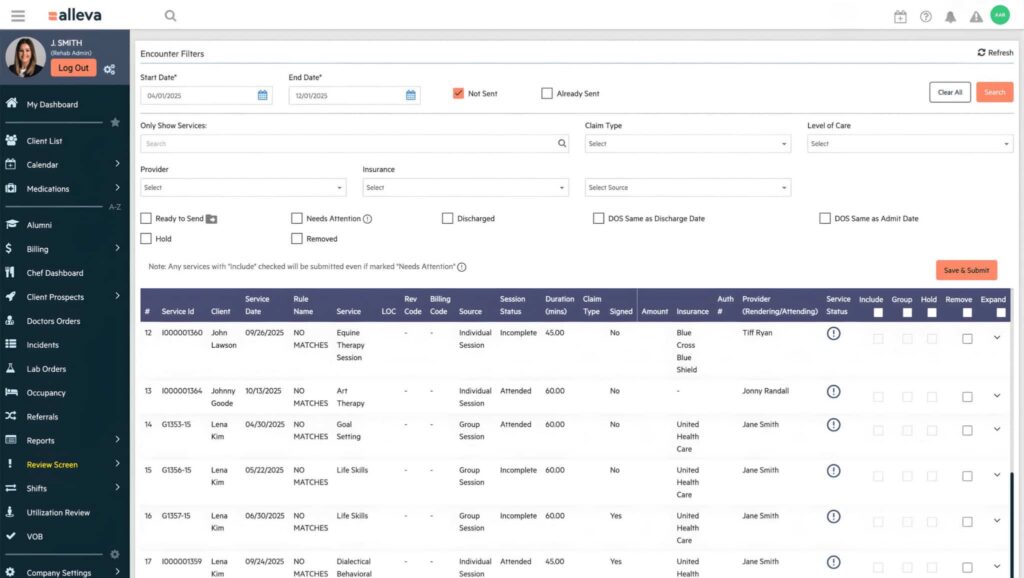
Alleva is behavioral health operations software built for treatment programs of every size, from a single startup facility to a multi-location group. It connects clinical documentation, billing, governance and compliance, admissions tracking and analytics in one platform instead of a stack of point tools.
The EMR supports IOP/OP, PHP, residential and detox programs, and telehealth is built in, so clients join video sessions without a third-party app. Group sessions automatically create each attendee’s individual note, so clinicians don’t document the same group twice. Alleva Billing covers charge capture, claim submission, ERA auto-posting and instant eligibility checks, with native Waystar clearinghouse connectivity.
Warriors Heart measured Echo, Alleva’s ambient documentation tool, over six months in 2025 against internal metrics it set at the start. Among clinicians proficient with Echo, it recorded 30% less documentation time, 25% better medical-necessity documentation, 5% fewer denied claims and 10% fewer missed charges.
How do Alleva and TherapyNotes compare?
| Attribute | Alleva | TherapyNotes |
|---|---|---|
| Best for | Treatment programs, from one facility to many | Solo therapists and small group practices |
| Levels of care | IOP/OP, PHP, residential, detox | Outpatient therapy |
| Billing | Built-in RCM with ERA auto-posting and eligibility checks | Practice-level billing and claims |
| Group documentation | Each group session creates every attendee’s individual note | Group note wizard; TherapyFuel AI excludes group sessions |
| Medication workflows | Med administration, real-time med counts, e-prescribing and lab orders through integrations | E-prescribing on its psychiatry plan |
| Compliance | InCheck chart audits flag gaps, such as a missing ROI, and open a plan of correction | Audit logs and documentation tools |
| Admissions and referrals | Lead tracking and referral management | Not a core focus |
| AI | Alleva Intelligence (TravisAI assistant, Echo ambient documentation) | TherapyFuel add-on |
| Pricing | Demo and custom quote | Published monthly plans |
Pricing: Custom quote after a demo.
Key features:
- Behavioral health EMR with treatment planning and documentation across levels of care
- Group sessions that generate each attendee’s individual note
- Medication management with nurse administration records and real-time med counts and inventory
- E-prescribing and lab orders through integrations (lab orders are optional per facility)
- Release of information (ROI) tracking in every client chart
- Built-in telehealth with one-click client access
- Billing with ERA auto-posting, eligibility verification and Waystar connectivity
- Superbills for private-pay and out-of-network clients, with or without Alleva Billing
- InCheck, Alleva’s GRC platform, for chart audits and plans of correction
- Lead tracking, referral management and communication workflows for admissions teams
- Alleva Intelligence, including the TravisAI in-app assistant and Echo ambient documentation
Pros:
- Built specifically for behavioral health, not adapted from general medical software
- Clinical, billing and compliance work share one record, which cuts handoffs
- Group notes generate automatically for each attendee, which cuts duplicate documentation
- Scales from a first facility to multi-location operations
Fit considerations:
- Built for treatment programs, so it’s more platform than a solo private-pay therapist needs
- Larger organizations should plan for structured implementation and change management
2. SimplePractice: Best for Solo and Small Private Practices
SimplePractice targets solo clinicians and small private practices with a consumer-style interface and strong client-facing tools. TherapyNotes leans more toward structured documentation, while SimplePractice puts booking, intake and telehealth first.
Pricing: Starter, Essential and Plus plans at $49, $79 and $99 a month. AI note taking is an add-on, and insurance claims carry separate fees.
Key features:
- Built-in telehealth and client portal with online booking and intake
- Scheduling with automated reminders
- Note templates and treatment plans
- Insurance billing and claim submission
- Mobile apps for clinicians and clients
Pros:
- Intuitive interface that shortens training
- Telehealth and client portal included
- Strong scheduling and intake automation
Cons:
- Costs rise as you add clinicians, claims and add-ons
- Reporting is lighter than in program-level platforms
- Not built for residential or multi-level programs
3. TheraNest (Ensora Mental Health): Best for Affordable Group Practices
TheraNest suits small to mid-size outpatient groups that want lower per-clinician costs with billing inside the EHR. Its parent company, Therapy Brands, rebranded as Ensora Health in April 2025, and you’ll see the product listed as both TheraNest and Ensora Mental Health.
Pricing: Published per-clinician plans; check Ensora’s site for current tiers.
Key features:
- Progress note templates and recurring note automation
- Built-in billing, claims and patient statements
- Scheduling with reminders and a client portal
- Telehealth and an AI Session Assistant for note drafting
Pros:
- Strong price-to-feature ratio for outpatient groups
- Built-in billing covers what many small clinics need
- Quick setup
Cons:
- Billing depth is lighter than dedicated RCM platforms
- Multi-site governance and reporting are basic
- Not designed around residential or detox workflows
4. Valant: Best for Outpatient Groups Adding IOP and PHP
Valant is a behavioral health EHR for outpatient practices that recently expanded to Intensive Outpatient (IOP) and Partial Hospitalization (PHP) programs. It fits groups that want behavioral-health-specific workflows with integrated billing.
Pricing: Custom quote.
Key features:
- Behavioral-health-specific documentation templates
- Integrated billing and reporting
- Patient engagement and portal tools
- Workflows for outpatient, IOP and PHP care
Pros:
- Built only for behavioral health
- Supports groups growing into higher levels of outpatient care
- Reporting for practice operations
Cons:
- More implementation work than clinician-first EHRs
- Quote-based pricing makes early budgeting harder
- Residential and detox programs should confirm fit in the demo
5. Tebra (Formerly Kareo): Best for Billing-First Independent Practices
Tebra formed when Kareo and PatientPop merged, and the Kareo brand now lives inside Tebra. It’s a practice management and EHR platform for independent practices that care most about claims and collections.
Pricing: Vendor quote.
Key features:
- Billing and claims management with clearinghouse connections
- Scheduling tied to patient accounts
- Dashboards for accounts receivable (A/R) and collections
- EHR for notes and treatment plans
Pros:
- Revenue cycle tools that cut manual claim work
- One vendor for billing, scheduling and patient engagement
- Built for independent practices focused on cash flow
Cons:
- Fewer therapy-specific templates than therapy-first EHRs
- Clinical workflows can feel generic for behavioral health
- Complex treatment plans may need configuration
6. Jane: Best for Flexible Scheduling and Clinic Workflows
Jane focuses on multi-provider calendars, class-style group sessions and online booking. Choose it when clinic scheduling matters more than deep in-platform billing.
Pricing: U.S. plans at $54, $79 and $99 a month, plus add-ons such as group telehealth.
Key features:
- Multi-provider calendars, waitlists and recurring groups
- Group session booking and attendance tracking
- Online booking and patient portal
- Behavioral health charting, including psychotherapy notes, for U.S. clinics
Pros:
- Strong scheduling and group session workflows
- Good for clinics running many providers or workshops
- Flexible appointment rules
Cons:
- Complex scheduling rules take time to configure
- Insurance billing depth should be tested in the demo
- Less focus on claims automation
7. Carepatron: Best Modern Interface for Private-Pay Therapists
Carepatron targets private-pay and boutique practices with a telehealth-first interface. It focuses on clinician productivity and in-chart video, with lighter insurance billing.
Pricing: Free plan available, with paid per-user tiers.
Key features:
- In-chart telehealth and one-click video
- Mobile-first scheduling and client portal
- Streamlined note templates
- Secure messaging and document sharing
Pros:
- Low learning curve and fast onboarding
- Telehealth is native, not an add-on
- A free tier that works for very small caseloads
Cons:
- Limited depth for insurance billing and RCM
- Fewer organization-level admin controls for large groups
How We Evaluated TherapyNotes Alternatives
We reviewed vendor documentation, published pricing pages and user reviews on G2 and Capterra, checked in November 2026. We also used federal guidance from the HHS Office for Civil Rights (OCR) to frame privacy, security and interoperability questions.
Disclosure: Alleva publishes this guide and is included in it. For a deeper methodology, see our behavioral health EMR buying guide.
Scoring rubric
Score each vendor 0 to 3 on every criterion (0 = no, 1 = partial, 2 = meets, 3 = exceeds), then multiply by the weight. Set your pass line before demos start, for example 70% of the maximum score.
| Criterion | Weight | What to test |
|---|---|---|
| Features and clinical workflows | 30% | Templates, treatment plans, supervision and levels of care |
| RCM and claims performance | 20% | Claim submission, ERA posting, denials and eligibility |
| Security and compliance | 15% | BAA, SOC 2 Type II, audit logs, Part 2 segmentation |
| UX and clinician productivity | 15% | Clicks per note, telehealth flow, mobile use |
| Migration and interoperability | 10% | Exports, APIs, FHIR support, data ownership terms |
| Pricing and total cost | 10% | Itemized quote modeled on your real volumes |
What to Look For in a TherapyNotes Alternative
Test each area with a real workflow during demos, and weight the areas tied to your highest operational risk.
Clinical notes and template flexibility
Look for templates you can build, version and push to clinicians as program or accreditation rules change. Ask the vendor to show a custom progress note template built for your program.
Billing, RCM and ERA/EDI support
Native billing with electronic remittance advice (ERA) and electronic data interchange (EDI) support shortens bill-to-cash cycles. Ask which clearinghouses connect natively and watch an ERA import-to-post workflow live. Our breakdown of why built-in billing matters for behavioral health covers the tradeoffs.
Telehealth and client portal quality
Test call reliability, in-session documentation and secure messaging. Ask how clinicians document while connected and how clients join a session.
Outcomes and reporting
Look for automated score capture, trend dashboards and exports that feed treatment plans and accreditation reviews. Ask to see an outcomes dashboard with real alert rules.
Data export and interoperability
Confirm HL7 and FHIR (Fast Healthcare Interoperability Resources) endpoints plus CSV and document exports. Ask whether you can export a full client chart in a machine-readable format.
Security, audit logs and the BAA
Require role-based access controls, audit logs you can review and a clear BAA. It helps to know what a defensible EMR audit trail includes before you sit through the demo.
Multi-site roles and supervision
For multi-location groups, check centralized admin, per-site settings and supervisor sign-off. Ask how permissions are scoped across sites and whether supervisors can batch-review notes.
Support, onboarding and SLAs
Ask for a documented onboarding plan, a named customer success manager and service level agreement (SLA) commitments for critical incidents.
How Much Do TherapyNotes Alternatives Cost?
Behavioral health EHRs charge for subscriptions, billing services, onboarding, training, integrations and annual increases. Ask each vendor for an itemized quote built on your historical claim volume and collections.
| Cost component | Typical pricing model | What to ask |
|---|---|---|
| Base subscription | Published per-clinician plans or custom quote | Does the price include billing, portal and reporting? Per clinician or per location? |
| Claim, transaction or RCM fees | Per-claim fee or percentage of collections | Model the fee on your actual collections and denial rate |
| Onboarding and data migration | One-time fee | Can the fee be capped and tied to milestones? |
| Training and support | Included hours, then billed | Which hours are in the statement of work? What’s the support SLA? |
| Integrations | Custom quote or hourly | Clearinghouse, single sign-on and analytics costs |
| Annual increases | Contract term | Is there an escalation cap on multi-year terms? |
A simple first-year cost model
Use this formula for each finalist: (12 × monthly subscription × clinicians) + migration fee + training fees + integration fees + (expected collections × RCM percentage). Have each vendor fill it in with your real numbers, assumed denial rates and average days in A/R.
How to Switch From TherapyNotes
A switch is a staged migration: export and map your data, test payer claims, train clinicians, run both systems in parallel, then cut over. Name one project owner and one clinical super-user so decisions don’t stall. For a deeper walkthrough, use our EMR migration guide.
Typical timelines by organization size
These are planning ranges to pressure-test with each vendor, not guarantees.
| Organization size | Typical timeline | Key milestones | Core team |
|---|---|---|---|
| Solo practitioner | 2 to 4 weeks | Data export, test import, short parallel run, go-live | Clinician, billing |
| Small group (2 to 10) | 4 to 8 weeks | Field mapping, payer test claims, staggered onboarding | Ops, clinical lead, billing, IT |
| Mid-size (11 to 50) | 2 to 4 months | Phased rollout, integrations, payer testing | Ops, clinical leadership, billing manager, IT |
| Multi-site or 50+ clinicians | 4 to 6 months | Site pilots, parallel billing, reporting validation, train-the-trainer | Executive sponsor, regional leads, IT, project manager |
Getting your data out of TherapyNotes
TherapyNotes recommends starting a data export before you cancel, because records are deleted after its data retention period ends. Client lists export as spreadsheets and chart documents export from each client record. Validate a sample export against a trial import before the bulk move.
Pre-migration checks
- Map demographics, notes, appointments, superbills and custom fields to the new system
- Run small test imports and reconcile IDs, dates and attachments
- Submit test claims to your top payers and confirm they adjudicate
Parallel run and cutover
- Run both systems for 1 to 4 weeks and reconcile schedules, notes and claims daily
- Verify Current Procedural Terminology (CPT) mapping, superbill exports and telehealth session records
- At cutover, check a sample of claims, recent notes, permissions and audit logs
- Watch denials, A/R aging and documentation quality daily for two weeks, then weekly for 90 days
Common derailers
- Incomplete exports: Reconcile sample notes and run a second-pass export.
- Untested claim flows: Send end-to-end payer test claims before cutover.
- Thin clinician training: Protect training time and keep super-users on call.
Our EHR implementation checklist breaks these steps into tasks you can assign.
Demo and RFP Checklist
Require a live demo or documentation for every must-have, and score every vendor against the same rubric.
Security and compliance
- Request a sample BAA and ask who signs it on the vendor side
- Ask for a recent SOC 2 Type II report, vulnerability scan cadence and penetration test summary
- Confirm encryption at rest and in transit, multi-factor authentication (MFA), audit log retention and breach notification terms
Billing and RCM
- Ask which clearinghouses and payers are supported and how claims are submitted
- Confirm ERA posting cadence, denial workflows and appeals tracking
- Ask whether outsourced billing is offered, how it’s priced and which KPIs it reports (denial rate, days in A/R, net collection rate)
Clinical workflows
- Verify custom templates, versioning and e-signature workflows
- Confirm supervisor workflows, role access and standardized outcome measures
Integrations and export
- Confirm FHIR and HL7 support, APIs, webhooks and sandbox access
- Verify bulk export tools and clear data ownership terms
Onboarding and support
- Ask for expected time to go-live, migration scope and included training hours
- Request a named customer success manager, a critical-incident SLA and two or three reference customers
AI and data governance
- Ask what each AI feature does and where clinicians review and sign its output
- Confirm whether the vendor trains models on customer data and what opt-out controls exist
How 2024 to 2026 Rule Changes Affect Vendor Selection
Recent privacy and interoperability rules raise the bar for auditability, data segmentation and API support. Update your contract language and evaluation checklist to match.
42 CFR Part 2 and substance use disorder records
The 2024 Part 2 final rule required compliance by February 16, 2026, and the HHS OCR Part 2 fact sheet summarizes what changed, including bringing business associates under Part 2 confidentiality rules.
If your records include substance use disorder (SUD) data, require consent tracking and data segmentation that stay attached to records during exports and integrations. Validate both with sample exports before you sign.
Ask each vendor exactly what its software does with consent. In Alleva, for example, ROIs are tracked in each client chart, and InCheck chart audits flag a missing ROI so your team can open a plan of correction. The EMR is your system of record; your compliance program still decides what gets disclosed.
HIPAA, BAAs and AI processing
Require a signed BAA that covers subcontractors and any AI processing of protected health information. HHS explains what a BA relationship requires in its business associate guidance. Negotiate incident notification windows and logging that supports forensic review, and check them against your EMR HIPAA compliance checklist.
Interoperability and FHIR support
Ask for FHIR APIs, published implementation guides and conformance statements from the Office of the National Coordinator for Health IT (ONC) certification program. Tie FHIR commitments to acceptance tests and SLA clauses.
State telehealth and payer rules
Require telehealth audit trails that capture session metadata, consent and clinician notes. Ask for templates you can map to payer and state rules and a contractual commitment to timely updates.
FAQs About TherapyNotes Alternatives
Should I pick a solo-clinician EHR or a program-level platform?
Choose a program-level platform if you run groups regularly, deliver more than one level of care or bill through a dedicated team. A clinician-focused EHR works if you’re a solo practitioner with simple billing.
What should I test for group workflows?
Run a trial that mirrors a real group session: multi-client scheduling, attendance capture, group notes and group superbills. Our guide to group therapy software lists what to check.
How do telehealth features differ between vendors?
Some vendors build telehealth into the chart, and others integrate a third-party video tool. Ask about encryption, session logs, recording policy and mobile usability in the demo.
What export formats should I expect from TherapyNotes?
Expect spreadsheet exports for client lists and document exports from each chart. Custom fields and attachments often need mapping, so request a full data export early and test a trial import.
Will billing continue smoothly after the switch?
Billing continuity depends on accurate payer IDs, superbill templates and modifier mapping. Protect revenue with a parallel billing period and test claims to your major payers.
Do vendors handle migration, or do I need outside help?
Vendors offer anything from self-serve imports to full migration packages. Bring in outside help for large attachment sets, heavily customized templates or complex payer rules.
What security evidence should I require?
Require a signed BAA, a SOC 2 Type II report, encryption details, MFA, audit log access and breach notification terms. Ask for a redacted SOC 2 report and a BAA template during demos.
Can I still give private-pay clients superbills after switching?
Most practice EHRs and program platforms generate superbills, so confirm the format before you migrate. Check that modifiers, place of service codes and payment details carry over, since out-of-network clients need them to file their own claims.
Is TherapyNotes ever the right choice to keep?
Yes. If you’re a solo or small outpatient practice with simple billing and no plans to add levels of care, TherapyNotes may still be the most cost-effective fit.
Choosing the Right TherapyNotes Alternative
Solo and small private practices will usually do best with SimplePractice, TheraNest or Carepatron. Outpatient groups adding IOP or PHP should look closely at Valant. Treatment programs that want EMR, billing, compliance and admissions in one place, from a first facility to many locations, should compare Alleva.
Book a demo to get a migration estimate and see the billing workflow with your own payer mix.
This guide is for informational purposes only and isn’t legal, compliance or financial advice. Confirm regulatory requirements with qualified counsel and billing professionals.

Kayla Briones is Sr. Product Marketing Manager at Alleva.