

The best addiction treatment software combines a behavioral health electronic health record (EHR), admissions CRM, revenue cycle management (RCM), and compliance tooling in one platform built for substance use disorder (SUD) programs. This guide helps you evaluate a purpose-built behavioral health EHR against the operational problems that slow programs down.
Those problems include intake and admissions, group and individual documentation, medication-assisted treatment (MAT) workflows, and audit-ready reporting. You will see the outcomes to expect, the actions to take during vendor evaluation, the integration standards that matter (FHIR and HL7), the pricing and total cost of ownership tradeoffs, and the privacy rules that govern SUD data under 42 CFR Part 2 and HIPAA.
Key Takeaways
- Buy purpose-built, not bolted-on: Behavioral health EHRs handle group notes, MAT dosing, consent segmentation, and accreditation reporting that general medical EHRs were never designed to do.
- One platform beats stitched-together tools: Connecting intake, clinical, billing, and compliance on a shared data model cuts duplicate entry and shortens claim cycles.
- Demand standards-based integration: Prioritize FHIR APIs and documented HL7 interfaces so labs, PDMPs, and billing systems exchange data without manual reconciliation.
Ready to see how this works in practice? Request a demo of Alleva’s behavioral health platform to test your own workflows.
What Is Addiction Treatment Software?
You use addiction treatment software to manage the full client journey: intake, clinical care, care coordination, billing, compliance, and discharge. A purpose-built system centralizes audit-ready records and reduces manual work, so multidisciplinary teams spend less time on documentation and more time on care.
Three advantages separate a connected platform from a collection of point tools. Intake-to-discharge coordination cuts duplicated data entry, speeds placements, and improves client throughput. A platform model keeps billing and clinical workflows connected and lowers administrative time.
The third advantage is specialization. Behavioral health EHRs prioritize therapy notes, group programming, consent workflows, and accreditation reporting in ways general medical EHRs often do not. Those behavioral-health-specific features are exactly what to scrutinize during vendor selection and audit preparation.
Best Addiction treatment Software for Inpatient & Outpatient Program Coordination
Here is a list of the best addiction treatment software for a variety of program types and treatment services.
1. ALLEVA – Best for behavioral health treatment centers wanting AI-assisted documentation
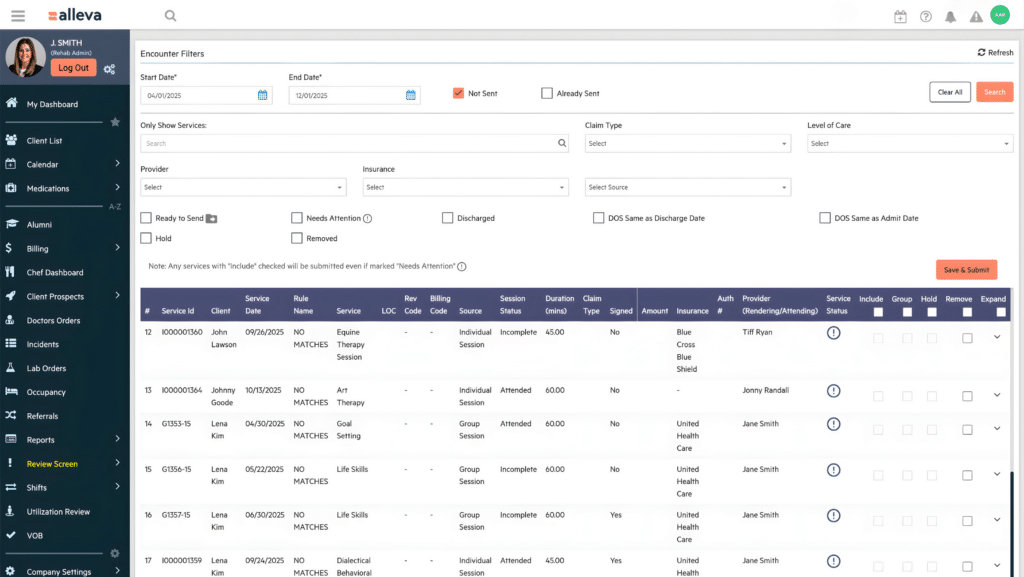
Alleva is a behavioral health EHR/EMR platform built exclusively for addiction and mental health treatment programs. It combines clinical documentation, RCM and billing, e-prescribing, and analytics in one easy-to-use system designed to reduce admin work and improve quality of care.
Alleva works well for teams that want ambient AI note-taking, with its Echo tool listening to sessions to generate audit-ready notes in real time.
ALLEVA FEATURES
- Echo ambient AI for audit-ready notes
- Client and family portal with built-in telehealth
- Task-based clinical documentation workflow
- Integrated billing and revenue cycle management
- Medication management and ePrescribe
- Powerful analytics, automation, and AI engine
Pros
- Built specifically for behavioral health
- Fast support, under 20 seconds
- AI cuts documentation time
- Robust, built-in GRC module
Cons
- Not suited to general medical practices
- Not suited for solo clinicians
If Alleva sounds like the fit your programs have been missing, there’s no substitute for seeing it run on your own workflows. Book a demo today and we’ll walk you through exactly how it works for teams like yours.
2. EHRYOURWAY – Best for behavioral health practices wanting deep configurability
EHRYourWay is an ONC-certified, CCBHC-ready behavioral health EHR built for both outpatient and inpatient mental health and addiction treatment. It combines clinical documentation, billing, and practice management in a single platform without requiring third-party integrations.
EHRYourWay works well for growing organizations because every form field is reportable, letting teams build unlimited custom reports.
EHRYOURWAY FEATURES
- ONC-certified with CCBHC and UDS reporting
- EPCS e-prescribing with PDMP checking
- Reportable fields for custom reports
Pros
- Single platform, no third-party integrations
- Highly customizable to your workflows
Cons
- Implementation takes 3-4 months
- Built for 10+ provider organizations
- Custom reports rely on vendor team
3. SIMPLEPRACTICE – Best for solo and small therapy practices
SimplePractice is a HIPAA-compliant EHR and practice management platform for therapists and health and wellness professionals. It bundles scheduling, documentation, billing, and telehealth into one intuitive system used by over 250,000 practitioners.
SimplePractice works well for new practices, offering free insurance credentialing with up to two payers when you sign up.
SIMPLEPRACTICE FEATURES
- Integrated telehealth for virtual sessions
- Insurance and credentialing tools
- Client portal and online scheduling
Pros
- Easy to use for solo practitioners
- Free 30-day trial available
Cons
- Less suited to large enterprises
- Add-on costs raise the price
- Not behavioral-health-specialized
4. PRACTICE MATE – Best for small practices wanting free practice management
Practice Mate by Office Ally is a no-cost, cloud-based practice management system that handles scheduling, insurance verification, account management, and revenue cycle tracking. It is built to help independent practices and small groups run more efficiently without subscription fees.
Practice Mate works well for budget-conscious providers, charging no licensing or monthly fees for its core scheduling, billing, and reporting features.
PRACTICE MATE FEATURES
- Real-time eligibility and benefits verification
- Integrated patient payments via Stripe
- Patient portal and digital intake forms
Pros
- No subscription or licensing fees
- Scalable with optional add-ons
Cons
- Transactional fees may apply
- Add-ons needed for full functionality
- Not specialty-specific for behavioral health
5. KIPU – Best for established addiction and behavioral health treatment centers
Kipu Health is a behavioral health treatment center platform spanning CRM, EMR, revenue cycle management, and compliance on an AI-native operating system. It is designed to manage the full patient journey from admissions through care delivery, billing, and regulatory adherence.
Kipu works well for larger facilities, supporting more than 6,000 facilities and 150,000 users globally.
KIPU FEATURES
- Centralized CRM for admissions and leads
- Revenue cycle management and eligibility checks
- Analytics dashboards and custom reporting
Pros
- Comprehensive end-to-end platform
- Built by a treatment center
Cons
- Geared toward larger organizations
- Can be complex for small clinics
- Broad platform takes time to learn
6. MEDICSPREMIER – Best for revenue-focused multi-specialty practices
MedicsPremier by Advanced Data Systems is a proven practice management platform built to maximize collections and reduce claim errors across medical practices, groups, and networks. It automates scheduling, eligibility, claims, and patient payments while supporting an integrated certified EHR.
MedicsPremier works well for billing-heavy practices, citing near-perfect first-attempt clearinghouse success on submitted claims.
MEDICSPREMIER FEATURES
- Denial risk alerts before claims submit
- Medics SMS interactive text reminders
- Analytics, KPIs, and exportable reports
Pros
- Handles HCFA, UB, Workers’ Comp
- Integrated or interfaced EHR options
Cons
- More billing-oriented than clinical
- Heavier system for tiny practices
- EHR is a separate add-on or interface
7. ZANDA – Best for allied health practitioners wanting top-tier security
Zanda (formerly Power Diary) is practice management software loved by allied health practitioners across mental health, rehab, and wellness fields. It automates the busy work of running a clinic, from bookings and notes to payments and communication, so practitioners can focus on care.
Zanda works well for security-conscious clinics, as one of the only systems to be ISO 27001 certified for data security and privacy.
ZANDA FEATURES
- Automated SMS and email reminders
- Online forms that update client profiles
- Calendar, billing, and reporting tools
Pros
- ISO 27001 certified security
- Has free trial offer
Cons
- Focused on allied health, not enterprise
- Telehealth relies on Zoom integration
- Less tailored to addiction treatment
Core Features To Look For In Addiction Treatment Software
The strongest platforms replace scattered tools with one connected system. An all-in-one behavioral health platform typically spans intake and CRM, admissions, scheduling, treatment planning, progress notes, custom forms, MAT dosing logs, e-prescribing, telehealth, a patient portal, automation, multi-site management, and role-based permissions.
| Feature area | Must-have capabilities | Why it matters for SUD programs |
| Intake, admissions, CRM | Referral tracking, bed/program eligibility, payer fields | Speeds placement, preserves audit trails |
| Clinical documentation | Configurable plans, linked group notes, outcome measures | Supports measurement-based care and accreditation |
| Medication and e-prescribing | eMAR, MAT dosing logs, controlled-substance safeguards | Reduces transcription errors, supports safety |
| Telehealth and engagement | Embedded video, portal, appointment reminders | Lowers no-shows, improves retention |
| Operations and governance | Role-based permissions, multi-site controls, automation | Scales without adding administrative headcount |
Clinical documentation and treatment planning
Treatment plans must be configurable, with linked group notes and built-in outcome measures. Those measures support measurement-based care and produce the documentation accreditors expect. Our guide to choosing an addiction treatment planner covers how to weigh these capabilities.
Medication support and e-prescribing
Look for eMAR (electronic medication administration record), MAT dosing logs, e-prescribing (eRx), and controlled-substance workflows. These should integrate with clinical notes and audit logs to reduce transcription errors and support regulatory requirements.
Telehealth, patient portal, and engagement
Patient tools should sync with scheduling and documentation. When telehealth, portal messaging, and charts share one record, you lower no-shows and keep clinicians from toggling between systems.
Operations, multi-site, permissions, and automation
Confirm the platform offers role-based permissions, centralized multi-site controls, task automation, and customizable forms. These let operational teams scale without duplicating administrative work.
Integrations, interoperability standards, and typical connections
Start by mapping which systems must connect, then favor standards-based APIs to reduce manual work and billing friction. Compare each vendor’s connections against your operational needs and review support, costs, and documentation before piloting. Clear EHR integration requirements prevent surprises at go-live.
1. Assess required connections. List the systems that must exchange data and why:
- RCM and billing systems for claims and remittance.
- Labs and toxicology vendors for results ingestion.
- Prescription drug monitoring programs (PDMPs) and state systems for controlled-substance checks.
- Pharmacies and eRx for medication orders.
- Outcomes tools and state reporting for quality and regulatory submissions.
2. Verify standards and documentation. Request each vendor’s API docs, supported FHIR resources, HL7 interfaces, and any interface fees. The ONC Cures Act Final Rule requires certified APIs to adopt FHIR implementation guides for interoperability.
3. Prototype and plan workflow changes. Run a scoped integration pilot to measure task time, exception rates, and who owns mapping updates. Train staff on changed tasks before go-live so exceptions have clear ownership. For example, run a weeklong lab-to-chart pilot and track how many results require manual reconciliation.
Addiction Treatment Software Pricing Considerations
How much does addiction treatment software cost for your practice? There area few things to consider.
Typical pricing models
Expect SaaS per-user or per-site licensing, module-based fees, upfront implementation costs, and optional transaction-based pricing. Each model shifts cost differently as you grow.
Additional fees to expect
Budget beyond the subscription for data migration, EDI and HL7 interfaces, premium support, and custom reports or configurations. These line items frequently surprise buyers who compare list price alone.
Estimating total cost of ownership and ROI
Model faster billing cycles, fewer denials, and lower administrative hours to estimate payback. Timeframes vary widely by program size, payer mix, and how cleanly your data migrates, so build the model on your own baseline rather than a vendor average. Where billing performance is the primary gap, a focused comparison of addiction billing systems narrows the shortlist faster than a full-platform evaluation.
Negotiation and demo checklist
- Request the SLA and onboarding timeline in writing.
- Get a detailed hidden-fee schedule and defined success metrics.
- Watch a live demo of payer-rule editing and denial workflows.
A strong demo reveals operational fit and exposes gaps you might otherwise miss after signing.
The 42 CFR Part 2 Final Rule: what changed and what your software must now do
The most important recent shift in addiction treatment software is regulatory. In 2024, HHS issued a Final Rule revising 42 CFR Part 2 to align it more closely with HIPAA, and the compliance deadline arrived on February 16, 2026. If your platform has not been updated for it, you are already behind.
42 CFR Part 2 governs the confidentiality of SUD patient records and has long imposed stricter consent rules than general HIPAA. The Part 2 Final Rule changes several mechanics that your software has to enforce, not just your policies.
Single consent for treatment, payment, and operations
Under the Final Rule, a patient can provide a single consent for all future uses and disclosures for treatment, payment, and health care operations (TPO). Your EHR must capture, store, and honor that consent scope, then apply redisclosure restrictions downstream.
New patient rights and disclosure accounting
Patients gain the right to an accounting of disclosures and to request restrictions on certain disclosures, mirroring HIPAA. The system needs to log who accessed a Part 2 record, when, and why, then produce that accounting on request.
Breach notification and penalty alignment
The rule applies HIPAA Breach Notification requirements to Part 2 records and aligns enforcement penalties. Practically, your vendor’s security posture and audit logging now carry the same regulatory weight as the rest of your HIPAA program.
What to ask vendors now
Confirm the platform enforces consent logic inside integrations and third-party exchanges, so controls persist across interfaces. Ask how the system tags Part 2 data, manages an updated Notice of Privacy Practices, and segregates records behind extra consent. This is the single highest-value compliance question in a 2026 evaluation.
Implementation, onboarding timeline, training, and support
A clear rollout reduces risk, speeds adoption, and protects revenue. Work a phased sequence you can measure and repeat, and treat EMR migration as a project with its own owner and timeline.
- Discovery. Map clinical, admissions, billing, and compliance requirements. Define KPIs and accreditation touchpoints such as CARF or Joint Commission readiness.
- Configuration. Convert workflows into role-based templates and permissions. Keep templates minimal to accelerate adoption.
- Data migration. Validate patient, billing, and referral records with reconciliation runs and backups.
- Testing. Run parallel charting and simulated billing before go-live.
- Phased go-live. Launch by location or cohort with a pilot group and designated super-users.
- Training and support. Use role-based live sessions, recorded modules, and sandboxes. Confirm support includes a customer success manager, a named account contact, and defined SLAs.
Single-site clinics commonly complete discovery through go-live in six to twelve weeks. Multi-site or highly customized deployments often run three to six months or longer.
Security, HIPAA, certifications, and data ownership
Evaluate vendors against concrete controls, not marketing language. Start by confirming how the system handles SUD records under 42 CFR Part 2 and whether it enforces granular consent and redisclosure controls. A vendor’s HIPAA compliance checklist is a useful starting reference for your own review.
Verify encryption in transit and at rest, role-based access, multi-factor authentication, and routine penetration testing. Require an immutable audit trail that records who accessed each record and why.
Look for SOC 2 or HITRUST attestations and documented disaster-recovery objectives (RPO and RTO). Robust governance and audit tooling should map directly to your policies and accreditation needs.
Data ownership deserves equal scrutiny. Confirm machine-readable export procedures and full control of your EHR data so onboarding, reporting, and any future vendor change stay under your control.
Reporting, analytics, and measurement-based care
Reporting and analytics shorten the time between insight and a treatment change. When clinical data ties to operations, supervisors intervene earlier and finance teams report faster.
Dashboards and interactive analytics
Visual dashboards surface relapse-risk patterns and program-level trends. Interactive filters let supervisors drill from aggregated KPIs down to an individual client trajectory in minutes.
Custom report builders and export formats
Build CARF- and state-aligned reports that export to CSV, PDF, and XML for audits and funder submissions. Exportable templates reduce manual spreadsheet work and accelerate audit readiness.
Outcome tracking that changes care
Track standardized scales and attendance to practice measurement-based care. Weekly outcome data drives treatment-plan updates, replacing guesswork with documented decisions.
How to choose: matching the platform to your programs
Translate everything above into a scored comparison tied to your own programs and payer mix. A structured approach to choosing an EHR system keeps the decision anchored to operational fit rather than feature lists. Programs that score vendors by level of care instead can pair that scoring with a survey of rehab software platforms for 2026.
When documentation, billing, and outcomes live in one platform, supervisors audit faster and finance teams produce funder-ready reports with less manual work. Align workflows, roles, and reporting standards up front so scaling stays orderly.
Frequently Asked Questions About Addiction Treatment Software
Here are some questions people also ask about choosing the best addiction treatment software for their behavioral health clinic or programs.
How does addiction treatment software handle group therapy notes across multiple patient records?
Most behavioral health platforms treat a group session as a single encounter linked to multiple participant records, while preserving an individual-level view for each client. A group-note template captures session details once — attendance, topics, facilitator, objectives — then attaches a participant-specific addendum to each attendee’s chart.
That addendum records individualized goals, brief clinical observations, attendee-specific billing codes, and consent flags. Good systems apply role-based visibility so each role sees only what it needs, and auto-populate roster and billing fields. Ask for a live demo of creating a group note, linking participants, and producing a combined group report.
Does addiction treatment software support MAT workflows and e-prescribing for controlled substances?
Yes. Mature behavioral health EHRs include MAT features such as intake medication history, dosing logs and eMAR, medication reconciliation, diversion checks, and scheduled dosing reminders.
Many integrate with e-prescribing services that support controlled substances through DEA-compliant eRx and state PDMP lookups. Confirm whether the vendor’s e-prescribing partner supports your state PDMP and whether controlled-substance prescriptions require secondary authentication. Also confirm MAT-specific reporting, such as dosing adherence and toxicology correlation.
What safeguards support 42 CFR Part 2 privacy and consent management?
Behavioral health EHRs use fine-grained consent management, segmented data tagging, and restricted-disclosure workflows to align with 42 CFR Part 2. Core safeguards include tagging records or individual data elements as Part 2, requiring signed consent before disclosure, generating consent and revocation documentation, and masking sensitive fields so only authorized roles can view them.
Many vendors also provide automated audit trails showing who accessed a Part 2 record and why. With the Part 2 Final Rule now in effect, make sure the system can enforce single-consent logic across integrations and third-party exchanges so consent controls persist between interfaces.
How long does implementation take, and what extra costs should we expect?
Timelines vary by size and complexity. Single-site clinics commonly complete discovery, configuration, migration, testing, and go-live in six to twelve weeks, while multi-site or highly customized deployments often run three to six months or longer.
Expect one-time costs such as data migration, custom interface development, integration fees for labs or state reporting, project management, and additional training. Ongoing extras can include premium support tiers, optional modules, and per-transaction fees for clearinghouses or PDMP queries. Ask for a line-item estimate and an SLA that defines what counts as a billable change request.
Can we export our data, and how is ownership handled if we leave the vendor?
Most reputable vendors state that you retain ownership of your clinical and operational data and provide exports in common formats such as CSV, CCDA, and FHIR resources. Confirm the export process, typical turnaround, and whether exports include attachments, scanned documents, and audit logs.
Verify any fees for bulk exports or extended retention, and whether the contract obligates the vendor to assist with data mapping to your new system. Request a sample data extract and a written exit plan during contract negotiation, and run an export test during the pilot so you can validate completeness before go-live.
–
See Alleva Addiction Treatment EMR in Action
A connected behavioral health platform unifies intake, care, compliance, and billing on one record, so your teams stop reconciling systems and start acting on clean data. The right fit depends on your programs, payer mix, and compliance posture.
Ready to see how an all-in-one platform fits your programs? Request a demo to test your workflows and integrations and confirm that MAT, group documentation, and consent controls work the way your teams need.

Kayla Briones is Sr. Product Marketing Manager at Alleva.