

The best behavioral health billing software ties clinical documentation to claims, eligibility, and collections so mental health and addiction programs protect revenue while staying compliant. This guide explains how these systems handle the workflows that general medical tools miss, and how to choose the model that fits your program. For the full comparison, see our EMR software buying guide.
This guide is written for U.S. behavioral health operators, billing teams, and clinical leaders evaluating software at the national level. Payer rules referenced here vary by state and plan, so treat specifics as starting points to confirm with your own payers.
Key Takeaways
- Behavioral health denials run high: Industry reporting puts behavioral health denial rates near 12–20%, roughly double the 5–10% common in medical and surgical care.
- Modifier and time errors drive rejections: Modifier mistakes and missing session start/stop times on codes like 90832, 90834, and 90837 are leading preventable denial causes.
- Track four core KPIs: Aim for a clean-claim rate at or above 95%, days in accounts receivable under 40, denial rate under 5%, and net collection of 92–98%.
- Best behavioral health billing software makes it simple: Connecting clinical notes to claims in one platform cuts manual handoffs that cause coding errors and slow cash.
Ready to see connected billing in practice? Request a personalized demo to review your workflows with the Alleva team.
What is Behavioral Health Billing Software?
Behavioral health billing software manages the claims and revenue workflows built for mental health and addiction services. Alleva’s behavioral health billing and RCM platform automates claim submission, benefit verification, patient statements, and accounts receivable (AR) tracking.
The platform handles modalities that general systems struggle with, including intensive outpatient programs (IOP), partial hospitalization programs (PHP), outpatient care, group therapy, and case management. Revenue cycle management (RCM) here means the full path from intake through final payment.
Top Behavioral Health Billing Software and What Each Does Best
Finding the best behavioral health billing software will depend on your exact needs as an organization or individual. Here is a selection of top behavioral billing solutions to choose from, with a highlight of how each one stands out (and for whom).
1. Alleva — Best billing for behavioral health treatment centers
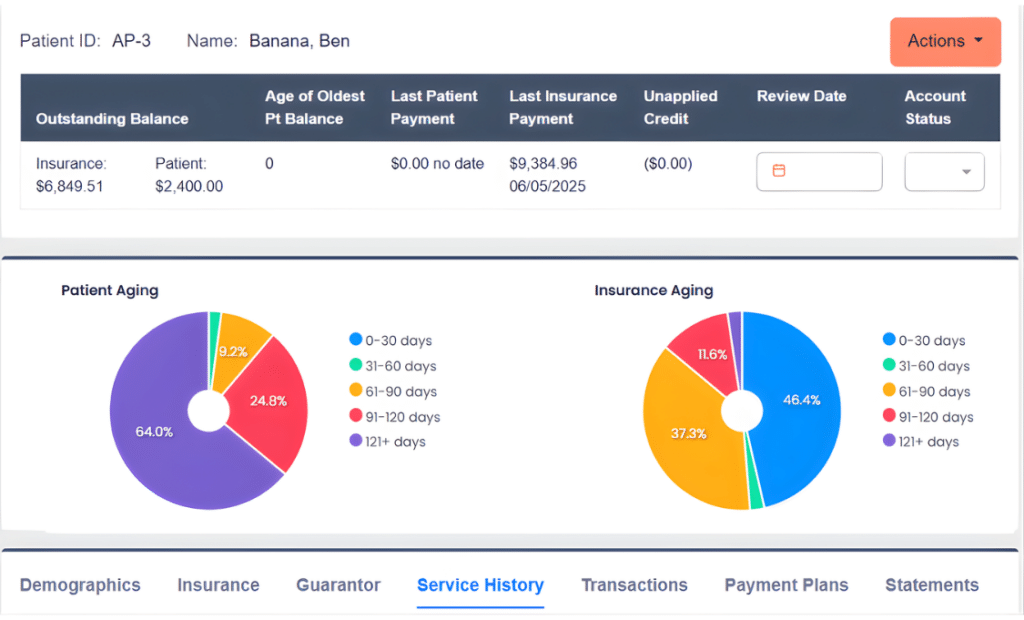
Alleva is an all-in-one EMR/EHR built exclusively for behavioral health and addiction treatment programs, covering everything from admissions and treatment planning to e-prescribing, billing, and outcomes tracking. It pairs a task-based documentation workflow with built-in AI tools to cut paperwork across IOP, PHP, residential, and detox settings. Behavioral health teams get this in Alleva’s all-in-one EMR.
Alleva behavioral health billing software works well for treatment teams that want HIPAA-compliant ambient AI (Echo) generating audit-ready session notes in real time.
ALLEVA FEATURES
- Echo ambient AI and TravisAI assistant
- Integrated revenue cycle and billing
- Medication management with e-prescribe
- Client/family portal and telehealth
- Custom dashboards with Alleva Insights
Pros
- Purpose-built for behavioral health
- Fast support, under 20 seconds
- Strong AI documentation tools
Cons
- Only for behavioral health services
- Not built for solo practitioners
Integrated EHR and Behavioral Health Billing
If you run a behavioral health or addiction treatment program and you’re tired of stitching together documentation, billing, and compliance across disconnected tools, Alleva is worth a closer look. Its behavioral-health-only focus, ambient AI note-taking, and fast support make it especially strong for IOP, PHP, residential, and detox teams that want to spend less time on paperwork and more time with clients.
Book a demo to see how Alleva behavioral health billing software fits your workflow.
2. Osmind — Best for interventional psychiatry and measurement-based care
Osmind is a psychiatry-specific EHR built by psychiatrists, designed for medication management and interventional treatments like TMS, ketamine, and SPRAVATO®. It combines psych-tailored charting, e-prescribing, and 50+ validated rating scales with a patient engagement app to deliver measurement-based care.
Osmind works well for practices offering SPRAVATO®, with REMS compliance automation that submits required monitoring forms to J&J automatically.
OSMIND FEATURES
- Mobile e-prescribing with PDMP access
- Patient engagement and outcomes app
- Interventional psych and billing services
Pros
- Built by psychiatrists
- Supportive clinician community
Cons
- Native AI scribe still upcoming
- Full-service tiers add cost
- Less suited to pure therapy
3. DrChrono — Best for all-in-one mobile practices
DrChrono is an integrated EHR and medical billing platform that brings scheduling, charting, telehealth, and revenue cycle management into one connected, mobile-first system. For psychiatry it offers behavioral health forms, EPCS e-prescribing, and DSM-5-compatible billing.
DrChrono works well for providers who want to chart, prescribe, and bill from an iPad or iPhone with speech-to-text and macro buttons.
DRCHRONO FEATURES
- EHR for iPad/iPhone
- PHQ-9 and behavioral health forms
- Full-service revenue cycle management
Pros
- Mobile-first charting
- EHR and billing together
Cons
- Pricing only by quote
- Not psychiatry-built from ground up
- Mixed reviews on support
4. ICANotes — Best for fast, template-driven documentation
ICANotes is a behavioral health EHR built exclusively for mental health clinicians, designed by a practicing psychiatrist around menu-driven, button-click charting. It bundles ONC-certified documentation, e-prescribing, telehealth, scheduling, and billing in one platform purpose-built for psychiatry rather than adapted from a general medical EHR.
ICANotes works well for prescribers who want to generate detailed narrative psychiatric notes in minutes with almost no typing.
ICANOTES FEATURES
- ePrescribing with automatic coding
- Integrated telehealth and patient portal
- Billing and revenue cycle management
Pros
- Fast note completion
- Serves prescribers and therapists
Cons
- Button-driven interface feels dated
- Notes can read templated
- Learning curve at first
5. SimplePractice — Best for solo mental health practitioners
SimplePractice is a HIPAA-compliant EHR and practice management platform used by 250,000+ therapists and wellness professionals, with a dedicated workflow for psychiatrists. It bundles scheduling, documentation, telehealth, billing, and a client portal into one easy-to-use system.
SimplePractice works well for psychiatrists who want ePrescribe plus customizable rate tables and treatment plans without enterprise complexity.
SIMPLEPRACTICE FEATURES
- ePrescribe for medication management
- Integrated telehealth and client portal
- Insurance and credentialing tools
Pros
- Very easy to use
- Credentialing offer available
Cons
- Lighter on psychiatry-specific tooling
- Add-ons raise the price
- Built more for therapists
6. TheraNest — Best for therapy groups and nonprofits
TheraNest is mental health practice management software for therapists, counselors, and social workers, scaling from solo practitioners to large clinics and non-profits. It centralizes scheduling, notes, billing, and electronic claims, with supervisor co-sign options for training settings.
TheraNest works well for group practices and supervised training programs that need notes co-signed by supervisors.
THERANEST FEATURES
- Electronic claims and superbills
- Supervisor review and co-sign
- Client portal with intake forms
Pros
- Group and supervisor tools
- Flexible plans by client volume
Cons
- Interface feels dated
- Therapy-first, limited med management
- Pricing scales with active clients
7. Tebra — Best for independent practices wanting growth tools
Tebra (formed from Kareo and PatientPop) is an all-in-one EHR+ platform for independent practices, connecting charting, billing, scheduling, and practice marketing. It adds reputation management and AI Smart Staff to its clinical and revenue tools, with a mental health specialty workflow.
Tebra works well for practice owners who want clinical, billing, and patient-acquisition tools under one login.
TEBRA FEATURES
- Integrated billing and claims management
- Practice marketing and reputation tools
- Telehealth and electronic labs
Pros
- Adds marketing and reputation tools
- Simple, all-in-one pricing
Cons
- Not behavioral-health specialized
- Mid-range third-party review scores
- Broad focus, not psychiatry-first
Wondering for to choose the best behavioral health billing software for you? Keep reading for tips on key features, implimentation strategies, and pricing expectations.
Key Billing Features Every Behavioral Health System Should Include
A purpose-built behavioral health billing software system combines automated checks with manual review so clinical nuance is preserved. Automation handles volume; human review handles judgment.
These features reduce denials and raise first-pass claim rates when they work together. The list below covers the core capabilities to evaluate.
- Eligibility and benefits checks: Real-time eligibility to prevent rejections.
- Prior authorization tracking: Automated alerts and status logs tied to the clinical workflow.
- Claims creation and batch submission (837/837I/837P): Standard electronic data interchange (EDI) output.
- ERA and EFT auto-posting: Automatically post electronic remittance advice (ERA) and electronic funds transfer (EFT) payments.
- Charge review and rule-based autofixes: Automatic edits for common errors before submission.
- Denial management and appeals: Triage, root-cause analysis, and appeal generation.
- Secondary claims and coordination of benefits: Auto-submit secondaries to speed collections.
- Fee schedule and modifier handling: Centralized rates plus correct CPT, HCPCS, and modifier logic.
- Telehealth coding: Place-of-service, modifiers, and payer-specific rules.
Automation within behavioral health billing software is common for eligibility, claims edits, ERA/EFT posting, reconciliation, and secondary claims. Manual review remains necessary for complex prior authorizations, nuanced denials, and clinical coding judgments.
Increasingly, AI-assisted clinical documentation tools shorten the gap between a session and a billable note. When notes are complete at session end, charge capture can happen the same day.
Integrations: EHR, clearinghouses, and payment or telehealth tools
Behavioral health billing software connects to electronic health records (EHRs), clearinghouses, and payment or telehealth tools. The goal is one clean path from clinical event to posted payment.
Map each integration point before go-live, then validate it in a test environment. Confirm payer and clearinghouse support so you are not surprised during certification.
Configure single sign-on and eligibility
Enable SAML or OAuth single sign-on (SSO) and automated user provisioning in your behavioral health billing software so clinicians and billers share one identity. This reduces login friction and shrinks the audit surface.
Then implement payer eligibility application programming interfaces (APIs) to verify coverage at intake. A reliable verification of benefits process is the upstream gate that shapes how your AR behaves downstream.
Sync clinical data and export claims
In any behavioral health billing software, you should map required clinical fields using Fast Healthcare Interoperability Resources (FHIR) or HL7 v2 feeds. Use custom payloads only when payers require nonstandard data.
Export ANSI X12 837 files or submit via API, then run end-to-end tests in a sandbox clearinghouse. Validate remittance flows and reconcile at the claim level, not just the batch level.
Payer setup timeline
Plan a staged payer rollout with a test clearinghouse, and expect iterative fixes during certification. Configuration and integrations of any behavioral health billing software commonly take four to eight weeks, depending on payer count and integration complexity.
KPIs And Reporting: Measuring Billing Performance
Billing and AR reporting turn raw claims data into action. Measurement must match behavioral-health workflows, because payer mix and bundled payments change what “good” looks like.
Track a concise set of KPIs by payer and service line, not just in aggregate. A blended rate can hide a strong commercial book subsidizing weak Medicaid performance. The benchmarks below are detailed in Alleva’s days in accounts receivable benchmarks guide.
| KPI | Definition | Behavioral Health Target | Why It Matters |
| Clean Claim Rate | Claims accepted on first submission ÷ total | 95%+ | Reduces rework and speeds cash |
| Days in AR | Average days claims stay outstanding | Under 40 days | Persistent 60+ signals systemic failure |
| Denial Rate | Claims denied ÷ total submitted | Under 5% | Higher rates point to intake or coding gaps |
| First-Pass Acceptance | Claims paid on first submission | 85–95% | Direct readout of submission quality |
| Net Collection Rate | Cash ÷ (charges − contractual adjustments) | 92–98% | Summarizes the whole cycle in one number |
Monitor weekly and trend monthly so you can spot payer-level shifts quickly. Provide executives forecasted KPIs and variance commentary, and give billing teams claim queues and denial drilldowns.
Behavioral health billing software dashboards should show denial root causes, payer trends, and time-to-collect. That visibility also reveals where documentation or authorization workflows need tightening.
Parity, Prior Authorization, And Privacy: The Behavioral-Health Compliance Layer
Behavioral health organizations face a regulatory layer that general practices do not, and it directly affects how claims are documented, appealed, and audited. Three areas stand out in 2026: mental health parity, the new electronic prior-authorization rule, and substance use disorder (SUD) privacy. Your behavioral health billing software must keep up.
Mental health parity (MHPAEA)
The Mental Health Parity and Addiction Equity Act (MHPAEA) requires payers to apply the same financial requirements and treatment limitations to behavioral health benefits as they do to medical and surgical benefits. In practice, payers cannot impose stricter prior authorization or visit limits on mental health claims.
For your billing team, this changes denial strategy. When a behavioral health claim is denied for medical necessity, your appeals team should evaluate whether the limitation is applied more strictly than for comparable medical services.
The 2024 MHPAEA final rule strengthened nonquantitative treatment limitation (NQTL) requirements. Payers must document a comparative analysis, which you can request and reference in appeals to recover denied claims.
The 2026 CMS electronic prior authorization rule
The intersection of eligibility and authorization is changing fast. The CMS Interoperability and Prior Authorization final rule requires many plans to implement electronic prior-authorization APIs with set decision windows.
Those windows are 72 hours for standard requests and 24 hours for urgent requests. Affected plans include Medicare Advantage, Medicaid managed care, and many marketplace plans.
For billing teams, this means faster, structured authorization feedback integrated with your VOB workflow. Some payers are also adding “Gold Carding” provisions that exempt high-approval providers from routine prior authorization for certain services.
SUD privacy under 42 CFR Part 2
Substance use disorder records carry stricter confidentiality protections than HIPAA alone, under 42 CFR Part 2. This affects what can be disclosed to payers during claims processing and appeals without patient consent.
Confirm with legal counsel that your RCM workflows, including any third-party vendor access to SUD records, comply with both HIPAA and 42 CFR Part 2. Build documentation infrastructure that supports parity-aware appeals now, since state regulators continue enforcement independently.
Behavioral Health Billing Software Pricing, Contracts, And Implementation Timeline
Behavioral health billing software is sold per-provider, per-claim, or as a percentage of collections. Compare fee structures against your expected volume and risk tolerance before committing.
Per-provider subscriptions are predictable; per-claim fees scale with volume; percent-of-collections ties vendor incentives to your cash. Each shapes cash flow differently, so model them against forecasted claim volume.
Contract elements to watch
Look for minimum terms, included modules, implementation fees, and SLA response windows. Confirm data portability clauses so you can export clinical and billing data in standard formats if you leave.
Request trial periods, clear exit provisions, and performance remedies such as remediation plans or fee credits. Get measurable success criteria tied to go-live in writing.
Typical implementation timeline
A mid-market organization can expect three to six months from contract to stabilized operations of new behavioral health billing software. The phases below are directional and expand with custom integrations or large data migrations.
- Discovery and planning: 2–4 weeks
- Configuration and integrations: 4–8 weeks
- Data migration and mapping: 2–6 weeks
- Testing and training: 3–6 weeks
- Go-live and stabilization: 4–12 weeks of close monitoring
Plan a parallel run and expect brief cutover disruption during final claim-routing tests. A named project manager on both sides shortens time to value.
See integrated billing in action
If your team is managing aging claims, denial backlogs, or disconnected billing and clinical documentation, a connected platform can support a more predictable revenue cycle. The goal is cleaner claims, more precise follow-up, and audit-ready documentation that speeds appeals. Related reading: revenue cycle management.
Request a demo to see how workflow-driven documentation, payer-aware RCM tools, and built-in reporting work together for your organization. Related reading: why built-in billing beats a bolt-on.
Frequently Asked Questions About Behavioral Health Billing
Here are some questions people also ask about behavioral health billing software and behavioral health operations more generally.
What is the difference between behavioral health billing software and a general medical billing system?
It is built around specialty workflows and payer rules for mental health and substance-use services rather than general medical needs. It supports group-session and per-member billing, bundled IOP/PHP claims, authorization tracking, and sliding-fee balances. General medical systems often lack these rulesets and require manual workarounds, which slows claim mapping and increases denials. Programs weighted toward addiction services can compare billing platforms built for SUD programs to see where those payer rulesets diverge from general behavioral health billing.
Does behavioral health billing software integrate with EHRs and clinical documentation?
Yes. Most modern solutions sync demographics, encounter details, and superbills from the EHR into the billing pipeline using HL7/FHIR or vendor APIs, and support single sign-on to reduce duplicate entry. Confirm that the vendor supports your EHR build and mapping for behavioral-health fields such as group-session attendance and treatment-plan flags, and request a test export during implementation.
Can the system reduce claim denials and improve first-pass acceptance rates?
Automated eligibility checks, payer-specific pre-submission edits, and rule-based charge validation are the main levers that reduce denials. Programs often see meaningful improvement after ruleset tuning, though exact results vary by payer mix and baseline performance. Ask vendors for documented customer outcomes from organizations at a similar level of care rather than relying on general claims.
Do vendors offer full-service RCM or only software for in-house teams?
Options vary by vendor. Some sell software only for in-house teams, others provide full-service revenue cycle management, and several offer hybrid models that combine software with targeted services such as credentialing. Ask for pricing by model (per-provider license, per-claim fee, or percentage-based RCM) and request performance metrics from comparable clients.
Is the system HIPAA-compliant, and what security certifications should I require?
A compliant system implements HIPAA administrative, physical, and technical safeguards, including encryption, role-based access controls, and breach response procedures. Ask vendors for business-associate agreements, SOC 2 or HITRUST attestation when available, penetration-test summaries, and published SLA response times. For SUD programs, confirm 42 CFR Part 2 compatibility as well.
How does the software handle both professional (CMS-1500) and facility (UB-04) claims?
A comprehensive behavioral health billing module should support both professional and facility claim workflows, since the two forms have different data elements and submission rules. This matters for programs operating under both a facility NPI and individual provider NPIs. Ask for a demonstration of how the system handles an IOP or residential claim to confirm facility billing is fully functional.

Nick Leija is a Product Manager at Alleva specializing in revenue cycle management, billing operations, and financial technology for behavioral health organizations. With more than 15 years of healthcare experience, Nick works closely with providers to develop solutions that improve reimbursement performance, streamline workflows, and strengthen financial operations. His expertise helps ensure behavioral health organizations can focus more on care delivery and less on administrative complexity.