

The best mental health EHR for your program is the one that handles behavioral health work natively: group notes, 42 CFR Part 2 consent gating, level-of-care documentation, and billing that understands your payer mix. General-medical systems retrofitted for behavioral health tend to break on all four. Start with the behavioral health EHR capabilities your clinical and billing teams actually use daily, then compare vendors on evidence you can verify in a live demo.
Key takeaways
- Match the platform to program size. Solo and small-group practices need scheduling, notes, and simple billing. Multi-site programs need group notes, Part 2 consent gating, integrated billing, and accreditation exports.
- Four capabilities separate mental health systems from general-medical ones: group therapy documentation, 42 CFR Part 2 data segmentation, electronic prescribing of controlled substances with prescription-monitoring logging, and integrated revenue cycle management.
- Price the whole first year, not the subscription. Implementation, data migration, integrations, prescriber enrollment, and per-claim fees are quoted separately and routinely exceed the license line.
- Make vendors prove it live. Run the Part 2 segmentation, prescribing audit-log, and note-to-claim tests during the demo. A feature list and a working workflow are not the same thing.
What a mental health EHR actually does
A mental health EHR documents and coordinates care across intake, clinical documentation, group therapy, medication, and billing, under U.S. federal and state rules specific to behavioral health and substance use records.
It supports clinic owners, clinical directors, operations and revenue-cycle teams, and compliance officers across private therapy practices, outpatient clinics, multi-site groups, and addiction treatment programs. The core jobs:
- Intake, referrals, and admissions CRM. Capture inquiries and track referral sources through to admit.
- Group scheduling and group notes. Schedule one event, document many attendees, produce billable encounter records.
- Progress notes, treatment plans, and outcomes. Maintain clinical continuity and defensible medical necessity.
- Medication management and controlled-substance prescribing. Electronic prescribing with prescription-monitoring checks and audit logs.
- Billing, claims, and verification of benefits. Authorizations, claim submission, denial routing, remittance posting.
- Consent management and 42 CFR Part 2 controls. Segment substance use records and enforce consent at the interface and API level.
- Reporting and analytics. Exportable evidence for surveys and dashboards for leadership.
For a fuller walkthrough of the evaluation process, see our guide on how to choose an EHR system.
How we evaluated these platforms
We reviewed vendor product documentation, live demos, published security attestations, case studies, and public user reviews including Capterra, and checked regulatory guidance from HHS and SAMHSA. Research current as of September 2026.
We assessed every platform against the same criteria:
- Behavioral-health-specific clinical workflows
- Compliance and audit readiness, including 42 CFR Part 2 handling
- Billing and revenue cycle integration
- Interoperability and data portability
- Security posture and access controls
- Group therapy scheduling and documentation support
Alleva publishes this guide and appears first. That relationship is disclosed, the same criteria were applied throughout, and Alleva’s entry is limited to what our product pages and published case studies support.
Comparison at a glance
| Platform | Best for | Program size | Group documentation | Integrated billing |
|---|---|---|---|---|
| Alleva | Multi-site behavioral health operations and AI-assisted documentation | Mid to enterprise | Native group notes | Yes, Alleva Billing |
| Cantata Health (Arize) | Enterprise human services agencies | Large | Verify in demo | Verify in demo |
| SimplePractice | Solo and small wellness practices | Solo to small group | Verify in demo | Yes, with add-ons |
| CareLogic (Qualifacts) | Multi-state behavioral health enterprises | Large | Verify in demo | Yes, clean-claims billing |
| Ensora Health (TheraNest) | Mental and rehab therapy practices | Small to mid | Verify in demo | Yes, with add-ons |
| Valant | Psychiatry-focused practices | Small to mid | Verify in demo | Yes |
| ICANotes | Fast, template-driven charting | Solo to mid | Verify in demo | Verify in demo |
Pricing is quoted after a demo for most platforms in this category, and published rates for the smaller systems change with add-ons. Treat any public figure as a starting point and price the full first year. See the cost section below.
1. ALLEVA: best for multi-site mental health operations
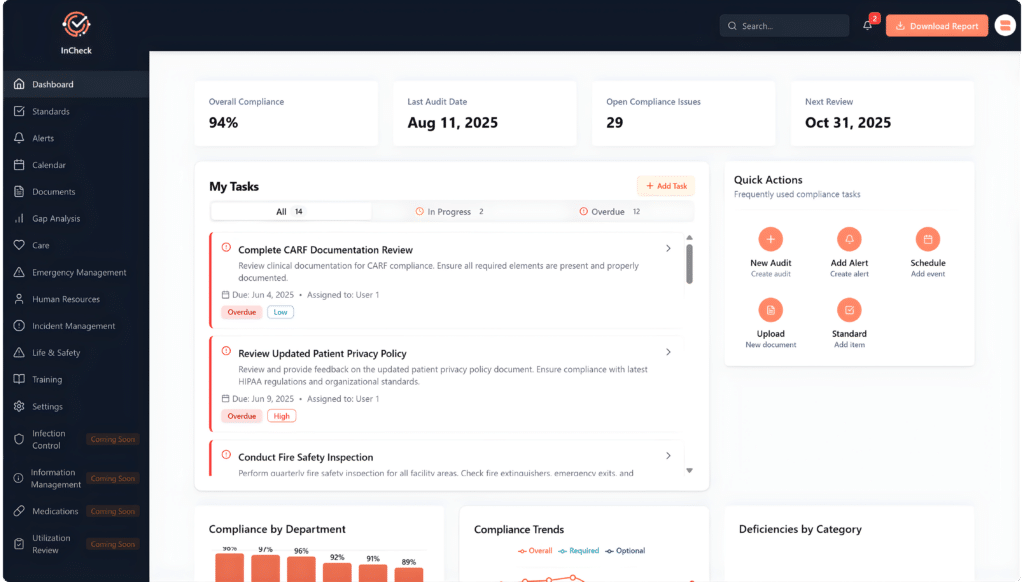
Alleva InCheck compliance dashboard showing compliance score, open issues, assigned CARF tasks, and trends by department, built for behavioral health.
Alleva is an all-in-one operations platform built exclusively for behavioral health. Documentation, revenue cycle management, admissions CRM, compliance, and analytics run in one system rather than four stitched together. That matters most when a client record has to travel from an admissions inquiry through clinical documentation to a clean claim without anyone rekeying it.
Who it fits: treatment centers, multi-site behavioral health organizations, and multidisciplinary teams running intensive outpatient, partial hospitalization, residential, or detox programs.
ALLEVA features
- Admissions CRM that captures referral sources and tracks conversion through to admit
- Behavioral health documentation templates and group-note workflows designed to cut time spent charting
- Alleva Billing for claims and accounts receivable, with self-service verification of benefits powered by Waystar
- InCheck, a governance and compliance module built by a behavioral health compliance insider around CARF, Joint Commission, and state requirements
- Echo for HIPAA-compliant ambient documentation, TravisAI, and Insights dashboards for clinical and financial reporting
- Client and family portal with telehealth and medication management
Pros
- Purpose-built for behavioral health rather than adapted from primary care
- One record across admissions, clinical, and billing, which removes duplicate entry
- Compliance tooling and audit trails that support year-round survey readiness
- Certified to SOC 2 Type II, HIPAA, and ONC standards, documented at the Alleva trust center
- Scales across sites with role-based access controls
Cons
- Full platform carries a learning curve
- Pricing is scope-based and quoted after a demo, so budgeting requires a scoping conversation
Proof point: in Alleva’s published Warriors Heart case study, the program reported a 30% reduction in documentation time, a 15% improvement in claim accuracy, and a 25% increase in medical-necessity documentation after adopting Echo. Those results reflect that program’s experience.
2. Cantata Health (Arize): best for enterprise human services agencies
Cantata Health’s Arize platform targets large human services agencies that need a configurable system out of the box. It leans toward organizations running broad service lines rather than a single program type.
Key features: configurable out-of-the-box platform, built-in telehealth, methadone dispensing support, full mobile access.
Pros: modern interface; configurability reduces dependence on vendor support for routine changes.
Cons: geared toward larger organizations and generally more platform than a small practice needs. Pricing requires a demo.
3. SimplePractice: best for solo and small wellness practices
SimplePractice is a lightweight practice-management EHR built around clinician productivity and a polished client-facing experience. It suits solo clinicians and small groups more than multi-site programs.
Key features: integrated telehealth and client portal, template library, insurance and credentialing tools.
Pros: fast to learn, free trial available, credentialing support at signup.
Cons: less suited to large agencies; add-ons raise the effective cost; enterprise reporting is lighter than full-platform systems. Confirm advanced payer workflows and accreditation support during a demo.
4. CareLogic (Qualifacts): best for multi-state behavioral health enterprises
CareLogic is aimed at behavioral health organizations operating across multiple states, where configurability and compliance depth matter more than speed of setup.
Key features: self-service configurability, clean-claims billing, compliance support, outcomes dashboards, electronic prescribing, and support for intellectual and developmental disability and autism services.
Pros: deep compliance expertise and a highly configurable data model.
Cons: built for larger organizations, with a steeper setup. Pricing requires a demo.
5. Ensora Health (TheraNest): best for mental and rehab therapy practices
Ensora Health packages TheraNest and Fusion for therapy practices, covering scheduling, notes, billing, and telehealth at a footprint suited to small and mid-size groups.
Key features: TheraNest EHR and practice management, revenue cycle management, telehealth, electronic prescribing, and clearinghouse add-ons.
Pros: discipline-specific products and strong billing tooling.
Cons: two product lines can confuse buyers; not built for large agencies; add-ons increase cost.
6. Valant: best for psychiatry-focused practices
Valant is psychiatry-first, with medication management and measurement-based care built into outpatient templates. It fits clinics centered on psychiatric visits and outcomes tracking.
Key features: electronic prescribing with prescription-monitoring and lab integrations, billing, scheduling, utilization review, and the MYIO patient portal with telehealth.
Pros: strong psychiatry workflow fit and a live support team.
Cons: less suited to solo therapists; carries a learning curve; pricing varies by plan, which makes side-by-side comparison harder.
7. ICANotes: best for fast, template-driven charting
ICANotes is built around menu-driven charting, where clinicians assemble notes largely by selection rather than typing. It appeals to prescribers and clinicians who prioritize note speed above interface polish.
Key features: button-click charting, automatic coding and treatment plans, electronic prescribing, and assessments.
Pros: very fast note creation; ONC-certified and HIPAA compliant.
Cons: the interface feels dated next to newer systems, and the template model has its own learning curve.
What to look for in a mental health EHR
This checklist separates systems that fit behavioral health workflows from general-purpose EHRs. Ask every vendor to demonstrate each capability in a live workflow, not a slide.
1. Behavioral health documentation and progress-note templates Prebuilt therapy and treatment-plan templates with session-level outcomes. Good templates cut charting time and enforce measurable goals. Ask: “Show an intake and an ongoing progress note preloaded for therapy, including diagnosis, treatment goals, and measurable session-level outcomes.”
2. Group therapy scheduling and group notes Native group sessions with one note covering many attendees. This saves clinician time and produces billing-ready encounter records. Our guide on how to document group therapy sessions covers what auditors expect to see. Ask: “Create a group session, add attendees, and complete one group note that posts attendance and billing-ready encounters.”
3. Controlled-substance prescribing and monitoring-program integration Electronic prescribing of controlled substances with prescription drug monitoring program checks, plus the audit log behind both. Ask: “Place a controlled-substance order, run the monitoring-program query, and show me the resulting audit log.”
4. 42 CFR Part 2 consent and segmentation controls Consent management and data segmentation that restrict substance use records. This is what prevents unlawful disclosure and what surveyors ask about. Our overview of healthcare compliance certifications covers the credentials behind this work. Ask: “Show how Part 2 consents are recorded, enforced at the interface and API level, and how segmented data is included or excluded from exports.”
5. Integrated billing and revenue cycle Claim creation, submission, denial routing, and remittance posting inside or tightly connected to the record. Handoffs between systems are where revenue leaks. Our field guide to billing behavioral health claims covers the common failure points. Ask: “Walk me from a clinician note to a billed encounter, claim submission, and remittance posting.”
6. Admissions CRM and referral tracking Lead intake, referral source capture, and conversion workflow. Lost referrals are lost revenue, and most general EHRs do not track them. Ask: “Show an intake-to-admit workflow: lead capture, referral tracking, follow-up tasks, and a closed-loop admit status.”
7. Reporting, outcomes measurement, and analytics Scheduled reports, cohort analysis, and outcome instruments that produce accreditation evidence rather than raw exports. Ask: “Produce a cohort outcomes report and show me how to schedule it for leadership.”
8. Interoperability and data export Standards-based integration and patient-level export that preserves consent metadata. Required for health information exchanges, analytics, and referral partners. See our guide to EHR integration standards for what to expect on timelines. Ask: “Show a FHIR or HL7 integration, or an export of patient-level data that preserves consent flags.”
Three demo tests that separate real capability from a feature list
Run these in the vendor’s sandbox. They surface gaps that no feature matrix will.
Data segmentation test
- Mark a note as restricted under 42 CFR Part 2.
- From a clinician role without consent, attempt to view it. Expect access denied, and expect the denial to be logged.
- Grant time-limited consent and confirm the system writes consent metadata including user ID and expiration.
Consent metadata export test
- Create a limited-scope consent and attach it to the record.
- Export the metadata and confirm the fields include who consented, scope, start and end dates, and timestamp.
Prescribing audit-log test
- Simulate a controlled-substance order and a monitoring-program query in the sandbox.
- Pull the audit log and confirm entries include user ID, action type, timestamp, and prescription detail.
- Request the vendor’s monitoring-program integration specification and how it reconciles state responses.
Validate results against SAMHSA guidance on 42 CFR Part 2 and current CMS and HHS expectations for telehealth and electronic prescribing. A vendor without native segmentation or prescribing audit logs will need middleware or legal work, which adds cost and time to the project.
What a mental health EHR costs
Mental health EHR pricing rarely stops at the subscription line. Vendors price per user per month, per location, or by module, then bill implementation, data migration, integrations, and per-claim transaction fees separately. Ask every vendor to split recurring from one-time costs in writing, because two proposals with the same monthly rate can differ substantially in year-one total.
| Cost component | What drives it | Ask the vendor |
|---|---|---|
| Subscription or license | Seats, locations, or module mix | Which model, and what triggers a tier change? |
| Implementation and training | Number of sites, workflow complexity, clinician headcount | Are implementation hours capped, and what happens if we exceed them? |
| Data migration | Record volume, source format, years of history | How many years migrate as structured data, and what arrives as a flat archive? |
| Integrations and APIs | Labs, payers, clearinghouse, monitoring programs, telehealth | Which are included, and which are billed as custom work? |
| Per-claim transaction fees | Claim volume and clearinghouse relationship | Per claim, per submission, or per accepted claim? |
| Prescriber enrollment | Prescriber count and identity-proofing workflow | Who pays for identity proofing, and how long does it take per prescriber? |
Negotiation levers worth using: volume pricing across seats and sites, bundling revenue cycle management with the record system, capped implementation hours tied to defined go-live milestones, and training or migration credits written into the agreement.
How to implement a mental health EHR
Implementation is a staged, stakeholder-led migration. Plan for data mapping, integrations, clinician training, a parallel run, and a phased cutover. Our EMR migration guide covers the full runbook.
1. Set scope, governance, and timeline. Appoint a project sponsor plus a clinical champion, operations and billing leads, IT, and a privacy or compliance officer. Agree milestones and an executive sign-off cadence before anything is configured.
2. Map the data. Inventory source systems, then build a field-level map for demographics, notes, medications, encounters, and billing codes. Set realistic migration windows and write the rollback plan before you need it.
3. Build and test integrations. Prioritize practice management, labs, telehealth, payer clearinghouses, and electronic prescribing. Run endpoint and end-to-end tests with sample patients and track failures by scenario rather than by count.
4. Train clinicians and run a parallel validation. Start role-based training early and protect clinician time for it. Before cutover, reconcile a sample of patient charts, verify scheduling and payer mappings, confirm secure access and audit trails for test users, validate templates and prescribing, and publish escalation paths.
5. Staff a hypercare window. Keep rapid-response IT and clinical super-users available for the first weeks after go-live. Track issues, denials, and documentation gaps, then fix and retrain.
Timelines vary by scope, number of sites, and how clean the source data is. Integration work alone commonly runs several weeks to several months. Ask each vendor for timelines from programs of your size and service mix rather than a generic range.
How an EHR supports CARF and Joint Commission accreditation
Surveyors ask for the same categories of evidence every cycle: audit trails, policy-linked documentation, standardized treatment plans, staff training records, and consent logs. A system that stores all five in one place and exports them on demand turns a multi-week scramble into a report pull. What separates platforms is whether that evidence exports as a packet or has to be assembled chart by chart.
| Evidence request | System capability | What to export or show |
|---|---|---|
| Document control and versioning | Version history and locked policy links | Policy-linked notes and change logs |
| Staff training records | Training tracking and attestations | Completion timestamps and competency forms |
| Outcome measurement | Built-in instruments and roll-up reporting | Aggregate outcome reports by program |
| Consent and authorization | Signed electronic consent with timestamps | Consent documents with signature metadata |
| Access logs and security | Detailed access audit and role controls | User activity summaries and access reports |
Next steps: map internal policies to system templates and lock controlled documents, run a sample export for each row above, assemble a survey packet, then do a mock record review and assign owners to whatever is missing.
What recent regulatory changes mean for your shortlist
The 42 CFR Part 2 final rule aligning substance use disorder record confidentiality with HIPAA carried a compliance deadline of February 16, 2026, which is now in effect. Any system on your shortlist needs to support data segmentation, machine-readable consent metadata, and auditable prescribing and monitoring-program logs. Put these in the request for proposal in plain language, then test them rather than trusting the response.
Language to use in your RFP:
- Data segmentation: tag and restrict access to record fragments, enforced at both the interface and the API.
- Consent metadata: machine-readable consent records capturing who consented, scope, timestamps, and expiration.
- Prescribing and monitoring logs: auditable records of monitoring-program queries and controlled-substance events with user IDs and timestamps.
- Role controls tied to consent state: access that changes when consent changes, not just by job title.
- Consent-aware exchange: HL7 and FHIR exchanges that carry explicit data-release flags.
Also ask for sample audit exports, API documentation, a written data-retention and consent policy, and service-level commitments covering audit readiness and data extraction at the end of the contract.
Frequently asked questions
Are mental health EHRs required to be HIPAA and 42 CFR Part 2 compliant?
Yes. Systems handling behavioral health records must support HIPAA privacy and security controls, and systems storing substance use disorder records must support 42 CFR Part 2 confidentiality. The Part 2 final rule aligning the two took effect February 16, 2026. Validate audit trails, role-based access, and Part 2 gating in a demo rather than accepting a compliance checkbox.
How should I think about pricing?
Expect per-user or per-license fees plus implementation, training, and optional modules. Ask each vendor for an itemized split of recurring versus one-time costs and a total cost of ownership for year one and year three. Quotes with the same monthly rate can differ by a wide margin once migration and per-claim fees land.
Do mental health EHRs support controlled-substance prescribing?
Many do. Confirm DEA-compliant identity proofing for each prescriber, pharmacy network integration, and the audit log behind both. Test the full prescribing flow in a demo, including the monitoring-program query, rather than confirming it from a feature list.
Can these systems document group therapy efficiently?
Yes, though implementations vary. Most behavioral health systems include group scheduling and group-note templates. Verify that attendance rolls automatically into each attendee’s chart and that billing rules apply correctly per attendee, since this is where general-purpose systems tend to fall down.
What are the main risks when switching systems?
Data loss, mapping errors, downtime, and billing interruption. Mitigate with phased migration, clean exports validated before cutover, a documented vendor migration playbook, and a parallel run. Our EMR migration guide walks through each stage.
What should I ask for in a demo?
Request role-based walkthroughs and sandbox access rather than a scripted presentation. Ask for a Part 2 consent demonstration, a note-to-claim walkthrough, and references from organizations of similar size and service mix.
How do these systems affect billing and revenue cycle?
Behavioral-health-aware systems with embedded revenue cycle management can reduce claim errors and shorten collection cycles, though results depend heavily on configuration and payer rules. Verify verification of benefits, claim-edit logic, and payer mapping against your actual payer list.
How portable is my clinical data if I leave a vendor?
Portability varies widely. Require written commitments in the contract covering export formats, timing, and any extraction fees, and include a documented data-exit plan. Confirm which data exports as structured records and which arrives as a flat archive.
Is a mental health EHR different from a behavioral health EMR?
Functionally, no. The terms are used interchangeably across this category. Evaluate on capability rather than label: native group documentation, 42 CFR Part 2 handling, behavioral health billing, and accreditation-ready exports.
Choosing between them
Solo and small practices should weigh setup speed and predictable pricing.
Multi-site and residential programs should weigh group documentation, 42 CFR Part 2 segmentation, accreditation exports, and integrated billing.
If you’re the second kind, you already know the cost: the clinician still charting at 8pm, the claim denied over a note nobody could find.
We built Alleva to take that off them. Bring your hardest workflow to the demo, the group session, the Part 2 consent, the denial you keep losing, and we’ll walk it with you.
This guide is for informational purposes and does not constitute legal, compliance, or reimbursement advice. Regulatory requirements vary by state and program type. Confirm any compliance, security, or billing capability directly with the vendor and with your own counsel or compliance officer before making a purchasing decision.

Kayla Briones is Sr. Product Marketing Manager at Alleva.