

Rehab software runs a treatment program that moves people between levels of care, and what separates it from practice management software is whether a client can step down from detox to residential to outpatient without being discharged and re-admitted at every stage. Most platforms cover a slice of that continuum. A few cover all of it, which is why a platform built for the whole behavioral health operation behaves differently from a system built for one clinic.
Key Takeaways
- The episode is the unit, not the appointment. If a detox-to-residential step-down means a discharge summary plus a fresh intake packet, your staff pay that tax at every transition.
- Admissions decides census. Inquiry-to-admit time, referral attribution and benefits verification matter long before clinical features do.
- Utilization review is where facility programs lose money. Concurrent review runs on the payer’s clock, and the evidence has to come out of the chart.
- Match the platform to your widest level of care, not your busiest one. A system strong at IOP and weak at withdrawal management fails at the hardest moment.
- Decision rule: one level of care and no beds, choose an outpatient practice platform. Two or more levels with beds, choose a continuum platform with native admissions, census and utilization review. Recovery residences alone, choose residence management software.
Want to see a step-down run end to end on one record? Request an ALLEVA demo and walk your own levels of care through it.
What rehab software has to do that practice software does not
Practice management software is organized around the appointment: a session, a note, a claim. Rehab software is organized around the episode, so admission, level-of-care changes, authorizations, medication administration and discharge all hang off one continuous record.
Programs feel the difference at three moments. When a referral arrives and someone has to verify benefits before promising a bed. When a client moves between levels of care. When a payer asks why the current level of care is still necessary. None of those is an appointment, and all three are where facility-based care either runs smoothly or bleeds money.
The discharge-and-readmit test
Ask a vendor to move a client from detox to residential to partial hospitalization inside the demo, then count what your staff would redo. Most systems keep one patient record, so that is not the question. The question is how much of the admission happens twice.
| At the transition | What should happen | What it costs when it does not |
|---|---|---|
| Intake paperwork | The level of care changes on the existing episode | A discharge summary plus a full intake packet, for a client who never left the building |
| Treatment plan | Goals carry forward and get revised, version history intact | A plan rewritten from scratch, earlier progress lost |
| Consent | Existing scope carries, and each disclosure records the consent it relied on | Clients re-sign, and nobody can show which consent covered which disclosure |
| Assessments | Prior data populates forward and is updated | The biopsychosocial re-collected from a client who answered it four days ago |
| Authorization | The new level inherits the payer thread and prompts the next request | Days delivered before the new authorization lands |
| Utilization review | The reviewer sees the whole stay across levels | The reviewer sees the current level and reconstructs the rest |
The last two rows are the ones finance notices. Delivered-but-unauthorized days are expensive and largely preventable, and they usually trace to a workflow gap rather than a billing error.
Best rehab software in 2026
| Platform | Best for | Levels of care it is built for |
|---|---|---|
| Alleva | Programs running the full continuum on one record | Detox, residential, PHP, IOP, outpatient |
| Sunwave Health | Admissions-driven operators | SUD, mental health, eating disorder, MAT and OTP, multi-site |
| BestNotes | Residential programs that want published pricing | Outpatient through residential |
| EHRYourWay | Facilities needing live bed status and shift structure | Residential, inpatient, outpatient |
| Qualifacts InSync | Smaller programs wanting an enterprise vendor | Outpatient, with an upgrade path |
| Welligent | Agencies running many program types | Community, outpatient, multi-program |
| NextGen Behavioral Health | Sharing one chart across medical and behavioral care | Outpatient, residential and detox inside an ambulatory EHR |
| TherapyNotes | Outpatient therapy groups billing insurance themselves | Outpatient only |
| SimplePractice | Solo and small practices | Outpatient only |
| Sobriety Hub | Recovery residence operators | Sober living only |
Four publish pricing openly: BestNotes lists per-user tiers, TherapyNotes and SimplePractice publish plan tiers, and Sobriety Hub publishes staff-seat rates. Everything built for the full continuum quotes. Verify current pricing with each vendor before building a comparison.
1. ALLEVA: best for programs running the full continuum on one record
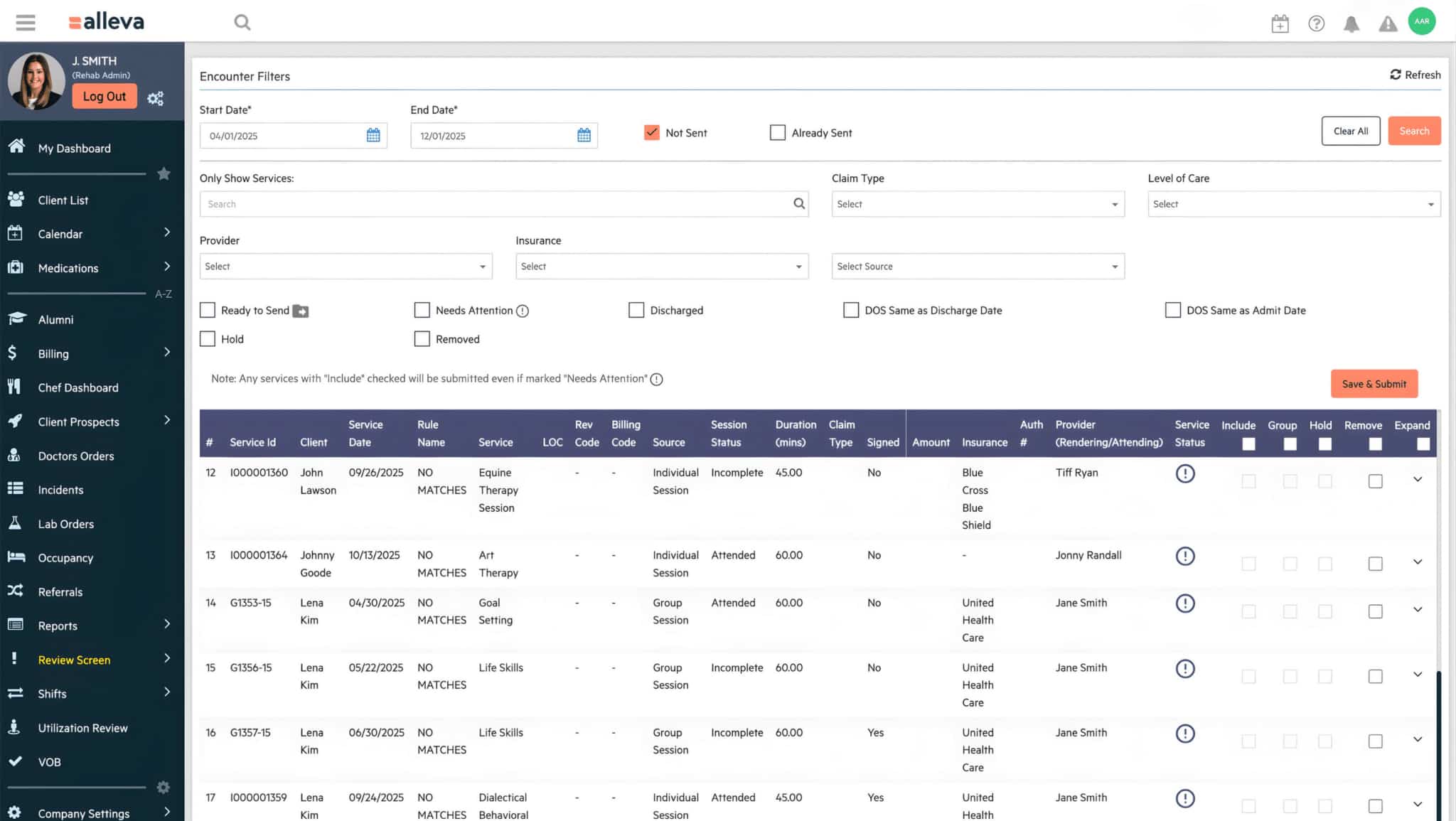
Alleva billing review screen showing encounter rows with level of care, authorization number, signature status and claim type before submission
Alleva is a behavioral health operations platform built only for addiction and mental health programs, combining the EMR, admissions CRM, revenue cycle management, compliance tooling and analytics on one data model. Admissions, clinical, billing and compliance teams work from the same episode rather than reconciling exports, so a step-down is a state change on an existing record rather than a fresh intake.
It is the broadest fit in this list for operators running two or more levels of care, because it covers the front door, the clinical record, the claim and the survey evidence without stitching four vendors together.
Features
- Behavioral health documentation templates for substance use and mental health, including group workflows
- Admissions, referral tracking and census management for facility-based programs
- Built-in billing and revenue cycle management, with self-service verification of benefits powered by Waystar
- InCheck, a governance, risk and compliance module designed around CARF, Joint Commission and state behavioral health requirements
- Alleva Intelligence, covering Insights reporting, the Echo ambient documentation tool and TravisAI
- Medication management, e-prescribing, telehealth, and a client and family portal
Pros
- Purpose-built for behavioral health rather than adapted from a general medical EMR
- Covers every level of care from withdrawal management through outpatient on one episode
- Compliance tooling and the clinical record live in one system, so survey evidence comes out of the chart
- Billing is native rather than integrated after the fact, and benefits verification runs at the point of inquiry
- SOC 2 Type II certified and HIPAA compliant, with ONC certification through Drummond, all documented on the company trust center
- Hands-on migration support for programs switching EMR
Cons
- Pricing is quote-only, with no published tiers
- Demo-led sales rather than self-serve sign-up
- Not aimed at solo clinicians or general medical practices
A documented result. In the Warriors Heart case study, the program reported up to a 30% reduction in documentation time among proficient users, a 15% improvement in revenue collection and claim accuracy, and a 25% improvement in medical-necessity documentation after adopting Echo.
Ready to test it on your own step-down workflow?
2. Sunwave Health: best for admissions-driven operators
Sunwave Health combines EMR, CRM and revenue cycle management on a single database, with referral management and a bed board sitting in the CRM. Lightning Step and Sunwave unified under one brand, so programs that shortlisted them separately are now looking at a single vendor.
Features: referral management, bed board and marketing analytics; clinical documentation across programs and sites; revenue cycle management with eligibility; SIA documentation AI; alumni management.
Pros
- Admissions, clinical and billing share one database rather than syncing
- Named segment support for MAT and OTP clinics, including prescription monitoring integration
Cons
- Two product lines recently merged, so confirm which one your deployment sits on
- Pricing is quote-only, and AI feature availability varies by level of care
3. BestNotes: best for programs that want published pricing
BestNotes is a behavioral health and addiction treatment EHR covering documentation, admissions, medication administration and billing, with a CRM layer for referral tracking. It publishes per-user pricing openly, which is rare in this category.
Features: published per-user tiers with month-to-month contracting; CRM with referral tracking and Salesforce integration; eMAR with grouped med-pass, inventory and refusal capture; intake prescreen that auto-populates clinical documentation.
Pros
- Published pricing means you can model cost before entering a sales process
- eMAR handles med-pass grouping and refusal documentation, which matters in residential settings
Cons
- Per-user pricing scales directly with headcount, which suits small teams better than large ones
- Two editions exist, and no dedicated accreditation module is named on the vendor site
4. EHRYourWay: best for facilities needing live bed status
EHRYourWay spans outpatient clinics and inpatient or residential facilities in one platform, with modules configured per organization. It suits facilities where nursing shift structure drives the day.
Features: real-time bed management and census dashboard; eMAR with EPCS and prescription monitoring checks; FHIR R4 and SMART on FHIR APIs; clinical flowsheets and shift notes.
Pros
- Genuine inpatient workflow depth rather than configured bed pools
- Verifiable ONC certification with a listed version
Cons
- Configuration-heavy setup rather than out of the box
- No accreditation or governance module named, and pricing is quote-only
5. Qualifacts InSync, best for smaller programs wanting an enterprise vendor
Qualifacts InSync is a configurable behavioral health EHR for solo, small and mid-sized practices, sitting inside a larger portfolio so organizations can move up-market without changing vendors.
Features: configurable clinical workflows and treatment planning; integrated billing; compliance and state reporting; measurement-based care in the workflow.
Pros
- ONC certified across the product family, with an upgrade path that avoids a vendor change
- Outcomes measurement sits in the clinical workflow rather than a separate tool
Cons
- Telehealth is sold as a separate product
- No admissions CRM or census module named, so facility programs should test intake specifically
6. Welligent: best for agencies running many program types
Welligent is a cloud behavioral health EHR for community and human services organizations delivering mental health, substance use, intellectual and developmental disability, foster care and school-based services from one record.
Features: caseload management across program types; mobile EHR for field documentation; medication administration and integrated claims.
Pros
- Broadest program-type coverage in this group, focused on behavioral health and human services
- ONC certified with a SOC attestation
Cons
- No published pricing, with an RFP-driven sales process
- Breadth across program types rather than depth in residential operations
7. NextGen Behavioral Health: best for integrated medical and behavioral records
NextGen Behavioral Health is a behavioral health suite layered onto a general ambulatory EHR, built for whole-person care where medical, dental and behavioral data share a chart.
Features: shared record across medical and behavioral care; ambient clinical AI documentation; built-in UDS+, CMS and MIPS reporting; mobile documentation.
Pros
- Strong regulatory reporting coverage for federally funded programs
- One chart across co-located medical and behavioral services
Cons
- Behavioral health is one specialty among many rather than the whole product
- No detox, PHP or IOP workflows named, and no admissions CRM or census management
8. TherapyNotes: best for outpatient therapy groups
TherapyNotes is behavioral-health-only practice management software covering notes, scheduling and insurance billing, with the clearinghouse included in the account.
Features: included clearinghouse with claim scrubbing; auto-scored outcome measures; e-prescribing with EPCS; real-time eligibility.
Pros
- Behavioral health only, with the clearinghouse included rather than contracted separately
- HITRUST certified, including its AI certification
Cons
- No residential census, bed management or admissions pipeline
- Outpatient by design, so facility programs outgrow it immediately
9. SimplePractice: best for solo and small practices
SimplePractice is a practice management and EHR platform for independent clinicians, where sign-up, scheduling, notes, telehealth and billing run without a sales process.
Features: integrated telehealth and client portal; template library with treatment planning; self-serve onboarding with published pricing.
Pros
- Fastest path from decision to a working practice, with transparent pricing
- HITRUST certified and PCI compliant
Cons
- No facility operations of any kind
- E-prescribing and AI notes are add-ons, and no API is documented
10. Sobriety Hub: best for recovery residence operators
Sobriety Hub is management software for recovery residences and sober living homes, handling resident tracking, bed and room assignment, rent collection and outcome reporting.
Features: bed management with room assignment; drug test logging, infractions and passes; length-of-stay outcome reports; resident mobile app.
Pros
- Purpose-built for recovery residences, with reporting formatted for their funders
- Staff-seat licensing rather than per-bed pricing
Cons
- Not a licensed treatment EHR, so clinical programs need a separate system
- No integrations or API published
Level-of-care fit: what each setting demands
Match the platform to the widest level of care you run.
| Level of care | What the software has to get right | Where general systems fall short |
|---|---|---|
| Medically monitored withdrawal | CIWA-Ar and COWS scoring on a nursing cadence, protocol medication, narcotic count and waste, shift handoff | Appointment-based charting cannot express a 24-hour day |
| Residential and inpatient | Census that reconciles to billing, milieu and group documentation, incident reporting, AMA and AWOL | Bed pools get configured rather than built in |
| Partial hospitalization | Day-level attendance and hours tracking, multi-discipline group scheduling, per-diem billing | Hour thresholds and per-diem logic end up in spreadsheets |
| Intensive outpatient | Group rosters tied to billing, flexible scheduling, telehealth parity | Group notes need a workaround, attendance is re-entered |
| OTP or office-based MAT | Dosing records, take-home and guest dosing, prescription monitoring, state authority reporting | E-prescribing does not cover dispensing, and OTP reporting is rarely native |
| Standard outpatient | Individual session documentation, clean claims, portal access | Usually fine, which is why outpatient tools demo well |
| Recovery residence | Occupancy, resident accountability, length of stay, funder reporting | Clinical EHRs carry complexity a residence does not need |
For procurement mechanics see the residential treatment software buyer’s guide, and for the day-treatment end, the IOP software comparison.
Admissions: the system most rehab programs underweight
Treatment is a referral business, and census is set at the front door. An inquiry that waits four hours for a benefits check calls somewhere else. Three capabilities decide whether admissions works, and all three belong in the platform rather than a shared inbox.
Inquiry capture with clinical detail attached. Referral source, presenting concern, substances, prior treatment and insurance captured once and carried into intake without re-entry. When admissions works in a CRM that does not talk to the EHR, the intake assessment repeats the whole conversation.
Benefits verification at the point of inquiry. Verification of benefits determines whether you can admit and at what level, so it has to run in minutes. Ask where the eligibility response lands and whether the admissions rep sees it without opening a payer portal.
Referral attribution that survives to the outcome. You need to know which referral relationships produce admissions that complete treatment, not just which produce calls. That means the referral field persists on the episode through discharge, which many systems drop at intake.
The authorization clock: utilization review and medical necessity
Initial authorization approves a level of care for a set number of days. Concurrent review decides whether the next set gets approved, on the payer’s schedule.
Medical necessity has to be visible in the chart. Reviewers want the current clinical picture, what changed, and why this level of care remains appropriate. If a utilization review nurse is reading progress notes aloud and paraphrasing, the evidence was never structured. The fix is upstream: documentation prompts at the point of care that produce review-ready language.
Level-of-care decisions need a documented basis. Most commercial payers expect placement and continued-stay decisions to track recognized criteria, and the ASAM Criteria is the common reference point. Assessment data in a scanned PDF cannot be queried or produced under time pressure, and dimension-level detail is what reviewers ask for.
The review calendar belongs on the episode, along with submitted evidence, payer responses and approved units. In a shared spreadsheet the failure is silent, and nobody notices a lapsed authorization until the remittance arrives.
Peer-to-peer reviews and denied days need tracking. When a review is denied, a physician does a peer-to-peer: ask where it gets scheduled and whether the outcome attaches to the days in question. Then ask for the report that matters, authorized against delivered against paid units by level of care. Single case agreements for out-of-network clients add another thread that rarely fits the standard authorization field.
A platform where billing sits on the same record as the clinical documentation closes the loop between what was delivered and what was authorized.
What the 42 CFR Part 2 Final Rule changed, and three things buyers get wrong
Compliance with the Final Rule was required by February 16, 2026, per the HHS fact sheet on the Part 2 Final Rule. Criteria written before that date are out of step in three ways.
One. Segmentation is not required. The Final Rule expressly states that segregating or segmenting Part 2 records is not required. Buyers still write “must segment SUD data” into RFPs and score vendors against it. Consent management, redisclosure handling and access logging are the real requirements.
Two. A single consent covers treatment, payment and operations. A patient can give one consent for all future uses and disclosures for those purposes, and HIPAA covered entities receiving records under it may redisclose in accordance with HIPAA. The system has to capture that scope, apply it, and include a copy of the consent or a clear explanation of its scope with each disclosure. Records still cannot be used in legal proceedings against a patient absent specific consent or a court order.
Three. SUD counseling notes are a separate record class. The Final Rule defines a clinician’s notes analyzing a counseling session, kept separately from the record, as requiring specific consent rather than a broad treatment-payment-operations consent. It works like the psychotherapy notes protection under HIPAA. Most systems offer a progress note and nothing else, so ask whether a distinct SUD counseling note type exists with its own consent gate.
Breach notification now mirrors the HIPAA Breach Notification Rule for Part 2 records, and penalties align with HIPAA’s enforcement authorities. Patients also gain a right to an accounting of disclosures, though HHS notes its compliance date will be set when the equivalent HIPAA right is revised, so plan for the capability rather than demanding evidence today.
The disclosure nobody plans for is the explanation of benefits. When a claim adjudicates, the payer sends an EOB to the policyholder, who may be a parent or spouse. Programs serving adolescents and young adults hit this constantly. Ask how the system documents that conversation and records the client’s choices.
Compliance tooling supports this work. It does not replace your policies or your accountability for them. An audit trail recording who accessed each record and why is the evidence layer, not the program.
Two workflows that fail licensure inspections
Toxicology. Drug screening is constant in substance use treatment and general systems handle the results workflow badly. Results should arrive electronically, attach to the client and ordering clinician, flag abnormal findings to the team, and stay queryable. Confirm which lab interfaces exist in production, what a new one costs, and whether results land in the chart or an inbox someone forwards.
Controlled substances. Withdrawal management and MAT mean controlled substances on site. The eMAR has to support narcotic count at shift change, waste documentation with a witness signature, discrepancy reporting and an audit trail an inspector can follow. Ask to see a count discrepancy raised and resolved in the demo. It is an unglamorous request and it separates systems built for facilities from systems built for clinics.
The continuum demo test: six scenarios to run before you sign
Feature lists do not reveal continuity. Give every vendor the same six and time them.
- Take an inquiry and verify benefits. Capture a referral call, run eligibility, show the admissions rep the answer. Time it from call to decision.
- Admit and step down. Detox to residential to PHP. Count the forms your staff would redo and check the treatment plan history.
- Produce a concurrent review packet. Assemble what you would send a payer for continued stay, on screen, without leaving the system.
- Document a group and bill it. Schedule to attendance to billed encounter. Count how many times the roster is entered.
- Show the consent trail. Where Part 2 consent scope lives, how a disclosure records the consent it relied on, and whether a separate SUD counseling note type exists.
- Break something. What happens when an authorization expires mid-stay: what alerts fire, who sees them, what the record looks like afterwards.
Treat every answer that describes a roadmap as unbuilt. If you are switching systems, the EMR migration guide covers the sequencing that keeps a cutover from landing mid-authorization.
What it costs
Every facility platform here quotes rather than lists. Compare the structure rather than the headline rate, because vendors distribute cost across licence, implementation, migration, interfaces, training and support differently, and the lines that break first-year budgets are usually custom interfaces, state reporting feeds and conversion from more than one source system. The full cost-line breakdown and a total-cost-of-ownership model are worth taking into negotiation.
Frequently asked questions
Is rehab software the same as an EHR?
An EHR is one component. Rehab software describes a platform combining the clinical record with admissions, census, utilization review, billing and compliance. A program can run an EHR alone and manage the rest separately, which works until the handoffs cost more than the software.
Do detox and IOP need different systems?
They need different capabilities from the same system. Withdrawal management depends on structured observation, controlled-substance handling and short authorization cycles. Intensive outpatient depends on group rosters, attendance tied to billing and scheduling flexibility. A platform strong at one forces a workaround at the other.
Should each level of care have its own chart?
No. One episode with level-of-care changes recorded in place keeps treatment plan history, consent scope and the authorization thread continuous. Separate admissions split the clinical history and make continued-stay reviews harder to evidence.
Does 42 CFR Part 2 require us to segment SUD records in our EHR?
No. The Final Rule expressly states that segregating or segmenting Part 2 records is not required. The obligations concern consent scope, redisclosure, breach notification, patient rights and patient notice. Confirm against the regulation and your compliance officer rather than a vendor’s marketing page.
Are SUD counseling notes the same as psychotherapy notes?
Analogous but distinct. The Final Rule defines SUD counseling notes as a clinician’s notes analyzing a counseling session, maintained separately and requiring specific consent rather than a broad treatment-payment-operations consent. Ask whether your system supports that note type natively.
What happens to an authorization when a client steps down?
The new level usually needs its own authorization, and the gap between the clinical decision and the payer’s approval is where denied days accumulate. The system should prompt the request when the level-of-care change is entered, and hold approved units against the episode.
How does software handle an opioid treatment program?
Differently from standard e-prescribing. An OTP dispenses rather than prescribes, so it needs dosing records, take-home and guest dosing, prescription monitoring integration and state opioid treatment authority reporting. Confirm these exist natively rather than as a planned integration.
Can a sober living home use the same system as the treatment program?
Often it should not. Recovery residences need occupancy, accountability and funder reporting rather than clinical documentation. Operators running both usually run residence management software alongside the clinical system and connect them at the reporting layer.
See how ALLEVA can help you keep everything in one record
You have the six scenarios. Run them on us.
Bring a real admission, the levels of care you actually operate, and the payer that causes you the most trouble. We will trace one client from inquiry through step-down to discharge on a single record, in your workflows rather than a demo script, and you will see exactly where the paperwork stops repeating.
…and we will build the session around your program.
Already an Alleva customer with something specific? Contact our support team.
This article is for general information only and is not legal, clinical or reimbursement advice. Regulatory requirements change and payer policies vary by plan and state. Confirm current requirements against the source regulation and your own counsel or compliance officer before acting.
Sources
- HHS, Fact Sheet: 42 CFR Part 2 Final Rule
- eCFR, 42 CFR Part 2, Confidentiality of Substance Use Disorder Patient Records
- Federal Register, Confidentiality of Substance Use Disorder (SUD) Patient Records, February 16, 2024
- Vendor capability statements taken from each vendor’s own website, September 2026

Kayla Briones is Sr. Product Marketing Manager at Alleva.