

Detox center software choice depends on three things: how well a platform handles withdrawal monitoring and medication administration, how cleanly it connects admissions to billing, and how it holds up to accreditation and 42 CFR Part 2 privacy requirements.
If you want those jobs in one system, an all-in-one behavioral health operations platform is one option; a general behavioral health EHR (electronic health record) or a stack of point solutions are the others.
TL;DR: Pick detox software by workflow fit, not feature count. Script a real admit-to-claim demo, confirm Part 2 consent tools meet the February 2026 rule, and price the total cost of ownership, not the license.
Key Takeaways
- Match the platform to your setting: Standalone detox and residential programs usually need an all-in-one platform; hospital-based units lean toward the health system’s EHR; outpatient MAT clinics can often run on an outpatient EHR.
- Clinical must-haves: CIWA-Ar and COWS assessments with time stamps, a MAR (medication administration record), e-prescribing, and real-time census visibility.
- 2026 compliance check: The updated 42 CFR Part 2 rule took effect February 16, 2026, so ask every vendor to show single-consent capture and disclosure accounting.
- Budget beyond the license: Pricing is almost always quote-based. Build total cost of ownership (TCO) around migration, integrations, training, and annual uplift.
- Demo with your own scenarios: Require scripted admit-to-claim demos, written acceptance criteria, and 30/60/90-day KPI reviews after go-live.
Want to see how one platform handles the full detox workflow? Request a demo of Alleva.
Disclosure: Alleva publishes this guide and is included in the list.
What Is Detox Center Software?
Detox center software is a platform that runs the clinical, operational, and billing work of medically supervised withdrawal care in one flow. It covers admissions and census, withdrawal assessments and nursing observation, medication orders and administration, revenue-cycle management (RCM), and compliance documentation.
It differs from a general behavioral health EHR in its detox depth. You get frequent-observation flows, CIWA-Ar (Clinical Institute Withdrawal Assessment for Alcohol, revised) and COWS (Clinical Opiate Withdrawal Scale) templates, inpatient-level medication administration, and short-stay census management.
Core jobs detox software performs
| Workflow stage | What the software should do | Why it matters in detox |
|---|---|---|
| Admit | Intake triage, consent capture, eligibility checks, census view | Short stays mean fast turnover and constant intake |
| Monitor | Scheduled withdrawal assessments, vitals, shift handoffs | Scores drive medication and escalation decisions |
| Medicate | Orders, e-prescribing, MAR, reconciliation | Controlled substances need a complete audit trail |
| Transition | Step-down planning, referrals, aftercare scheduling | Most patients move to residential, PHP, or outpatient care next |
| Bill | Eligibility, authorizations, claim prep, remittance posting | Payers scrutinize medical necessity for withdrawal care |
| Prove compliance | Audit logs, chart audits, Part 2 consent records | Accreditation surveys and privacy rules require retrievable evidence |
Best Detox Center Software in 2026 at a Glance
| Platform | Best for | Care settings emphasized | Deployment | Pricing model |
|---|---|---|---|---|
| Alleva | Programs that want admissions, clinical, billing, and compliance in one platform | Detox, residential, PHP, IOP/OP | Cloud / SaaS | Custom quote |
| Netsmart | Large multi-site behavioral health organizations | Multi-program, community, and enterprise | Cloud / hosted | Custom quote |
| Oracle Health (formerly Cerner) | Detox units inside hospitals and health systems | Hospital inpatient | Enterprise | Custom quote |
| Valant | Outpatient clinics running MAT (medication-assisted treatment) | Outpatient and ambulatory | Cloud / SaaS | Custom quote |
| Welligent | Community clinics with mobile staff and state reporting needs | Outpatient and community | Cloud / SaaS | Custom quote |
Vendor capabilities below are summarized from public vendor materials as of September 2026. Confirm current features, modules, and pricing in a scripted demo.
1. ALLEVA: best for all-in-one detox-to-discharge operations
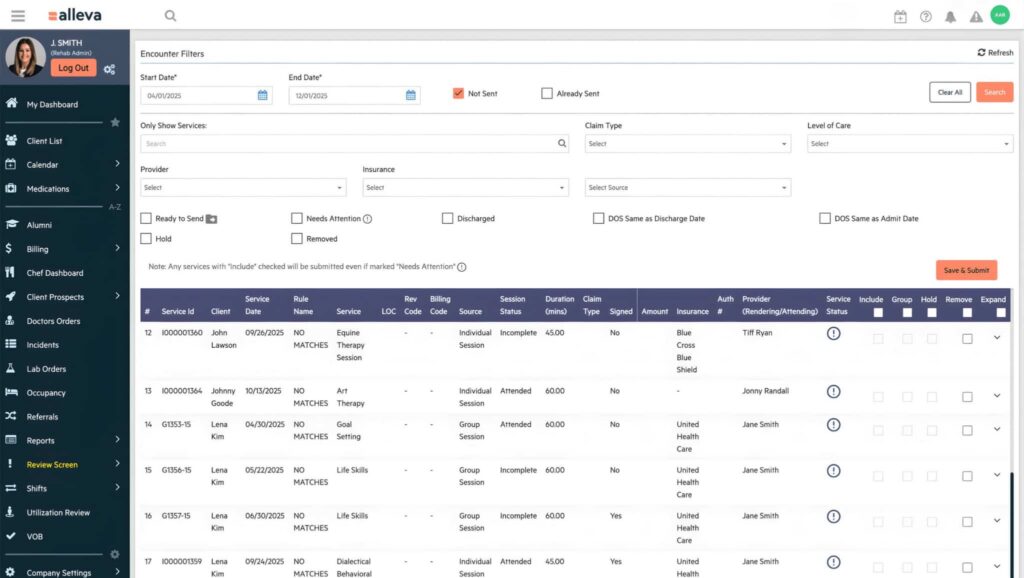
Alleva is an all-in-one operations platform built exclusively for behavioral health. It combines EMR/EHR, billing and RCM, compliance (InCheck), CRM, and AI (Alleva Intelligence) in one system, and it names detox and medically monitored withdrawal among the care settings it supports alongside residential, PHP, and IOP/OP.
For detox teams, the practical edge is fewer handoffs. Admissions, clinical documentation, medication records, and claims live in the same record instead of three systems.
Pricing: Custom quote
Key features:
- Detox and withdrawal workflows: Track vitals, manage protocols, and document care from admission through discharge.
- Medication management: Electronic prescribing sent directly to the pharmacy, a built-in medication database, and drug-interaction alerts.
- MAR safety checks: Required documentation, including staff signatures, for every medication given.
- Admissions CRM: Lead tracking and referral management from first inquiry through discharge.
- Built-in eligibility checks: Self-service verification of benefits (VOB) powered by Waystar.
- Integrated billing: Alleva Billing’s claim scrubbing and ERA auto-posting run on native Waystar clearinghouse connectivity.
- Compliance management: InCheck is designed around CARF, Joint Commission, and state behavioral health requirements.
- Ambient documentation: Echo, a HIPAA-compliant ambient AI tool, drafts structured notes for clinician review.
Client proof: In Alleva’s published Warriors Heart case study, the program reported a 30% reduction in documentation time, a 15% improvement in claim accuracy, and a 25% improvement in medical-necessity documentation after adopting Echo. Results are specific to that program. See the case study on the Alleva Intelligence page.
Trust signals: SOC 2 Type II, HIPAA compliant, and ONC certified, per the Alleva Trust Center. A BAA (business associate agreement) is available on request. Recognition includes Software Advice 2026 and the Capterra Shortlist 2026.
Consider Alleva if:
- You run detox alongside residential, PHP, or IOP and want one record across the continuum.
- You want clinical documentation and billing connected instead of reconciled by hand.
- Accreditation prep is a recurring fire drill for your team.
2. Netsmart: best for large multi-site behavioral health systems
Netsmart is an enterprise behavioral health EHR vendor that serves large, distributed organizations. Its strengths are scale, multi-site reporting, and interoperability with hospitals and HIEs (health information exchanges).
Pricing: Custom quote
Key features: Enterprise behavioral health workflows, centralized multi-site dashboards, hospital and HIE interoperability, and RCM services.
Consider Netsmart if: Enterprise reporting and deep hospital interfaces top your requirements list.
Watch for: Larger deployments usually mean longer timelines, more IT involvement, and more configuration effort.
3. Oracle Health (formerly Cerner): best for hospital-based detox units
Oracle Health’s EHR fits detox units embedded in hospitals. Those programs typically need pharmacy interfaces, device integration, and clinical decision support shared with the rest of the health system.
Pricing: Custom quote
Key features: Full inpatient EHR integration, medication ordering with pharmacy interfaces, structured nursing and physician workflows, and enterprise reporting.
Consider Oracle Health if: Your detox unit already runs inside a health system that uses it.
Watch for: Standalone detox centers without a hospital affiliation may find it heavier than they need, with longer implementation and higher TCO.
4. Valant: best for outpatient MAT and ambulatory withdrawal care
Valant is an outpatient behavioral health EHR used by ambulatory clinics. It focuses on visit-level documentation, e-prescribing, scheduling, and practice billing for repeat outpatient encounters.
Pricing: Custom quote
Key features: Outpatient documentation and care plans, e-prescribing, scheduling with billing, and behavioral health assessment templates.
Consider Valant if: Your program is outpatient-first and centers on MAT maintenance visits.
Watch for: Less emphasis on inpatient census and MAR workflows, so residential or inpatient detox may need added tools.
5. Welligent: best for mobile-first community clinics
Welligent is an outpatient behavioral health EHR built around mobile documentation and state reporting. It suits community clinics whose clinicians chart on phones and tablets in the field.
Pricing: Custom quote
Key features: Mobile documentation, scheduling, state-reporting connectors, clinical note templates, and integrated billing.
Consider Welligent if: Mobile capture and automated state reporting are priorities.
Watch for: Not built for inpatient census and MAR depth, so complex inpatient billing may require integrations.
How We Evaluated Detox Center Software
We reviewed public vendor documentation, published case studies, public user-review sites, and regulatory guidance from ASAM, SAMHSA, HHS, CARF, the Joint Commission, and the DEA. Research date: September 2026.
| Criterion | Weight | What we looked for |
|---|---|---|
| Detox-specific clinical workflows | 30% | CIWA-Ar/COWS, nursing observation, MAR depth |
| Compliance and audit readiness | 20% | CARF, Joint Commission, 42 CFR Part 2 support |
| RCM and payer support | 15% | Eligibility, authorizations, claim scrubbing, remittance |
| Integrations and interoperability | 15% | PDMP, labs, pharmacy, HIE connections |
| Implementation and vendor support | 10% | Migration help, training, go-live support |
| Pricing and total cost of ownership | 10% | Transparency of license and one-time costs |
Disclosure: Alleva is the publisher of this guide and is ranked first. Rankings reflect “best for” fit against the criteria above, not a universal ranking.
What to Look For in Detox Center Software
The right platform makes a safe, audit-ready detox workflow easier to run, not just easier to chart. Use each check below as a demo test and a vendor question.
Admissions and census management
A live census, waitlist, and referral queue shorten time to admit and help match patients by payer and clinical need. Referral tracking also shows which sources send appropriate admissions.
- Vendor question: How do you show bed status, expected length of stay, and referral assignment across sites?
- Demo check: Add a mock referral with a payer filter and confirm the census returns the right openings.
Withdrawal assessment and nursing flows (CIWA-Ar, COWS)
Withdrawal scales should be discrete, time-stamped fields with automatic totals and threshold alerts, not free-text notes. Scores need to trigger tasks so escalation doesn’t depend on someone remembering.
- Build test: Create a CIWA-Ar form, record scores over a 12-hour window, and confirm an escalation task fires at your threshold.
- Audit test: Confirm time stamps lock after saving and edits leave a visible trail.
Medication-assisted treatment (MAT) and e-prescribing
Detox and MAT programs need order sets for buprenorphine, methadone, or naltrexone, MAR entries for supervised dosing, and consent capture. Controlled-substance prescribing also requires DEA-compliant EPCS and a PDMP (prescription drug monitoring program) check. Alleva’s medication management tools are one example of e-prescribing built into the EHR.
- Vendor question: Do you support DEA EPCS and in-workflow PDMP queries at prescribing?
RCM, authorizations, and denial management
Integrated RCM helps catch errors before claims go out by checking eligibility, applying payer rules by level of care, and scrubbing claims. It supports cleaner submissions; it can’t guarantee payment.
- Vendor question: Can you map payer-specific rules and build a denial-to-appeal packet?
- Demo check: Run an authorization simulation and a denial-to-appeal workflow end to end.
Privacy controls and 42 CFR Part 2 consent management
Software can enable Part 2 controls, but legal responsibility stays with your program. Expect labeled Part 2 records, consent templates, role-based access, and exportable disclosure logs. Our guide to privacy in behavioral health EMR systems covers the broader access-control basics.
- Vendor question: Can the system tag Part 2 records, enforce disclosure limits, and export an accounting of disclosures?
What Changed in 2026: Part 2 Alignment and ASAM Fourth Edition
Two shifts change what detox software has to support this year: the revised 42 CFR Part 2 rule and the ASAM Criteria Fourth Edition. Both affect consent, documentation, and level-of-care fields your EHR stores every day.
The revised Part 2 rule is now enforceable
HHS finalized changes to 42 CFR Part 2 in February 2024, and programs had to comply by February 16, 2026. According to the HHS fact sheet on Part 2, the rule allows a single patient consent for all future uses and disclosures for treatment, payment, and health care operations (TPO).
The rule also applies HIPAA breach notification requirements to Part 2 records and aligns Part 2 penalties with HIPAA enforcement. Patients gain rights to an accounting of disclosures and to request restrictions on certain disclosures.
For software, those changes translate into specific features to test:
- Single TPO consent: A consent form that can capture one consent covering future TPO disclosures, with clear revocation tracking.
- Disclosure accounting: A report that lists who received Part 2 information and when.
- Restriction requests: A way to record and honor a patient’s request to limit certain disclosures.
- Breach workflow: Audit logs detailed enough to support HIPAA-style breach assessment and notification.
- Legal-proceeding safeguards: Part 2 records keep stricter limits in legal proceedings, so labeling needs to survive redisclosure.
Ask each vendor to walk through these live, not in a slide. Your privacy officer or counsel should confirm your policies match the rule.
ASAM Fourth Edition renamed withdrawal management levels
The ASAM Criteria Fourth Edition, released digitally in October 2023, integrated standalone withdrawal management levels into the main continuum of care. The ASAM Criteria FAQ maps the older “WM” levels to new numbers.
| Third Edition level | Fourth Edition level | Software implication |
|---|---|---|
| Level 1-WM | Level 1.7 | Update level-of-care picklists and outpatient order sets |
| Level 2-WM | Level 2.7 | Map existing authorizations to the new label |
| Level 3.2-WM | Level 3.5 | Clinically managed withdrawal now sits within high-intensity residential care |
| Level 3.7-WM | Level 3.7 | Medically monitored care keeps its number but not the “WM” suffix |
States and payers are adopting the Fourth Edition on different timelines, so many programs will see both labels for a while. Your EHR should let you configure level-of-care fields and keep a crosswalk, so utilization review notes and authorizations stay consistent.
Integrations That Matter for Detox Programs
Integrations cut double entry and reduce the chance of missed information at handoffs. For detox, the priority connections are PDMP lookups, EPCS, lab interfaces, pharmacy feeds, clearinghouse claims, and HIE exchange.
| Integration | Standard or format | Demo test |
|---|---|---|
| PDMP | State PDMP connection | Pull a PDMP record inside the chart |
| Labs | LOINC-coded results (Logical Observation Identifiers Names and Codes) | Post a result and confirm it links to the encounter |
| Pharmacy | NDC (National Drug Code) feeds, e-prescribing | Send a test prescription and confirm receipt |
| Claims | X12 837 claim / 835 remittance (ERA) | Submit a test claim and confirm the acknowledgment or ERA |
| HIE | CCDA (Consolidated Clinical Document Architecture) or FHIR (Fast Healthcare Interoperability Resources) | Exchange a document and check inbound and outbound logs |
Common pitfalls include identifier mismatches, unmapped LOINC or NDC codes, and PDMP single sign-on failures. Ask for integration playbooks, field-mapping matrices, sandbox access, and two client references per connector. Our EHR integration guide for behavioral health goes deeper on scoping.
Multisite Reporting and KPIs
Track readmission rate, length of stay, AMA (against medical advice) discharges, documentation timeliness, denial rate, days to payment, referral-to-admit conversion, and occupancy. A good dashboard rolls these up across sites and drills down to the patient record.
- Demo check: Ask for a multi-site KPI roll-up with 30/90/365-day trends and a scheduled audit export.
How Much Does Detox Center Software Cost?
Most behavioral health platforms price by module mix, users, providers, or beds, and nearly all require a custom quote. The license is only part of the bill. Implementation, migration, integrations, and annual support often decide whether the budget holds.
| Cost component | Typical pricing basis | What drives it up |
|---|---|---|
| Subscription or license | Per user, provider, bed, or module bundle | More modules and full-access seats |
| Implementation and configuration | One-time, scoped | More sites, custom workflows, accreditation needs |
| Data migration | One-time, scoped | Legacy formats and record volume |
| Training | One-time or per session | Role-based curricula and onsite support |
| Integrations | One-time build plus maintenance | Each PDMP, lab, pharmacy, or HIE connector |
| Ongoing support | Annual | Tiered service levels or percentage uplift |
Ask every vendor for a written TCO estimate that includes integrations, migration, training, and annual uplift. Compare those totals, not the headline license.
How to Implement Detox Center Software
Treat implementation as an operations project with clinical, billing, and compliance owners, not an IT install. The steps below keep go-live predictable.
- Confirm the timeline in writing. Single-site programs with few integrations often plan for roughly 8 to 12 weeks; multi-site or hospital-affiliated programs often plan for 12 to 24 weeks. Treat these as planning assumptions and validate them with vendor references.
- Assemble the core team. Include an executive sponsor, project manager, medical director, nursing super-users, billing lead, integration engineer, and privacy officer.
- Build detox flows first. Configure CIWA-Ar, COWS, and MAT order sets, then validate lab, pharmacy, PDMP, and clearinghouse connections.
- Migrate the essentials. Move the master patient index, active treatment plans, medications, allergies, and recent notes before older history.
- Run acceptance testing. Use scripted clinical and billing scenarios in a test environment, with written sign-off from clinical and billing leads.
- Staff go-live. Put super-users on the floor with vendor support for the first days and hold daily standups for two weeks.
- Review at 30, 60, and 90 days. Check admissions throughput, medication documentation, denial rates, and note timeliness.
Switching from another system? Our complete EMR migration guide walks through data mapping and cutover planning.
Vendor demo scripts to run
- Admit to authorization: Admit a Medicaid patient needing MAT induction, run a benefits check, and start an authorization. Pass if status updates and VOB notes save.
- Escalating withdrawal: Document rising CIWA-Ar scores over 24 hours and trigger nursing interventions. Pass if entries are time-stamped, orders fire, and the audit log shows every step.
- Denial to resubmission: Submit a claim, receive a denial, and generate an appeal. Pass if the denial, appeal packet, and resubmission are tracked end to end.
Can Software Help With CARF and Joint Commission Readiness?
Software can reduce audit effort with mapped standards, searchable records, and retrievable evidence. It doesn’t replace written policies, trained staff, or validated workflows. Ask vendors for sample audit exports and evidence-tracking examples, not just a feature list.
Alleva’s InCheck compliance management system is one example built around CARF, Joint Commission, and state behavioral health requirements. If you’re comparing broader platforms beyond detox, our roundup of the best addiction treatment software covers inpatient, IOP, and PHP options, and our residential treatment software buyer’s guide helps with step-down planning.
FAQs About Detox Center Software
How is detox software different from a general behavioral health EHR?
Detox software adds high-frequency observation, withdrawal-scale templates, inpatient-level medication administration, and short-stay census tools. A general behavioral health EHR often centers on therapy sessions and outpatient visits, so detox programs using one may need add-ons or workarounds.
Does detox center software need EPCS?
If your prescribers send controlled-substance prescriptions electronically, the system needs DEA-compliant EPCS. Many programs also want PDMP checks inside the prescribing workflow. Confirm both in the demo rather than on a feature sheet.
How does detox software protect patient privacy?
Look for role-based permissions, encryption, detailed audit logs, and Part 2 record labeling. Ask for security documentation such as a SOC 2 Type II report. Alleva, for example, publishes its SOC 2 Type II, HIPAA, and ONC documentation on its Trust Center, with a BAA available on request.
Can it integrate with our existing billing and lab systems?
Most platforms support HL7, FHIR, APIs, and clearinghouse connections. Prioritize vendors with documented interfaces to your labs, payers, and clearinghouse, and confirm who owns mapping and ongoing maintenance.
What are common migration pitfalls?
Programs often underestimate data mapping, duplicate-record cleanup, and staff training. Plan a sample record audit, a short parallel period for high-risk workflows, and super-user coverage at cutover.
How do detox software pricing models work?
Pricing usually mixes per-user seats, modules, per-bed fees, and one-time implementation. Request a full TCO that covers migration, integrations, training, and annual uplift so you can compare vendors fairly.
How long does implementation take?
Timelines vary with sites, integrations, and migration scope. Single-site programs with few integrations often plan in weeks to a few months, while multi-site programs plan longer. Validate any timeline with references from programs your size.
Does the ASAM Fourth Edition change what our EHR needs?
Yes, in labeling. Withdrawal management levels now map to new level numbers, so your level-of-care fields, utilization review templates, and authorization records should support both labels during your state’s transition.
Will software make us audit-ready for accreditation?
It can lower audit effort through mapped templates, searchable records, and exportable logs. Accreditation still depends on your policies, training, and day-to-day practice.
Choosing the Right Detox Center Software
Start with your care setting. If you run standalone detox alongside residential, PHP, or IOP care and want one connected record, shortlist an all-in-one platform like Alleva. Hospital-based units usually belong on the health system’s EHR, large multi-site organizations often evaluate Netsmart, and outpatient MAT clinics can look at outpatient-first tools like Valant.
Whatever you pick, script the demo around your real admit-to-claim workflow and confirm Part 2 consent tools before you sign.
…with a demo built around your detox workflow!
This content is for informational purposes only and is not legal, clinical, or billing advice. Alleva is a software vendor and does not provide treatment. Consult qualified counsel and your clinical leadership about requirements that apply to your program.

Kayla Briones is Sr. Product Marketing Manager at Alleva.