

Sunwave alternatives are behavioral health platforms that replace Sunwave’s EMR, intake CRM, and billing, either with one connected system or a set of specialized tools. If you’re reassessing your stack after the Sunwave and Lightning Step merger, start by deciding whether you want an all-in-one platform like Alleva’s behavioral health EMR software or separate tools for clinical, billing, and compliance work.
This guide ranks seven alternatives, explains what each one fits best, lays out cost drivers, and gives you a migration plan and demo scorecard so you can build a shortlist with confidence.
TL;DR: Get written answers from Sunwave on support, pricing, and data export first. Then compare alternatives on your own levels of care and payer mix, not on feature lists.
Key Takeaways
- Sunwave changed in late 2025. Sunwave Health and Lightning Step announced a merger on October 27, 2025, so roadmaps, support, and contracts may shift. Confirm in writing what stays the same for you.
- Best overall: Alleva, for treatment programs that want EMR, billing, CRM, compliance, and AI documentation in one platform. Alleva publishes this guide, and we’ve said so up front.
- Plan the timeline: Single-site programs commonly go live in six to twelve weeks. Multi-site or highly customized rollouts often take three to six months or longer.
- Price the full year: Implementation, migration, clearinghouse fees, and training move the total more than the subscription does.
- Ask for evidence, not assertions: a current SOC 2 Type II report, a signed BAA, audit logs, and 42 CFR Part 2 consent handling that holds up across integrations.
Why Teams Are Evaluating Sunwave Alternatives in 2026
On October 27, 2025, Sunwave Health and Lightning Step announced they would combine into one company, backed by a growth investment from BVP Forge, with Lightning Step’s CEO leading the combined business. Combinations like this often look good on paper: more resources and a bigger roadmap. For the programs running on either system, they also raise practical questions about which product carries forward, how support changes, and what happens at renewal.
We’ve written about the risks of EMR vendor consolidation for behavioral health programs. If you’re on Sunwave today, ask your account team four things in writing:
- Will your current product, modules, and integrations stay supported, and for how long?
- Will your support model or named contacts change?
- Are pricing or contract terms changing at renewal?
- Can you get a full data export, including audit logs and attachments, on request?
Those answers tell you whether to stay, renegotiate, or start a structured evaluation.
Whatever you choose has to cover what Sunwave does for you today:
- Clinical documentation: intake assessments, progress and group notes, treatment plans, and discharge summaries.
- CRM: lead and referral tracking from first call through intake.
- Billing and RCM: claims, remittance posting, and denial follow-up.
- Scheduling and reporting: session and group scheduling, census, and revenue reports.
If a vendor can’t cover one of these, plan for the gap before you sign.
7 Best Sunwave Alternatives at a Glance
| Platform | Best for | Pricing | Model |
|---|---|---|---|
| Alleva | Treatment programs that want one connected platform | Custom quote | Cloud EMR/EHR with built-in billing, CRM, and GRC |
| Kipu | Established addiction treatment centers | Quote-based | Cloud EMR, CRM, and RCM |
| Valant | Outpatient psychiatry and therapy practices | Quote-based | Cloud behavioral health EHR |
| Credible (Qualifacts) | Community mental health and CCBHC organizations | Quote-based | Cloud behavioral health EHR |
| ICANotes | Fast, template-driven clinical documentation | Varies by plan | Cloud behavioral health EHR with billing support |
| TherapyNotes | Solo clinicians and small outpatient groups | Published Solo and Group plans | Cloud practice management and EHR |
| Epic | Large health systems with behavioral health services | Enterprise quote | Enterprise EHR |
1. Alleva: Best Overall for Treatment Programs That Want One Connected Platform
Alleva is an EMR/EHR built exclusively for behavioral health and addiction treatment, with billing, CRM, compliance, and AI documentation on one record. It supports IOP and outpatient, PHP, residential, and detox programs, from a single site to a multi-location organization.
Key features
- Clinical documentation: a task-based workflow, customizable templates for individual, group, and family sessions, and medication management with ePrescribe.
- Built-in billing: Alleva’s integrated behavioral health billing covers charge capture, self-service VOB and claim submission through Waystar, custom claim rules and scrubbing, prior-authorization tracking, ERA auto-posting, and denial management and appeals.
- AI documentation: Alleva Intelligence AI tools include Echo, a HIPAA-compliant ambient AI that drafts DAP, SOAP, and UR notes for clinician review without saving recordings, plus TravisAI for in-app answers and Insights dashboards.
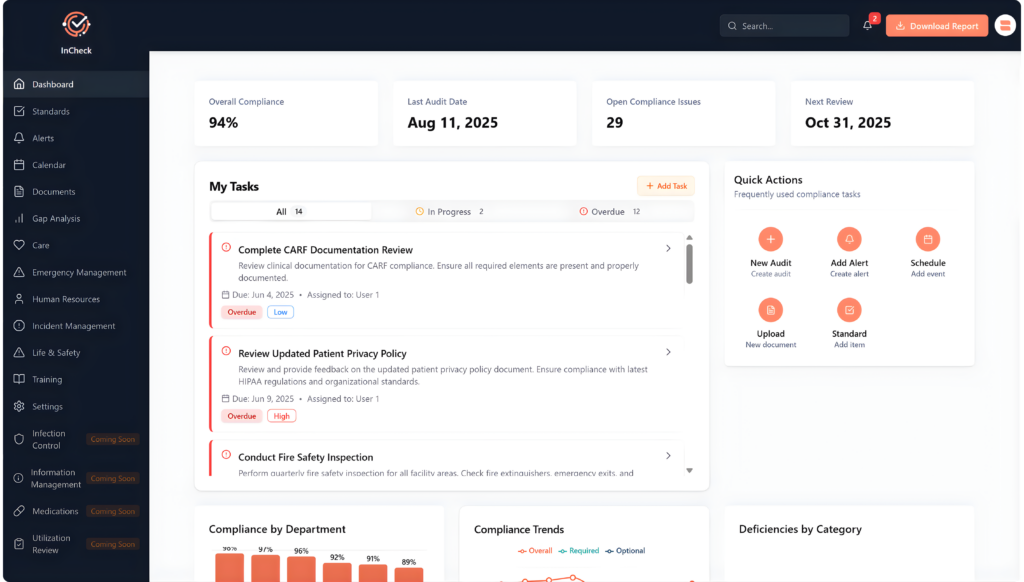
- Compliance: InCheck, Alleva’s GRC software, keeps CARF, Joint Commission, and state-requirement content and audit evidence in one place.
- Referrals and engagement: lead tracking and referral management, a branded client and family portal, and built-in telehealth with no third-party logins.
- Integrations: an open API plus connections such as Salesforce and CollaborateMD.
- Security: SOC 2 Type II, HIPAA compliant, and ONC certified, with a BAA on request.
Pros
- Built only for behavioral health, so level-of-care workflows aren’t retrofitted
- Clinical, billing, and compliance work share one record
- Fast support with a dedicated success manager
Cons
- Not designed for solo practitioners or non-behavioral-health specialties
- Implementation takes real setup time from your billing and clinical leads
Pricing: Custom quote.
2. Kipu: Best for Established Addiction Treatment Centers
Kipu Health is a behavioral health platform spanning CRM, EMR, revenue cycle management, and compliance, built to run the client journey from referral through billing.
Key features: centralized CRM for leads and referrals · RCM and eligibility checks · analytics dashboards and custom reporting
Pros: end-to-end platform; long track record in addiction treatment
Cons: geared toward larger organizations; a broad platform takes time to learn
Pricing: Quote-based
3. Valant: Best for Outpatient Psychiatry and Therapy Practices
Valant is a behavioral health EHR for outpatient mental health practices, with documentation, practice management, and patient engagement tools, including support for IOP and PHP programs.
Key features: psychiatry and therapy note templates · scheduling and practice management · engagement and measurement tools
Pros: built around outpatient clinician workflows; a strong fit for psychiatry practices
Cons: less suited to residential and detox programs; confirm billing depth for your payer mix during the demo
Pricing: Quote-based
4. Credible (Qualifacts): Best for Community Mental Health and CCBHC Organizations
Credible is Qualifacts’ web-based behavioral health EHR, used widely by community mental health centers and Certified Community Behavioral Health Clinics (CCBHCs), as well as residential and substance use agencies.
Key features: program-based documentation · state and CCBHC reporting · billing tied to clinical services
Pros: established in public-sector and CCBHC settings; supports multi-program agencies
Cons: built for larger agencies, so smaller private-pay centers may find it heavy
Pricing: Quote-based
5. ICANotes: Best for Fast, Template-Driven Documentation
ICANotes is a behavioral health EHR built around menu-driven charting for psychiatrists and therapists, with billing and RCM support.
Key features: menu-driven psychiatric and therapy notes · e-prescribing · billing and revenue cycle support
Pros: fast note completion; serves prescribers and therapists in one system
Cons: templated notes can read alike; there’s a learning curve at first
Pricing: Varies by plan
6. TherapyNotes: Best Budget Option for Small Outpatient Practices
TherapyNotes is practice management and EHR software for therapists and small groups, covering scheduling, notes, telehealth, and insurance claims.
Key features: scheduling and calendar · behavioral health note templates · telehealth · electronic claims
Pros: easy to learn; pricing is published
Cons: not built for level-of-care billing such as IOP, PHP, or residential; limited multi-site controls
Pricing: Published Solo and Group plans; check the vendor’s site for current rates.
7. Epic: Best for Large Health Systems With Behavioral Health Services
Epic is an enterprise EHR with behavioral health modules and population health tools for large health systems that want a single patient record across hospitals and clinics.
Key features: integrated charting, scheduling, and billing across sites · population health analytics · enterprise interoperability
Pros: scales across hospitals and clinics with centralized governance; broad interoperability
Cons: less behavioral-health-specific out of the box than specialized vendors; longer implementations and heavier procurement
Pricing: Enterprise quote
How We Chose These Sunwave Alternatives
We compared vendors using their public product pages and documentation, judged against what behavioral health programs need when replacing an EMR, CRM, and billing system. Alleva publishes this guide and lists its own product first; we’ve said so here so you can weigh it accordingly.
The criteria we used:
- Fit for behavioral health clinical workflows, including group documentation
- Depth of billing and RCM, not just claim submission
- Compliance and audit readiness, including 42 CFR Part 2
- Integrations, data export, and migration support
- Total cost of ownership and support model
If you’re also weighing Kipu, our guide to Kipu alternatives for treatment programs covers that shortlist in more depth.
What to Look for in a Sunwave Alternative
Evaluate vendors across the areas that most often cause problems after purchase. Here’s what to verify and what to ask in the demo.
1. Clinical workflows and group therapy support
Look for built-in group scheduling, rolling attendance, group notes with individual addenda, and batch billing. Group work is core to behavioral health programs, and weak support creates manual work. Ask: Can you demo a rolling-attendance group session from scheduling through billing?
2. RCM depth versus a billing add-on
Full RCM includes claim rules, eligibility checks, denial workflows, and A/R aging. Thin billing modules push reconciliation back onto your team. If you’re weighing integrated billing against a third-party service, here’s why built-in billing beats a bolt-on. Ask: Can you show denial workflows and an 837-to-ERA reconciliation for a recent cycle?
3. CRM and referral tracking
Look for referral pipelines, follow-up sequences, and reporting on how long it takes a referral to become an intake. Ask: Can you show how a referral moves from first call to intake, and report on that timeline?
4. Compliance and audit readiness
Look for consent versioning, redisclosure controls, and an EMR audit trail that records who opened each record, when, and why. Ask: Can you export an audit-log report and show how Part 2 records are kept out of disclosures that lack consent?
5. Interoperability and data export
Check FHIR and HL7 support, CCD/C-CDA exports, and bulk export. Migrations and integrations depend on documented standards and mapped fields. Ask: Which FHIR resources and HL7 messages do you support? Can we see sample payloads?
6. Security and certifications
Ask for evidence, not assertions: a SOC 2 Type II report, encryption at rest and in transit, single sign-on, penetration test summaries, and a signed business associate agreement (BAA). Ask: Can you share your latest SOC 2 Type II report and a sample BAA?
7. Analytics and AI guardrails
You need dashboards your operators trust and AI that keeps clinicians in control. Ask: Does the AI draft notes for clinician review, does it store session recordings, and can clinicians turn it off?
How Much Do Sunwave Alternatives Cost?
Most behavioral health platforms price by custom quote, so ask each vendor for a 12-month total cost of ownership.
| Cost component | What drives it |
|---|---|
| Subscription | Modules (EMR, billing, CRM, compliance) and user or site count |
| Implementation | Configuration, form builds, and project management |
| Data migration | Volume and cleanliness of records, attachments, and audit logs |
| Clearinghouse and per-claim fees | Claim volume and payer mix |
| Training and change management | Number of roles and sites, and clinician time away from care |
| Outsourced billing (if used) | Usually a percentage of collections |
Costs teams most often miss: running two systems in parallel during cutover, payer re-enrollment gaps that hold claims, and cleaning data before it moves. Billing is usually where these show up first, and our comparison of behavioral health insurance billing software covers that side in more depth.
How to Switch From Sunwave
Implementations succeed with clear owners, early payer testing, and a staged cutover. Single-site programs commonly go live in six to twelve weeks; multi-site or highly customized rollouts often take three to six months or longer.
- Set governance and a timeline. Form a steering group with operations, clinical leads, billing, IT and security, and the vendor’s project manager. Agree on decision rights and go/no-go criteria.
- Run discovery and mapping. Audit workflows, data models, and payer EDI connections. Export your datasets and build a field mapping matrix.
- Extract and validate data. Negotiate a full export, test small batches, and have clinicians and billers confirm the results match. Log any manual fixes.
- Validate payer connectivity. Test eligibility, claim submission, and remittance for each payer, and run parallel billing cycles where you can.
- Watch for common derailers. Incomplete exports, payer EDI failures, and weak change management stall more projects than software does. Plan extra extraction cycles, direct payer contacts, and role-based training.
- Cut over and monitor. Freeze edits in the old system where you can, staff a command center, and track denial rate, days in A/R, and audit findings at 90, 180, and 365 days.
Our EMR migration guide covers extraction, mapping, and validation in more detail.
Migration Playbook and Vendor Demo Scorecard
Extract clinical and billing data. Request clinical exports (CCD/C-CDA, FHIR, or equivalent) covering demographics, encounters, progress notes, medications, allergies, care plans, and audit logs. For billing, request raw 837 and 835 files, payer remits, and posting-level detail, plus record counts and an export schema.
Map and transform. Build a mapping matrix for CPT/HCPCS, ICD-10, NPI, payer IDs, and site IDs. Normalize identifiers and load a test subset drawn from both active and discharged clients.
Test claims end to end. Submit a sample of real claims through a staging clearinghouse, ingest the ERA, and post to the ledger. Set your matched-claim and paid-variance targets before you start, and don’t cut over until you hit them.
Plan the parallel run and rollback. Run both systems in parallel long enough to compare results daily, define rollback triggers in advance, test the rollback once in staging, and keep full exports for as long as your retention policy and contract require.
| Stakeholder | Demo scenarios to require | Key question |
|---|---|---|
| Operations | Intake-to-discharge pipeline, multi-site scheduling, bulk user provisioning | How are cross-site clients and role-based workflows handled? |
| Billing / RCM | 837 claim creation, ERA posting, denial management, A/R aging | Can you show an 837-to-ERA reconciliation and denial workflow? |
| Clinicians | Note templates, imported records, medication reconciliation | How do imported records appear in the clinician view? |
| IT / Security | SSO setup, audit log search, bulk export tools | Can we see SSO, audit search, and a bulk export live? |
| Compliance | Audit reporting, consent management, retention policies | How does the system reproduce historical records for an audit? |
Ask for a scripted multi-site demo, sandbox access with sample exports, and a migration reference from an existing behavioral health customer.
How 2024–2026 Rules Change Vendor Selection
Two federal rule sets now shape what you should require in a contract.
42 CFR Part 2. HHS finalized updates to the Part 2 rule in February 2024, with a compliance date of February 16, 2026. According to the HHS fact sheet on the 42 CFR Part 2 Final Rule, patients can now give a single consent for treatment, payment, and health care operations, and HIPAA breach notification rules apply to Part 2 records. Your new platform has to capture that consent scope and enforce redisclosure limits inside integrations, not just in policy.
Certified APIs. The ONC Cures Act Final Rule requires certified health IT to offer standardized FHIR APIs, which makes exports and integrations more predictable. Ask whether a vendor’s product is ONC certified, which FHIR resources it supports, and whether it can export a full patient population in bulk.
What to put in the contract:
- Data portability terms: export formats, turnaround, and any fees
- API documentation and sandbox access before signing
- Uptime and support SLAs with remedies
- A signed BAA and a current SOC 2 Type II report
Whatever you choose, keep control of your EHR data in writing, so a future vendor change never strands your records.
FAQs About Sunwave Alternatives
What are the top competitors to Sunwave?
Common alternatives include Alleva, Kipu, Valant, Credible (Qualifacts), ICANotes, TherapyNotes, and Epic. Lightning Step merged with Sunwave in late 2025, so it’s now part of the same company rather than a separate alternative.
Is Sunwave going away after the Lightning Step merger?
Product plans after a merger can change over time, so don’t rely on announcements alone. Ask your account team for written commitments on product support, pricing, and data export before your renewal.
How do I export patient data from Sunwave?
Export options depend on your contract and modules. Start with a data inventory and request sample extracts (CSV, CCD/C-CDA, or FHIR) from Sunwave, then use the migration checklist above.
How long does a typical migration take?
Single-site programs commonly go live in six to twelve weeks. Multi-site or highly customized rollouts often take three to six months or longer, driven mostly by billing setup, integrations, and data cleanup.
What drives cost when switching?
Data cleanup, custom integrations, payer interfaces, and staff training drive most one-time costs. Outsourced billing fees or per-claim charges affect ongoing costs.
Will switching affect HIPAA or 42 CFR Part 2 compliance?
Your obligations stay the same. Confirm the new vendor supports encryption, audit logs, access controls, a signed BAA, and Part 2 consent handling.
Will our integrations move with us?
Some integrations port directly; others need re-authorization or new contracts. Audit your integration list early and budget for re-testing and any certification fees.
Our Recommendation
For most addiction treatment and behavioral health programs leaving Sunwave, Alleva is the strongest overall fit: EMR, billing, CRM, InCheck compliance, and AI documentation on one record. Valant is the better pick for outpatient psychiatry practices, and TherapyNotes for small outpatient teams that want low cost and low training overhead.
Next 30 days: get written answers from Sunwave on support, pricing, and exports; request a sample data export; and shortlist two or three vendors.
Next 90 days: run scripted demos with the scorecard above, test a claims cycle in a sandbox, and sign with a dated migration plan.
Bring your current module list and demo script, and we’ll walk your own programs, payers, and Part 2 workflows through Alleva. Prefer to talk first? Call (877) 425-5382.
This guide is written for U.S. behavioral health operators, billing teams, and clinical leaders. Product details and pricing come from vendor materials and public listings reviewed in November 2026 and may change, so confirm current terms with each vendor. It isn’t legal or compliance advice; confirm your HIPAA and 42 CFR Part 2 obligations with qualified counsel.

Kayla Briones is Sr. Product Marketing Manager at Alleva.