

Outpatient addiction treatment software manages intake, group scheduling, clinical documentation, and billing for programs treating substance use disorder (SUD) outside a residential setting. The strongest systems for IOP and PHP programs are purpose-built behavioral health platforms rather than general medical EHRs, because outpatient SUD care runs on recurring groups, medication-assisted treatment, and confidentiality rules that general systems were never designed to handle. Alleva’s addiction treatment EMR software guide covers the category in more depth.
Key Takeaways
- Group scheduling is the make-or-break feature. Outpatient revenue runs through recurring groups with rolling enrollment. If attendance doesn’t map to billing rules automatically, you lose money every week.
- MAT depth separates real SUD platforms from general behavioral health tools. Look for e-prescribing with EPCS, live PDMP queries, and toxicology ordering inside the chart.
- 42 CFR Part 2 is not the same as HIPAA. SUD records need consent-based segmentation that most general medical EHRs cannot do at the encounter level.
- If you run a single small outpatient clinic, a lightweight documentation-first tool is usually enough. If you run multiple sites or bill IOP and PHP at volume, pick an all-in-one platform where clinical and billing share a system.
What outpatient addiction treatment software does
Outpatient addiction treatment software coordinates the client journey and the program’s billing and compliance obligations in one system. It differs from a general medical EHR in three specific ways: it handles recurring group care, it supports medication-assisted treatment (MAT) workflows end to end, and it enforces the confidentiality rules that apply to SUD records.
How it differs from a general medical EHR
General medical EHRs are built around individual encounters with one provider. Outpatient SUD programs run cohorts, and a single client may attend four group sessions and one individual session in a week, each with its own documentation and billing implications.
The confidentiality gap matters more. Records from federally assisted SUD programs fall under 42 CFR Part 2, which is stricter than HIPAA and requires consent-based segmentation so restricted information reaches only authorized users. Alleva’s behavioral health EMR is built for these workflows rather than retrofitted from a primary-care system.
The jobs the software has to do
| Function | What it covers |
|---|---|
| Intake and referral management | Capture leads, process referrals, triage admissions |
| Group scheduling and attendance | Recurring groups, rolling enrollment, no-show outreach |
| MAT and medication workflows | Orders, e-prescribing, PDMP checks, prescriber signoffs |
| Clinical documentation | Progress notes, treatment plans, team messaging |
| Revenue cycle management (RCM) | Claim creation, payer rules, denial management |
| Consent and Part 2 segmentation | Consent capture, access partitioning by role |
| Reporting and analytics | Utilization, outcomes, financial and audit reporting |
Best outpatient addiction treatment software in 2026
| Product | Best for | Starting price | Model |
|---|---|---|---|
| Alleva | Outpatient SUD programs wanting one operations stack | Custom quote | Cloud SaaS |
| Kipu | Programs running both residential and outpatient | Custom quote | Cloud SaaS |
| Netsmart | Large multi-site community behavioral health | Custom quote | Cloud SaaS |
| Valant | Outpatient psychotherapy and medication management | Custom quote | Cloud SaaS |
| ICANotes | Psychiatry-first documentation in SUD programs | Custom quote | Cloud SaaS |
| Welligent | County and community mental health providers | Custom quote | Cloud SaaS |
| TheraNest | Small outpatient clinics on a tight budget | Per clinician / month | Cloud SaaS |
ALLEVA: Best overall for outpatient SUD programs wanting one operations stack
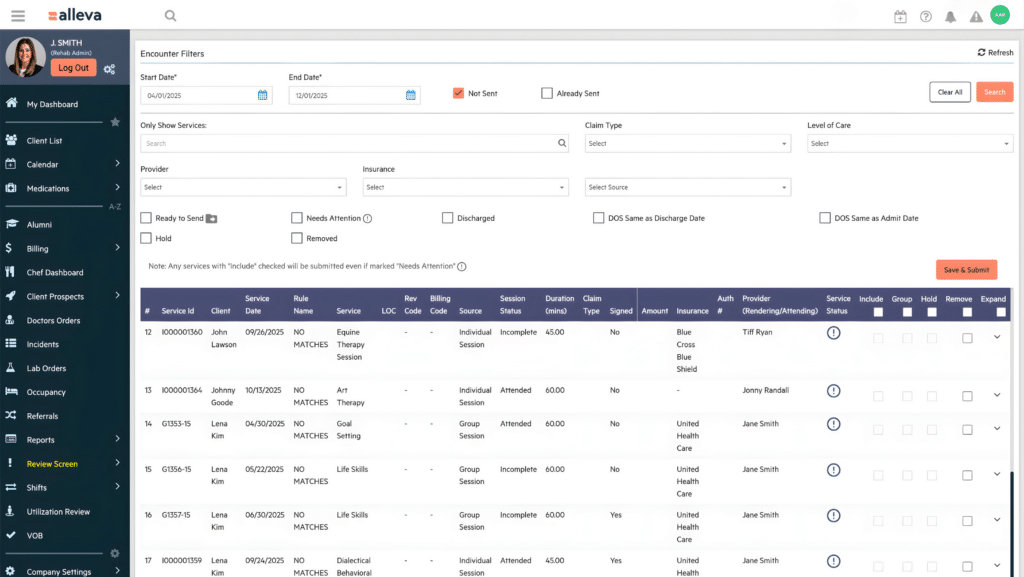
Alleva is the only all-in-one operations platform built exclusively for behavioral health. Admissions, clinical documentation, compliance, and billing run in one system rather than three integrated ones, which matters most for outpatient programs where a group session touches scheduling, a note, and a claim within the same day.
Three things distinguish it for outpatient SUD work.
InCheck was built by a behavioral health compliance insider. It maps to CARF, Joint Commission, and state behavioral health requirements rather than being a generic governance, risk, and compliance (GRC) tool with healthcare labels applied. InCheck’s compliance and audit tooling is designed around the surveys outpatient programs actually face.
Echo is HIPAA-compliant ambient AI with a documented case study. Warriors Heart, a treatment provider using Echo, reported a 30% reduction in documentation time, a 15% improvement in claim accuracy, and a 25% improvement in medical-necessity documentation. Those figures come from the Warriors Heart case study and describe one program’s results, not a guarantee. Echo’s ambient documentation runs inside the clinical workflow rather than as a bolt-on.
Billing sits in the same system as the documentation it comes from. Alleva Billing removes the re-entry step between clinical and revenue teams, with self-service verification of benefits (VOB) powered by Waystar.
The company was founded in 2016 after a friend’s son died of an overdose, which is where “help the helpers” comes from. It shows up in how the platform treats clinician burden.
Pricing: Custom quote
Key capabilities:
- Referral intake with consent flags, routed to admissions staff
- Group scheduling with attendance-to-billing mapping
- MAT templates with e-prescribing integration
- Configurable 42 CFR Part 2 controls
- Built-in RCM and AR dashboards
- CRM and outreach automation for referral sources
- Analytics for length of stay, revenue per client, clinician productivity
- Audit logging for accreditation readiness
Compliance posture: SOC 2 Type II, HIPAA compliant, and ONC certified. Documentation is available at trust.helloalleva.com. A business associate agreement (BAA) is available on request.
Recognition: Software Advice 2026, Capterra Shortlist 2026, NAATP member, NATSAP member.
Pros:
- One system for EMR, CRM, RCM, and compliance, which cuts vendor handoffs
- Behavioral-health-specific forms and templates for group and SUD documentation
- Hands-on migration support for programs switching from another EMR
- Open API with existing integrations including Waystar, CollaborateMD, and Salesforce
Cons:
- Built for mid-size and multi-site programs; solo practices may find it more than they need
- Full-platform depth means a longer implementation than a single-feature tool
Kipu: Best for programs running both residential and outpatient
Kipu suits programs running both residential and outpatient services, with an emphasis on handoffs and census control across levels of care. Its admissions flow, bed and census management, medication tracking, and unified charting reduce duplicate documentation when a client steps down from residential to IOP.
Pricing: Custom quote
Strengths: residential workflow and census controls; unified charting across levels of care; medication tracking supporting MAT; group scheduling for high-volume programs.
Limitations: heavier than a standalone outpatient clinic needs; implementation is more involved for mixed-level setups; the residential feature depth adds administrative overhead if you only run outpatient services.
If you are weighing levels of care, the residential treatment software comparison covers that side.
Netsmart: Best for large multi-site community behavioral health
Netsmart is an enterprise EHR with population-health capability, aimed at county agencies and large community behavioral health systems. It scales case management, care coordination, and payer connectivity across many locations.
Pricing: Custom quote
Strengths: built for county systems and large providers; strong interoperability and payer connections; designed for distributed teams and program-level reporting.
Limitations: pricing and contracting favor larger organizations; implementations are long and often need custom interfaces; the feature set is more than most outpatient-first clinics will use.
Valant: Best for outpatient psychotherapy and medication management
Valant is built around psychotherapy and medication management, with therapy-first note templates and medication reconciliation. It fits outpatient clinics focused on therapy and psychiatry rather than facility-based care.
Pricing: Custom quote
Strengths: psychotherapy templates that cut documentation time; medication management workflows that reduce reconciliation errors; good fit for combined psychiatry and therapy clinics.
Limitations: less emphasis on residential or facility workflows; programs needing census management will find gaps; large multi-site groups may need customization for centralized billing.
ICANotes: Best for psychiatry-first documentation in SUD programs
ICANotes centers on psychiatry workflows and structured psychiatric templates, which helps SUD programs treating co-occurring psychiatric conditions. Psychiatric exams, risk assessments, and medication tracking live in the same chart.
Pricing: Custom quote
Strengths: psychiatry-first templates that shorten note time for medication management; structured fields supporting audit readiness; psychiatry and SUD documentation in one record.
Limitations: template logic has a learning curve; limited native revenue cycle management compared with full RCM platforms.
For psychiatry-capable systems specifically, see the psychiatry EHR software comparison.
Welligent: Best for county and community mental health providers
Welligent is oriented to public-sector behavioral health, which makes it a fit for county and community providers. It supports configurable program-level documentation, multi-funding billing, and detailed audit controls.
Pricing: Custom quote
Strengths: configurable program-unit workflows; support for grants, Medicaid, and county funding streams with funder-specific billing rules; role-based permissions and audit trails for public-sector oversight; prebuilt state and county reporting templates.
Limitations: procurement cycles can be slow for smaller counties; implementations usually need customization to mirror county workflows; legacy payer integrations add integration work.
TheraNest: Best budget option for small outpatient clinics
TheraNest targets solo clinicians and very small clinics providing counseling and SUD-related therapy, with notes, scheduling, telehealth, and basic billing at a low per-clinician price.
Pricing: Per clinician per month, with public tiers
Strengths: low cost and fast onboarding; lightweight interface that shortens training; solid documentation and telehealth for counseling-focused care.
Limitations: not designed for complex billing, advanced RCM, or AR workflows; limited multi-site features; growing programs typically outgrow it.
How we evaluated these platforms
Evaluation drew on vendor documentation, product demos, user reviews, public case studies, and regulatory guidance, with hands-on testing where available. Research was completed in September 2026.
| Criterion | Weight | What it covers |
|---|---|---|
| Clinical workflows and MAT support | 30% | Template depth, medication workflows, measurement-based care |
| Compliance and consent controls | 20% | HIPAA features, audit trails, 42 CFR Part 2 segmentation |
| RCM and billing integration | 15% | Claims export, denial management, EDI |
| Integrations and interoperability | 10% | HL7 and FHIR, lab and pharmacy connections |
| Measurement-based care and reporting | 10% | Outcome measure support and dashboards |
| Implementation and support | 10% | Onboarding, service levels, training |
| Pricing and total cost of ownership | 5% | Licensing and implementation fees |
Alleva appears on this list and publishes it. The criteria and weights were applied the same way to every vendor, and the weighting reflects what outpatient SUD programs report caring about most.
What to look for in outpatient addiction treatment software
Eight capabilities separate systems that fit outpatient SUD work from systems that merely tolerate it. Each one comes with the question to put to the vendor during a demo.
1. Intake and referral CRM
What it is: A CRM that captures leads, referrals, payer verification, and program placement in one record.
Why it matters: When intake data flows through to scheduling, notes, and billing, referrals stop falling through the cracks.
Ask the vendor: Can you demo a client moving from referral to admission with intake history, automated eligibility checks, and an assigned treatment modality?
2. Group scheduling with rolling enrollment and billing mapping
What it is: Recurring group sessions with mid-cycle enrollment, capacity controls, and billing rules mapped to attendance.
Why it matters: Outpatient programs run on group care. Weak scheduling causes revenue loss and messy records at the same time.
Ask the vendor: Can you simulate a rolling-enrollment group that bills partial attendance differently and produces correct claims?
Related reading: group therapy software comparison.
3. MAT workflows
What it is: Controlled-medication workflows covering e-prescribing, prescription drug monitoring program (PDMP) queries, urine toxicology orders, and medical review officer (MRO) review paths.
Why it matters: MAT safety rests on documented checks, chain of custody for toxicology, and prescriber audit trails.
Ask the vendor: How does the system automate PDMP checks, schedule urine collections, and attach MRO review notes to the medication record?
4. Consent management and 42 CFR Part 2 segmentation
What it is: Consent flags and segmentation rules that limit access to SUD records, as required by 42 CFR Part 2.
Why it matters: Misapplied access breaches federal confidentiality rules and creates accreditation risk. SAMHSA publishes the current Part 2 guidance.
Ask the vendor: Can you show consent-based segmentation that prevents a named user from viewing restricted notes while leaving their other care tasks intact?
5. Integrated revenue cycle management
What it is: Eligibility and VOB checks, claims submission, electronic remittance advice (ERA) posting, and denials workflows connected to clinical records.
Why it matters: Built-in RCM removes the re-entry step between clinical documentation and claims.
Ask the vendor: Show a full claim lifecycle for a typical outpatient CPT code, from eligibility check through claim submission, ERA posting, and a denied claim routed to appeals.
Background: how VOB works in behavioral health billing.
6. Measurement-based care and outcome dashboards
What it is: Automated collection of validated instruments such as PHQ-9, GAD-7, and WHO ASSIST, with dashboards linking scores to treatment goals.
Why it matters: Longitudinal outcome data is increasingly what payers and accreditors ask to see.
Ask the vendor: Can you run a client timeline showing an intake PHQ-9, three follow-ups, and an aggregated program outcomes dashboard?
7. Interoperability
What it is: HL7 and FHIR support plus APIs for labs, PDMPs, health information exchanges, and partner EHRs.
Why it matters: Real interoperability removes duplicate entry and makes care coordination possible without fax.
Ask the vendor: Can you provide API documentation and a sandbox account for a lab result push and an appointment sync?
Technical primer: what is HL7.
8. Security and audit logs
What it is: Immutable audit logs, role-based access, and exportable reports for accreditor review.
Why it matters: Audit-ready logs shorten survey preparation and evidence compliance during an investigation.
Ask the vendor: Show an audit report for a sample chart listing views, edits, consent changes, and a time-stamped chain of custody.
What outpatient addiction treatment software costs
Most vendors in this category price by subscription and quote custom. Seats, provider full-time equivalents, encounters, and locations are the common units. Budget beyond the subscription: integration, data migration, training, and annual support all land in year one.
| Cost component | Typical range | Notes |
|---|---|---|
| Subscription / license | Custom quote | Per seat, per FTE, or per location; list pricing is rarely published |
| Implementation | Custom quote | Workflow setup, project management, vendor consulting |
| Data migration | Custom quote | Scales with volume, legacy format, and reconciliation effort |
| Integration interfaces | Custom quote | Often charged per interface for labs, PDMPs, payers, clearinghouses |
| Training | Custom quote | On-site or virtual training, super-user development, cutover support |
Rough shape by program size: a one-to-five-clinician practice needs a compact subscription and limited integrations; a six-to-twenty-five-clinician program needs multi-role licensing, dedicated training, and at least one paid integration; anything above that or multi-site needs enterprise licensing, several interfaces, and formal service levels.
For the billing side specifically, see the behavioral health billing software comparison.
How to implement without losing a quarter
Implementations run as phased projects: discovery and planning, configuration, data migration, training, pilot, then phased go-live. Timelines vary with organization size, interface count, and whether you need RCM, e-prescribing, or PDMP connections. Ask each vendor for a timeline based on programs of your size rather than working from a generic estimate.
Who needs to be in the room: a clinical champion, an operations lead, IT and security, a billing lead, and a compliance officer.
What derails projects: thin training, poor data mapping, and incomplete workflow configuration. Role-based training, field-level mapping reviews, and end-to-end validation address all three.
Test before cutover: claims end to end with payer acknowledgements; e-prescribing and PDMP workflows; group billing and attendance aggregation; sample chart audits.
Ask for a migration readiness assessment if you are consolidating several legacy systems, carry complex payer rules, or need merged charts across sites.
How 2024 to 2026 telehealth and privacy updates change vendor selection
Recent policy updates require finer-grained consent, encounter-level data controls, telehealth e-prescribing for controlled medications, and exportable audit trails. Vendors should be able to show you how each is implemented rather than assert it.
Three questions worth asking directly:
- Can you segment and prevent redisclosure of Part 2 records at the encounter, program-unit, or episode level? Ask for technical screenshots and implementation examples.
- Can you attach time-limited and purpose-limited consent terms to specific notes and attachments, and carry that consent into derived reports? Ask for export samples.
- Do you support telehealth e-prescribing for controlled substances, including buprenorphine, with integrated PDMP checks and timestamped attestations? Verify chain-of-custody logs and signature workflows.
Cite primary authorities when you write RFP requirements. SAMHSA governs Part 2, the DEA governs telemedicine prescribing of controlled substances, and HHS governs HIPAA. Ask for implementation evidence, not claims.
Integrations that matter for outpatient addiction care
Map the integrations that carry clinical and financial weight before vendor meetings. Prioritize the interfaces touching controlled substances, lab-driven decisions, telehealth documentation, and payer exchanges.
| Integration | Technical depth to verify | Impact | Question to ask |
|---|---|---|---|
| E-prescribing | Surescripts-certified broker or live API; EPCS support for controlled substances | Prescribing safety | Are you Surescripts-certified? Is it API or portal? |
| PDMP queries | Real-time API against a portal view | Controlled-substance risk checks | Which states are supported, and is it a live query? |
| Lab interfaces | HL7 or FHIR result mapping against CSV batches | Clinical decisions and billing triggers | How are results mapped to LOINC codes? |
| Telehealth | Embedded SDK or API against a link-out | Documentation completeness and billing | Is video embedded, and do sessions persist to the chart? |
| Payer portals and claims | X12 EDI or API against portal scraping | Direct revenue impact | Can you run 270/271 and 837/835 via API? |
Sandbox tests worth insisting on: multi-state PDMP queries, controlled-substance e-prescribing end to end with EPCS signing, lab result mapping with clinical rule triggers, telehealth session persistence with billing capture, and eligibility and claim round trips.
Put service-level commitments, per-state PDMP attestation, Surescripts certification proof, sandbox access, and end-to-end test evidence in the RFP.
FAQs
What core features should outpatient addiction treatment software have?
Intake and referral tracking, treatment planning and progress notes, group scheduling and attendance, billing and RCM integration, and care coordination tools. For SUD programs specifically, add MAT workflows and 42 CFR Part 2 consent controls.
Is this different from a generic EHR?
Yes. Purpose-built behavioral health systems include group notes, ASAM and DSM-aligned templates, and an admissions CRM that generic EHRs typically lack. They also handle Part 2 segmentation, which most general medical systems cannot do at the encounter level.
How does HIPAA affect the vendor choice?
Confirm the vendor will sign a business associate agreement (BAA), document administrative and technical safeguards, and support minimum-necessary access. HHS publishes what to expect from a compliant vendor relationship.
Can these platforms handle insurance billing and RCM?
Some include built-in billing; others integrate with third-party RCM vendors. Confirm supported payer types, ERA and 835 handling, denial management, and reporting depth before signing.
Will software help with accreditation and audit readiness?
The right system shortens audit preparation through document repositories, automated audit trails, and configurable compliance reports. No software guarantees an accreditation outcome.
How do I evaluate a vendor’s security posture?
Request SOC reports, encryption details, role-based access controls, audit logs, a signed BAA, data export options, breach response plans, and recent penetration test results.
What is the difference between 42 CFR Part 2 and HIPAA?
HIPAA governs protected health information broadly. Part 2 applies specifically to records from federally assisted SUD programs and is stricter, with tighter consent requirements and limits on redisclosure. A system can be fully HIPAA compliant and still fail Part 2 requirements.
How long does implementation usually take?
It depends on program size, interface count, and data migration complexity. Ask each vendor for a timeline drawn from programs comparable to yours, and confirm whether the estimate includes training and a pilot phase.
The bottom line
Alleva fits outpatient SUD programs that want admissions, clinical documentation, compliance, and billing in one system rather than stitched across vendors. Kipu suits programs running residential and outpatient together. Netsmart fits large multi-site community providers. TheraNest works for small clinics on a tight budget.
Whichever direction you go, test group scheduling against your real billing rules and test Part 2 segmentation against a real access scenario before you sign. Those two are where outpatient programs get hurt.
Let us walk you through intake-to-billing workflows and MAT support. You can also read what outpatient programs say about switching.
This guide is for informational purposes and does not constitute legal, clinical, or reimbursement advice. Confirm regulatory requirements with qualified counsel and your accrediting body.

Kayla Briones is Sr. Product Marketing Manager at Alleva.